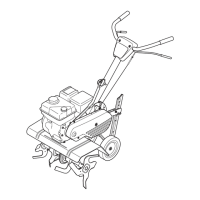
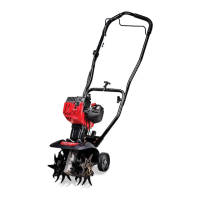
This document describes the Craftsman 139cc Front Tine Tiller, model number C459-62204-1. This tiller is designed for seed bed preparation, cultivating, furrowing, and mulching.
Function Description:
The Craftsman 139cc Front Tine Tiller is a power machine designed for various gardening and landscaping tasks. Its primary function is to break up and aerate soil, preparing it for planting or other uses. The tiller features rotating tines that dig into the ground, a depth stake to control tilling depth and speed, and a handle assembly for operator control. The engine is an internal combustion engine, specifically a 1P65TU model, which powers the tines.
Important Technical Specifications:
- Engine: 139cc internal combustion engine (Craftsman Engine Model No. 1P65TU).
- Tilling Width: Adjustable to 13 inches, 22 inches, or 24 inches. The 22-inch width is standard, expandable to 24 inches by sliding outer tines out 1 inch, and reducible to 13 inches by removing outer tines.
- Oil Capacity: 600 ml / 20 oz.
- Fuel Type: Regular unleaded gasoline with a minimum of 87 octane. Gasoline with up to 10% ethanol or 15% MTBE can be used. E85 gasoline is not recommended.
- Spark Plug Gap: 0.02-0.03 inches (0.60-0.80 mm).
- Average Useful Life (CPSC & EPA): 7 years or 130 hours of operation.
- Emissions Compliance Period: For engines less than 225 cc, Category C = 125 hours, B = 250 hours, A = 500 hours. For engines 225 cc or more, Category C = 250 hours, B = 500 hours, A = 1000 hours.
Usage Features:
- Handlebar Height Adjustment: The handlebar height is adjustable to three different settings, generally recommended to be at waist level when the tines are 3-4 inches in the ground.
- Tine Clutch Control: A lever on the upper handle engages the tine drive when squeezed against the handle and stops the tines when released.
- Depth Stake: This acts as a brake and controls the depth and speed of the tiller. Increasing its depth reduces forward speed and increases working depth. Raising it reduces working depth and increases forward speed. For tilling, the depth stake should be lowered and the wheels raised. For cultivating, a two to three-inch depth is desirable.
- Starting: The engine is started by pulling the recoil starter rope after engaging the choke (if the engine is cold) and turning the engine switch ON.
- Stopping: Turn off the engine switch.
- Cultivating: For cultivating, the tine width can be reduced to 13 inches by removing the outer tines. Check-row planting is recommended for crops like corn to permit cross-cultivation.
- Handle Pressure: Varying pressure on the handles can further control tilling depth and travel speed. Downward pressure reduces working depth and increases forward speed, while upward pressure increases working depth and reduces forward speed.
- Transport and Storage: For transport, lower the wheels and move the depth stake to the highest position. For storage, lower the wheels and orient the depth stake so both are touching the ground.
Maintenance Features:
- Oil Service: Check oil level regularly (every five hours or daily before starting). Change engine oil every 25 hours (more often under heavy load or high temperatures) and every 50 hours. Drain oil when the engine is warm for rapid and complete draining.
- Air Cleaner Service: Check before each use. Paper filters should be replaced annually or every 100 operating hours (more often in dusty conditions). Foam elements can be washed with mild liquid detergent and water, then thoroughly dried (do not oil).
- Spark Plug Service: Check every 25 hours and replace every 100 hours. Gap should be 0.02-0.03 inches.
- Fuel Filter Service: Replace annually or every 100 operating hours (more often with old gasoline).
- Belt Replacement: The tiller uses a special OEM belt for durability and performance. Replacement should be with a factory-approved OEM belt. Access involves removing the shroud, engine, and frame cover.
- Tine Shaft and Wheel Shaft Lubrication: Remove tine assemblies and wheels and lubricate the shafts at least once a season.
- General Checks: Regularly check for loose or missing hardware, clean the engine and muffler area, and inspect for damage.
- Off-Season Storage: Drain fuel from the tank or use a fuel stabilizer if storing for 30-90 days. Change oil. Pour 1/2 ounce of engine oil into the cylinder and crank slowly to distribute. Clean debris from the engine and muffler. Store in a clean, dry, well-ventilated area away from ignition sources and high humidity. Keep the engine level to prevent leakage.
- Troubleshooting: The manual provides a comprehensive troubleshooting guide for common issues like engine failure to start, erratic running, overheating, and tines not engaging, along with suggested remedies.

 Need help?


 To Next Page
 General