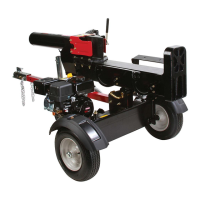
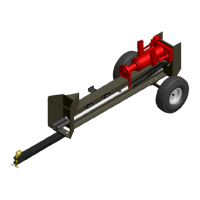
This document is a manual for a CRAFTSMAN Log Splitter, model CMXGLAM1143200. It provides instructions for safe operation, assembly, setup, maintenance, troubleshooting, and storage of the device.
Function Description
The CRAFTSMAN Log Splitter is a machine designed to split logs. It operates by applying force to a log, typically using a wedge, to divide it into smaller pieces. The manual emphasizes that this is a powerful machine and requires careful handling to prevent injury.
Important Technical Specifications
While specific numerical technical specifications like engine horsepower or splitting force are not explicitly listed on the provided pages, the manual indicates several key operational aspects:
- Engine: The log splitter is powered by an engine that requires unleaded gasoline and a specific type of engine oil (refer to a separate engine manual for details).
- Fuel: Unleaded gasoline.
- Hydraulic System: The log splitter utilizes a hydraulic system to generate the splitting force. This system requires specific hydraulic fluid (Shell Tellus® S2 M 32 Hydraulic Fluid, Dexron™ III/Mercon™ Automatic Transmission Fluid, Pro-Select™ AW-32 Hydraulic Oil, or AW-32 Viscosity Grade 32 Hydraulic Oil are recommended). The hydraulic fluid level must be maintained between the HIGH (H) and LOW (L) marks on the dipstick.
- Tires: The maximum tire pressure is 30 psi.
- Spark Plug: Requires a specific spark plug (0.030" gap).
- Oil Capacity: The reservoir tank has a capacity of 3 gallons and the entire hydraulic system has a capacity of approximately 4.7 gallons.
Usage Features
- Operation Control: The log splitter features a control handle with three positions: FORWARD, NEUTRAL, and REVERSE. The control handle is used to move the wedge up and down to split wood.
- Log Dislodger: The log dislodger is designed to remove any partially split wood from the wedge.
- Beam Locks: Two beam locks are used to secure the beam in either the horizontal or vertical position. The vertical beam lock is located on the tank bracket, and the horizontal beam lock is located on the beam support latch bracket.
- Coupler Hitch: The coupler hitch is at the end of the tongue and attaches to a tow ball for transportation purposes.
- Starting Procedure: The manual details a multi-step process for starting the engine, including checking the oil and fuel levels, engaging the choke, and using the recoil starter handle. It also provides troubleshooting steps for starting issues.
- Splitting Wood: Instructions are provided for placing logs on the log splitter, operating the control handle to split them, and dislodging any stuck wood.
- Transportation: The log splitter can be transported by attaching it to a towing vehicle. Maximum towing speed is 45 mph.
Maintenance Features
The manual outlines a comprehensive maintenance schedule to ensure the longevity and safe operation of the log splitter.
- Interval-Based Maintenance: Maintenance tasks are categorized by intervals: Each use, 1st 5 hours, Every 25 hours, Every 50 hours, and Every 100 hours.
- Engine Oil: Check and change engine oil regularly. The manual provides a viscosity chart (Figure 22) for oil recommendations based on ambient temperature.
- Hydraulic Fluid: Check and change hydraulic fluid regularly. The hydraulic filter should be changed every 50 hours.
- Spark Plug: Inspect, clean, and replace the spark plug as per the schedule. The gap should be 0.030".
- Air Filter: Inspect and clean the air filter. Replace if damaged.
- Fuel Filter: Replace as per the schedule.
- Fuel System: Drain the fuel tank and carburetor for off-season storage. Use a fuel stabilizer to prevent gum deposits.
- Beam & Wedge: Lubricate the beam and wedge.
- Hose Clamps: Check all hose clamps to ensure they are tight.
- Flexible Pump Coupler: Inspect for wear and replace if necessary.
- Tires: Maintain correct tire pressure (30 psi).
- General Recommendations: Always observe safety rules, perform maintenance according to the schedule, and periodically check all fasteners.
- Troubleshooting: A detailed troubleshooting section helps identify and resolve common problems related to the engine, hydraulic system, and other components.
- Storage: Instructions for preparing the log splitter for storage, including fuel stabilization and cleaning.
Safety Instructions
The manual places a strong emphasis on safety, with numerous warnings and precautions. Key safety symbols and their descriptions are provided, including:
- WARNING / ADVERTENCIA: General warnings about potential hazards.
- CRUSHING HAZARD / RIESGO DE APLASTAMIENTO: Keep hands away from the wedge, end plate, and moving parts.
- BYSTANDERS / OBSERVADORES: Keep bystanders, helpers, and children at least 10 feet away.
- SINGLE OPERATOR / OPERADOR ÚNICO: Only one person should operate the machine at a time.
- PRESSURIZED FLUID / FLUIDO PRESURIZADO: Never check for hose leaks with your hands; high pressure fluid can cause serious injury.
- EYE PROTECTION / PROTECCIÓN OCULAR: Always wear safety glasses or goggles.
- MOVING WEDGE / CUÑA MÓVIL: Keep hands away from the wedge and moving parts.
- CALIFORNIA PROPOSITION 65: Warning about chemicals known to cause cancer and birth defects.
- Safe Handling of Gasoline: Detailed instructions on how to handle gasoline safely to prevent fires and explosions.
- Maintenance Safety: Warnings about disconnecting the spark plug wire and wearing safety glasses during maintenance.
- Engine Exhaust: Warning about carbon monoxide.
- Kickback Hazard: Warning about the recoil starter handle.
The manual is provided in both English and Spanish, with corresponding sections for instructions and product information. Contact information for customer service is provided for questions or comments.

 Need help?
 General

 To Next Page