Need help?
Do you have a question about the Cramer 2101886 and is the answer not in the manual?
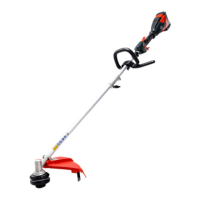
This document serves as a comprehensive manual for the Cramer 48V String Trimmer, model 48TB10 (STF457), which also functions as a brush cutter. It outlines the device's purpose, technical specifications, and various operational and maintenance procedures.
The Cramer 48V String Trimmer is designed for cutting grass, light weeds, and similar vegetation at or around ground level, with the cutting plane intended to be approximately parallel to the ground surface. It is explicitly stated that the machine should not be used for cutting or chopping hedges, shrubs, bushes, flowers, or compost. The device is versatile, capable of operating as a string trimmer or a brush cutter, depending on the attached head.
The device operates on a 48V voltage. For string trimming, the no-load speed is 6500 ±10% rpm, and for brush cutting, it is 6300 ±10% rpm. The cutting head for string trimming is a "Bump feed" type, while for brush cutting, it uses a "Brush cutter blade." The cutting line diameter is 2 mm. The cutting path diameter is adjustable: 356/406 mm for the grass trimmer and 254 mm for the brush cutter. The weight of the machine without the battery pack is 4.5 kg. Compatible battery models include BAM706/BAM713 and other BAM series. Compatible charger models include CAM806/CAM816 and other CAM series.
Sound power levels are provided for both modes: For the grass trimmer, the measured sound power level (LWA) is 93.3 dB(A), with a guaranteed sound power level (LWA.d) of 96 dB(A). For the brush cutter, the measured sound power level (LWA) is 97.47 dB(A), with a guaranteed sound power level (LWA.d) of 100 dB(A). Vibration levels for both modes are <2.5 m/s², with a K-value of 1.5 m/s².
Before operation, the machine requires assembly. This includes unpacking, attaching the guard (ensuring not to touch the cut-off blade), assembling the shaft, and attaching the auxiliary handle. The battery pack must be installed correctly, aligning the lift ribs with the grooves in the battery compartment until it locks into place with an audible click. The battery pack should be removed before any installation or maintenance.
To start the machine, the lock-out button must be pushed, and the trigger pulled. Releasing the trigger stops the machine. Users are advised to maintain clearance between their body and the machine and never operate it without the guard in place. When cutting, the machine should be held firmly with two hands, and tall grass should be cut from top to bottom. If grass winds around the trimmer head, the battery pack should be removed, and the grass cleared. Cutting tips include tilting the machine towards the area to be cut, using the tip of the cutting line, and moving the machine from right to left to prevent debris from being thrown towards the operator. Users are warned not to cut in dangerous areas or force the trimmer head into uncut grass. Wire fences, picket fences, stone walls, brick walls, curbs, and wood can cause rapid wear and breakage of the cutting line.
The cutting line wears and shortens during use. Its length can be adjusted by hitting the trimmer head against the ground while operating the machine. The line is automatically released, and the cut-off blade trims the excess length.
The machine is factory-set to a 356 mm cutting diameter but can be adjusted to 406 mm. A 356 mm diameter provides longer runtime, while 406 mm offers a larger cutting area. Adjustment involves removing the battery pack, removing the blade screws from the cut-off blade, turning the cut-off blade 180°, and then tightening the blade screws.
Maintenance not covered in the manual should only be performed by a dealer or approved service center. Before any maintenance, the machine must be stopped, the battery pack removed, the motor cooled, and the machine stored in a cool, dry place. Appropriate clothing, protective gloves, and safety glasses should be worn. All nuts, bolts, and screws must be tight, and handles regularly checked for firm mounting. Only original replacement parts and accessories should be used.
After use, the machine should be cleaned with a moist cloth dipped in neutral detergent. Aggressive detergents or solvents should not be used on plastic parts or handles. The trimmer head must be kept free of grass, leaves, or excessive grease. Air vents should be clean and free of debris to prevent overheating and damage. Water should not be sprayed onto the motor or electrical components.
No more than 4 meters of cutting line should be installed at a time. The process involves aligning spool cap slots with trimmer head slots, feeding the line through the holes until equal lengths exit both sides, and then turning the spool cap clockwise to wind the line, leaving approximately 13 cm exposed on each side.
This involves pressing tabs on the trimmer head, pulling off the spool cover, removing the old spool, replacing it with a new one, and reassembling the components until they click into place.
Similar to spool replacement, this involves removing the spool cover and spool, prying out the old bump knob with a metal rod, and inserting a new one.
A metal rod is used to fix the trimmer head in the angle transmission hole. The trimmer head is turned clockwise to loosen and remove it, and counter-clockwise to tighten it during assembly. The cut-off blade must be installed when using the trimmer head.
Gloves should be worn due to sharp edges. The guard must be applied to the blade. A metal rod is used to fix the trimmer head. The nut is loosened clockwise, and the outer cup removed to take off the brush-cutter blade. For assembly, the brush cutter blade is placed on the inner cup, ensuring it's centered, followed by the outer cup and a specified nylon locknut. The locknut must be tightened counter-clockwise to 44-58 Nm with a 19mm wrench and replaced after 20 uses.
When moving the machine, users should wear gloves, stop the machine, remove and charge the battery pack, and assemble the blade guard. For storage, the battery pack should be removed, and the machine kept away from children and corrosive agents. It should be secured during transport and inspected for damage.


 To Next Page
 General