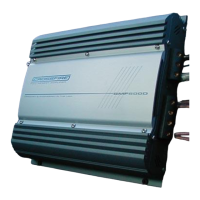
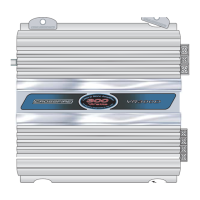
Need help?
Do you have a question about the Crossfire BMF600D and is the answer not in the manual?
Describes the core technology of the amplifiers, highlighting efficiency and sound quality.
Indicates the amplifier's capability to operate reliably at a 1 Ohm impedance load.
Highlights the use of high-quality, durable components for superior performance and reliability.
Details the advanced power supply design for optimal energy conversion and reduced heat.
Refers to the construction of the toroidal transformer for efficient power delivery.
Emphasizes the use of a larger toroidal core for improved power handling and stability.
Specifies the use of MOSFET technology for high performance and switching speed.
Highlights the presence of large capacitors for stable voltage and improved bass response.
Notes the use of separate, robust terminals for power and speaker connections.
Allows adjustable low-pass filtering for subwoofers, typically 50-250Hz.
Enables adjustable subsonic filtering to remove ultra-low frequencies and protect the subwoofer.
Provides line-level outputs for connecting additional amplifiers or processors.
Offers flexible crossover control (High-Pass, Low-Pass, Full Range) for various speaker configurations.
Allows two amplifiers to be linked together for increased power output.
Enables setting amplifier roles for bridging or system expansion.
Allows adjustment of subwoofer phase to optimize bass response.
Details built-in protection against thermal, DC offset, short circuit, overload, and reverse polarity.
Ensures gradual power-on and power-off to prevent "pops" or damage to speakers.
Provides remote control for adjusting subwoofer volume independently.
States the duration and type of warranty coverage for the product.
Lists the amplifier's continuous power output ratings at different impedance levels and distortion.
Indicates the amplifier's efficiency percentage under typical operating conditions.
Specifies the amplifier's efficiency under less ideal or maximum load conditions.
Defines the frequency range over which the amplifier maintains its rated power output.
Measures the ratio of signal power to noise power, indicating audio clarity.
Indicates the amplifier's control over the speaker cone's movement for improved accuracy.
Specifies the minimum input voltage required for full power output.
Defines the electrical resistance presented by the amplifier's input.
Lists the fuse or circuit breaker rating for system protection.
Provides the physical size (Width x Height x Length) of the amplifier unit.
Details the crossover filter types and settings available for audio signal management.
Specifies the steepness of the crossover filter's attenuation, typically 12dB/octave.
Allows adjustable subsonic filtering (e.g., 20-50Hz at 12dB) to remove unwanted low frequencies.
Refers to the adjustable crossover settings within the pre-amplifier stage.
Indicates the availability of preamp outputs for connecting other audio components.
Explains that these are single-channel subwoofer amplifiers and how speaker outputs are paralleled.
Illustrates how the amplifier sees a 2 ohm load when two 4 ohm subwoofers are connected.
Stresses the significance of mounting location for amplifier longevity and performance.
Advises on ensuring adequate airflow and clearance (2.5 inches) for effective heat dissipation.
Recommends pre-drilling mounting holes with a 1/8" or 3mm bit to prevent damage.
Warns to check the mounting area for wires, vacuum lines, or brake/fuel lines before drilling.
Specifies the operational voltage range (10.5-16V DC) and recommends checking vehicle electrical system.
Details how to check battery voltage with ignition off and engine running for proper supply.
Provides recommended wire gauge (4awg/8awg) and fuse (100A/60A) based on amplifier model.
Outlines guidelines for running power wire, including using grommets and avoiding sharp edges.
Instructs to install an inline fuse holder as close to the battery positive terminal as possible.
Specifies using the same gauge wire as power wire and connecting to a solid metal chassis point.
Advises selecting a clean metal area, avoiding seat bolts, and preparing the surface for good contact.
Recommends upgrading the ground strap for multiple amplifiers to ensure sufficient current flow.
Explains connecting the remote terminal to a switched +12V source, typically from the head unit.
Guides on finding the remote turn-on wire on aftermarket (blue/blue-white) and factory (power antenna) units.
Recommends using 18-gauge wire and connecting securely via barrel connector or soldering.
Suggests using a minimum of high-quality 12 gauge speaker wire for optimal performance.
Details stripping insulation and connecting wires to speakers using terminals or soldering.
Guides on routing power, ground, remote, and speaker wires to the amplifier location.
Instructs to cut wires to equal length, strip insulation, and insert into terminals securely.
Emphasizes checking correct polarity for power and speaker wires to prevent damage.
Stresses the importance of using proper signal cables for a clear audio signal from the source unit.
Recommends using higher quality RCA cables with better shielding for noise rejection.
Advises routing RCA cables away from power wires, large wire looms, and electric fans to prevent noise.
Explains connecting RCA cables to the "LOW IN" receptacles, maintaining left/right balance.
Details the variable low-pass filter (50-250Hz) for subwoofers and blending with midrange.
Explains the selectable (ON/OFF) and variable (20-50Hz) subsonic filter for noise reduction.
Describes the optional digital remote control for adjusting amplifier output level from the driver's seat.
Covers buffered line-level outputs for linking multiple amplifiers and electronic crossover.
Explains bridging two amplifiers for double output, requiring minimum 2ohm impedance.
Details the three settings (Master 0, Master 180, Slave) for amplifier communication and control.
Provides a visual guide for correctly connecting two amplifiers in a bridged configuration.
Outlines a three-step process to match amplifier input level to source unit output without distortion.
Warns that gain control is not a volume knob and improper use can damage speakers or amplifier.
Explains the function of the Green (Power ON) and Red (Protection Mode) LEDs on the amplifier.
Indicates that the Red LED signifies a problem requiring system troubleshooting.
Illustrates wiring for a two-way system with subwoofer and satellite speakers.
Demonstrates wiring configurations for systems with multiple subwoofers.
 General
| Channels | 1 |
|---|---|
| Damping Factor | >200 |
| Subsonic Filter | 10 Hz - 50 Hz |
| RMS Power at 4 Ohms | 600W |
| RMS Power at 2 Ohms | 1000W |
| Input Sensitivity | 200mV - 6V |
| Low Pass Filter | 50 Hz - 180 Hz |
| Bass Boost | 0dB |


 To Next Page