2
MICROPHONE TECHNIQUES FOR VIDEO
No matter what your video application — sports,
news, corporate training — the soundtrack quality
depends on the microphones you choose and where
you place them. This booklet covers microphone
techniques to help you achieve better audio for
your video productions.
There are many types of microphones, each de-
signed to help you solve a specific audio problem.
We’ll sort out these types and tell where each one is
useful. Then we’ll cover specific applications — how
to use microphones effectively in various
situations.
TRANSDUCER TYPES
A microphone is a transducer, a device that con-
verts energy from one form into another. Specifi-
cally, a microphone converts acoustical energy
(sound) into electrical energy (the signal).
Microphones differ in the way they convert sound
to electricity. Three popular transducer types are dy-
namic, ribbon, and condenser.
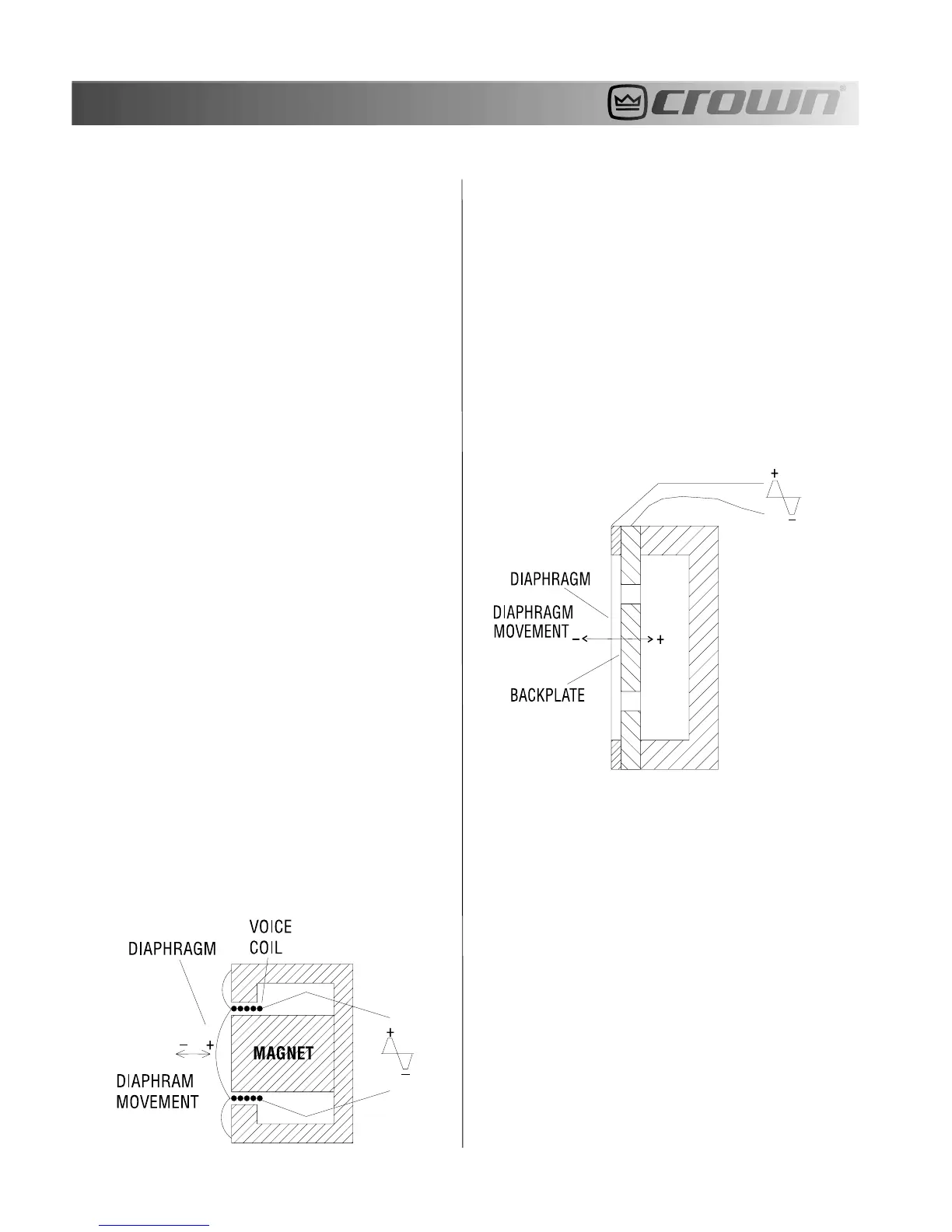
In a dynamic microphone (Figure 1), a coil of wire
attached to a diaphragm is suspended in a mag-
netic field. When sound waves vibrate the dia-
phragm, the coil vibrates in the magnetic field and
generates an electrical signal similar to the incom-
ing sound wave.
A ribbon microphone works the same, except that
the diaphragm is also the conductor. It is a thin metal
foil or ribbon suspended in a magnetic field.
In a condenser microphone (Figure 2), a diaphragm
and an adjacent metallic disk (backplate) are
charged to form two plates of a capacitor. Sound
waves striking the diaphragm vary the spacing be-
tween the plates; this varies the capacitance and
generates an electrical signal similar to the incom-
ing sound wave.
Fig. 1 – A dynamic microphone.
Fig. 2 – A condenser microphone.
The diaphragm and backplate can be charged ei-
ther by an externally applied voltage or by a perma-
nently charged electret material in the diaphragm
or on the backplate.
Because of its lower diaphragm mass and higher
damping, a condenser microphone responds faster
than a dynamic microphone to rapidly changing
sound waves (transients).
Dynamic microphones offer good sound quality, are
especially rugged, and require no power supply.
Condenser microphones require a power supply to
operate internal electronics, but generally provide
a clear, detailed sound quality with a wider,
smoother response than dynamics.


 To Next Page