7
ELECTRICAL CHARACTERISTICS
Whatever type of microphone you use, it should
have a low-impedance balanced output with a 3-
pin pro audio connector. This allows long cable runs
(hundreds of feet) without hum pickup or high-fre-
quency loss. All modern mixers are designed to work
with low-impedance microphones.
MICROPHONE-TECHNIQUE BASICS
How to reduce reverberation
Reverberation is sometimes loosely called “room
acoustics,” “ambience,” or “reverb.” It is a pattern
of sound reflections off the walls, ceiling, and floor.
For example, reverberation is the sound you hear
just after you shout in an empty gymnasium.
Too much reverberation in a recording sounds dis-
tant or muddy, and reduces intelligibility. To reduce
reverberation:
•Place the mic closer to the sound source.
•Use an automatic (gated) mixer. This device turns
off all microphones not in use, providing a clearer,
less muddy sound.
•Pick up each electric instrument with a direct box
or cable.
•Use a room or studio with dead acoustics. The
walls, ceiling and floor should be covered with
sound-absorbing material.
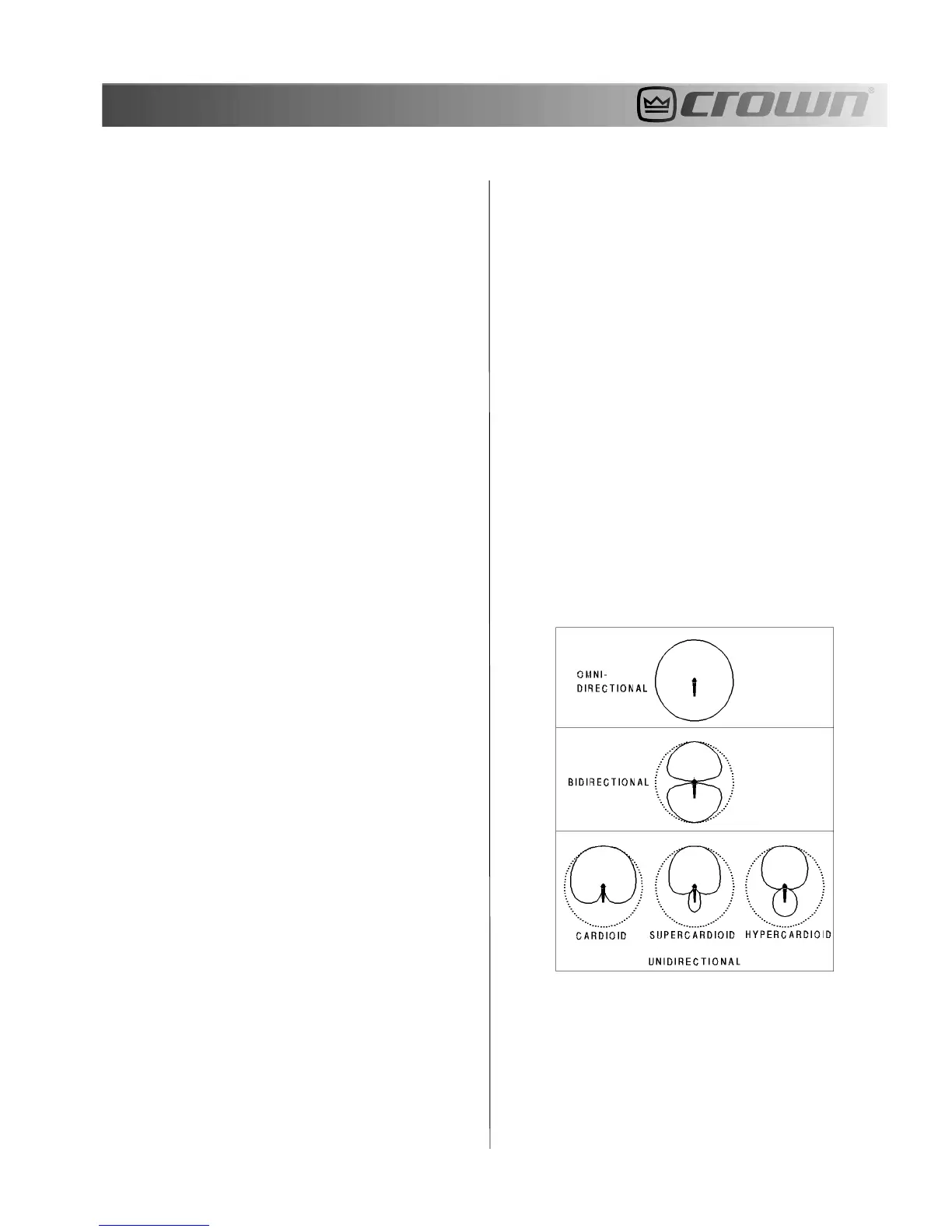
•Select a mic with a tighter polar pattern. Hyper-
cardioid and super-cardioid patterns reject reverb
more than cardioid. Cardioid and bi-directional pat-
terns reject reverb equally well, and more than an
omni.
The table below tells how many dB of reverb rejec-
tion you can expect from various polar patterns
compared to an omni-directional pattern at the same
working distance:
Omnidirectional: 0.0 dB
Cardioid:-4.8 dB
Bidirectional: -4.8 dB
Supercardioid: -5.7 dB
Hypercardioid: -6.0 dB
How to reduce background noise
•Stop the noise at its source: turn off appliances
and air conditioning; wait for airplanes to pass; close
and seal doors and windows; use a quiet room.
•Mike close with directional mics.
•Pick up each electric instrument with a direct box
or cable.
•Aim the null of the polar patern at the offending
noise source. The null is the angle off-axis where
the mic is least sensitive. Different polar patterns
have nulls at different angles. Shown below and in
Figure 16 are the null angles for various polar pat-
terns:
Cardioid:180 degrees.
Supercardioid: 125 degrees.
Hypercardioid: 110 degrees.
Bidirectional: 90 degrees.
Fig. 16 – Polar patterns
.
How to pick up sound at a distance
The farther a microphone is placed from a sound
source, the more reverberation and background
noise you pick up. Also, you hear more mixer self-
noise relative to the signal because the mixer gain
must be higher with distant miking.


 To Next Page