6
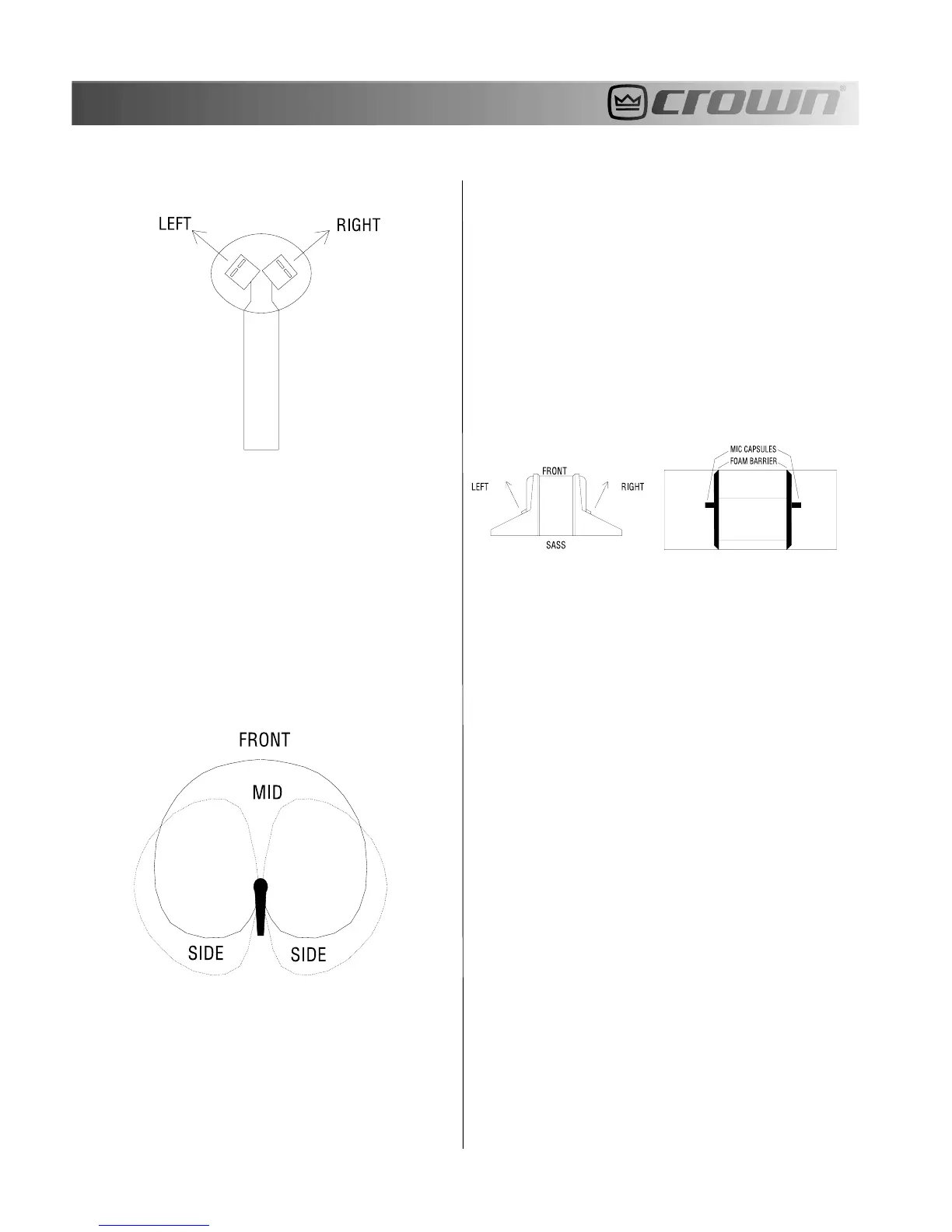
Fig. 12 – Stereo microphone.
Stereo: A stereo microphone combines two direc-
tional microphone capsules in a single housing for
convenient stereo miking (Figure 12). A special type
of stereo microphone is called mid-side or MS. It
uses two capsules: a MID unit aiming toward the
middle of the sound source, and a SIDE unit with a
bi-directional pattern aiming to the sides (Figure 13).
The mid unit can have any pattern, but cardioid is
most common.
Fig. 13 – Mid-side microphone polar patterns.
Inside the microphone or in an outboard box, the
mid and side signals are summed and differenced
to produce directional patterns aiming left and right.
By controlling the ratio between mid and side sig-
nals, you can control the stereo spread or stage
width. This can be done during recording or during
post-production.
A mid-side microphone is mono-compatible; that
is, it has the same frequency response in mono or
stereo. That’s because there is no spacing between
the mic capsules. If there were a spacing, this would
create a delay between left and right signals which
can cause phase cancellations in mono. The Crown
SASS stereo microphone, explained next, has
spaced mic capsules but is still mono-compatible
because of its special design.
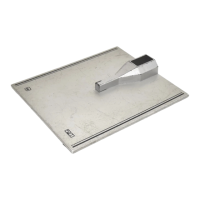
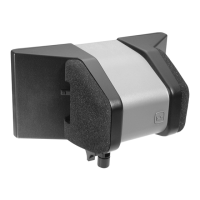
Fig. 14 & 15 – SASS-P MK
II stereo microphone.
The Crown SASS-P stereo microphone is shown
in Figure 14 (top view) and Figure 15 (front view).
It is made of two Pressure Zone Microphones
mounted on small boundaries that are angled apart
left and right. The capsules are spaced apart the
same distance as your ears. As a result, the SASS
gives very precise and spacious stereo imaging.
Between the two mic capsules is a special foam
baffle.The baffle creates amplitude or level differ-
ences between channels at high frequencies. Since
the two channels are different amplitudes, any
phase cancellations in the mono sum are incom-
plete, so the resulting dips in the frequency re-
sponse are relatively slight. Thus, the SASS is
mono-compatible.


 To Next Page