Use common sense and don’t force truss rod adjustments! If you feel abnormal resistance to movement, or if the neck is signicantly
out of spec, it would be prudent to leave further work to a qualied technician.
ACTION
Action refers to string height, which is adjusted by raising or lowering the bridge saddles. If set too low, buzzing occurs; too high and
playability is impacted
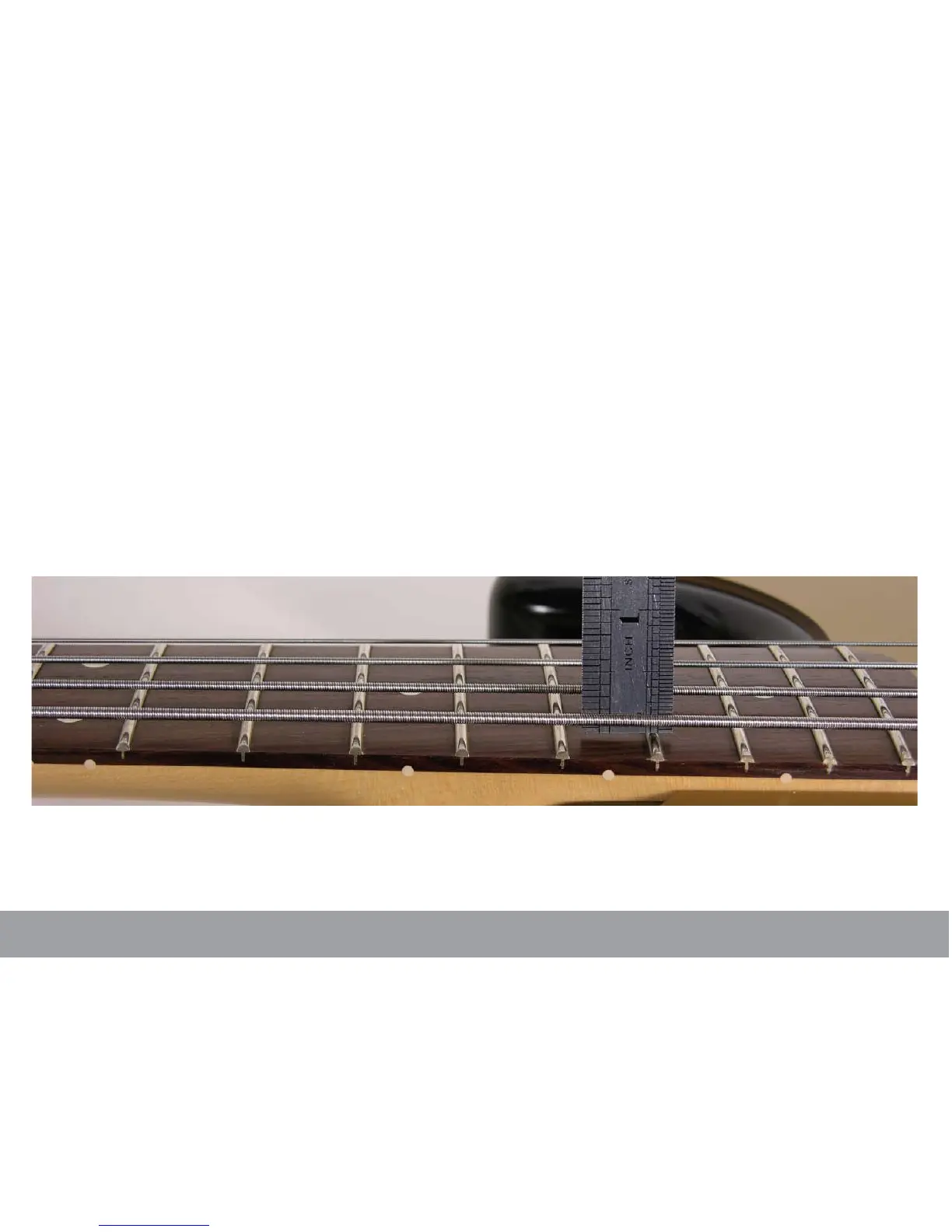
Measure clearance between the bottom of the string and top of the 17th fret, and adjust to about 5/64” for guitars (2mm may be easier
to read on the ruler) and 3/32” for basses. Rest the steel ruler on top of the fret, placed behind the string, and measure. Bridge saddles
require either a slotted screwdriver or hex key for adjustment. Make sure each saddle screw pair is set to approximately the same
height. Since thinner strings move less from vibration, you can usually set action lower on these without buzzing.
In addition to bowing in the direction of the truss rod, each neck also has a xed curve in the direction of the frets. If you were to com-
plete an imaginary circle from the frets, you would be able to associate a radius with it. Most guitars and basses have a radius ranging
from seven to twenty inches.
Setting string height as described above will roughly match neck radius. For more precision, you can purchase a commercially avail-
able steel gauge, make one using a protractor, or nd printable gauges on the web.
Action can be set to a wide range of preferences. Those who want lightning fast action might try for the lowest possible setting, per-
haps even to a level that tolerates slight buzzing. Others may be more comfortable with a higher setting. The key is to experiment and
nd what best suits your style.
5


 To Next Page
 Loading...