
 Need help?
Do you have a question about the Cuisinart CGG-608 and is the answer not in the manual?
Emphasizes that the grill is strictly for outdoor use to prevent hazards.
Highlights severe risks including fire, explosion, and injury from improper operation.
Notifies about chemicals in by-products known to cause cancer and reproductive harm.
Visual guide to identify all parts of the Cuisinart grill with part numbers.
Detailed diagram showing how all parts fit together for assembly.
Instructions for assembling the grill, including extending legs and inserting parts.
Guidelines for choosing a safe and suitable location for grill operation.
Special instructions for safely connecting and using the propane gas cylinder and regulator.
Procedure for connecting the propane cylinder to the grill outdoors.
Essential steps to perform a leak check before lighting the grill for safety.
How to safely ignite the grill burner, including backup match lighting.
Guidance on observing burner flame and safe operation practices.
Regular maintenance tips for keeping the grill in good operating condition.
Instructions for cleaning the Venturi tube to prevent gas flow blockage and fires.
Procedures for cleaning the grill's interior and exterior surfaces.
Information on using larger propane tanks with a conversion hose.
Clarification that the grill is not compatible with natural gas.
Solutions for common problems like the burner not lighting or not reaching high temperatures.
Information on what the warranty covers and for how long.
Conditions not covered by the warranty and user obligations.
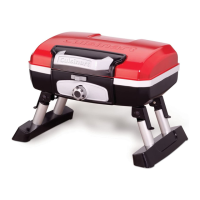
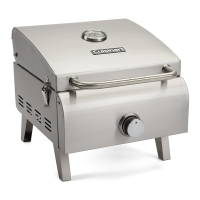
The Cuisinart Chef's Style Portable Single Burner Grill (Model: CGG-608) is a compact outdoor grilling appliance designed for convenient and safe use. This grill is intended for outdoor use only and must be assembled and operated according to the provided instructions to ensure safety and proper function.
The grill utilizes a single burner and operates on propane gas, specifically 14.1 oz. or 16.4 oz. LP cylinders, or a standard 20 lb. LP tank with a conversion hose (such as the Cuisinart QG-012B). It is designed to cook food by heating a cooking grate over a flame, providing a portable solution for grilling needs. The appliance features a control knob to regulate gas flow and burner intensity, an igniter for easy startup, and a thermometer to monitor internal temperature. A drip tray is included to collect grease and food drippings, simplifying cleanup. The grill's legs are foldable, enhancing its portability and ease of storage.
Before operation, the grill requires proper assembly, which involves extending the legs, installing the regulator to the burner, and inserting the drip tray. It is crucial to select a suitable outdoor location, ensuring it is placed on a hard, level surface, away from combustible materials and structures (at least 24 inches from the back and sides). The grill should never be used under overhead combustible surfaces or in enclosed areas like buildings, garages, or vehicles, due to the risk of fire and carbon monoxide poisoning.
Connecting the LP gas cylinder is a key step. The regulator, designed for CGA No.600 cylinder connections, must be threaded onto the cylinder and tightened by hand only. It's imperative to perform a leak check every time the cylinder is connected, using a solution of dishwashing soap and water. The presence of bubbles indicates a leak, which must be resolved before using the grill.
Lighting the grill involves opening the lid, ensuring the regulator knob is in the "OFF" position, then pushing down and turning the gas control knob counterclockwise to "HIGH." The igniter should click and light the burner. If ignition doesn't occur within 5 seconds, the knob must be turned off, and a 5-minute wait period is required before attempting to relight. For manual lighting, a match lighting hole is provided on the left side of the firebox, allowing a long wooden match to be positioned near the burner while the control knob is turned to "HIGH."
Before cooking for the first time, it's recommended to operate the grill on "HIGH" with the lid closed for about 15 minutes to "heat clean" internal parts and dissipate any odors from the painted finish. During operation, the lid should be opened carefully, standing to the side to avoid direct exposure to hot surfaces or cooking liquids. The burner flame should ideally be blue with minimal yellow tips.
The grill should never be left unattended, and children and pets must be kept away. It is not designed for use with charcoal, lighter fluid, gasoline, kerosene, or alcohol for lighting. The use of lava rocks, ceramic tiles, or charcoal briquettes is also prohibited, as this can create unsafe conditions and void the warranty. Insulated oven mitts or gloves are recommended when handling hot parts.
Regular care is essential for the grill's proper operation and longevity. All maintenance should be performed when the grill is cool and the fuel supply is turned off. Periodically, hardware should be inspected and tightened.
Exterior surfaces can be cleaned with warm soapy water. The drip tray should also be washed with warm soapy water and is dishwasher safe. The cooking grate can be cleaned with a grill brush when warm (not hot) or removed and cleaned with warm soapy water or in a dishwasher.
A critical maintenance task involves inspecting the Venturi Tube screen cover regularly to prevent blockages from insect nests (e.g., spiders or wasps). Blockages can impede gas flow and potentially cause a fire at the gas control valve.
When cleaning the interior, any accumulated debris from the bottom of the firebox can be carefully scraped away after the grill has cooled completely and the cooking grate has been removed. However, it is crucial not to apply any cleaners or liquids directly to the burner element or attempt to clean it in any way, nor should water or liquids be used to clean the grill interior. The fuel supply system should not be disassembled or altered, and professional assistance should be sought for any necessary repairs.
When not in use, the control knob should be turned to the "OFF" position, and the LP-gas cylinder should be disconnected and stored in a well-ventilated area away from the grill. The cylinder cap should be reinstalled. When transporting the grill, the LP-gas cylinder must always be removed.
 General
| Type | Portable Gas Grill |
|---|---|
| Burners | 1 |
| BTU | 10, 000 |
| Material | Stainless Steel |
| Grate Material | Porcelain-enameled cast iron |
| Fuel Type | Propane |
| Warranty | 3 years |

 To Next Page