EN
20
Often only small faults cause a malfunction. You can usually easily remedy such faults yourself.
Please consult the following table before contacting your local store. This saves effort and possibly
also costs. If you are unable to remedy the fault yourself, please contact your local store. Please
note that improper performance of repair work will lead to the loss of any warranty claims and that
additional costs may be incurred.
9. DISPOSAL
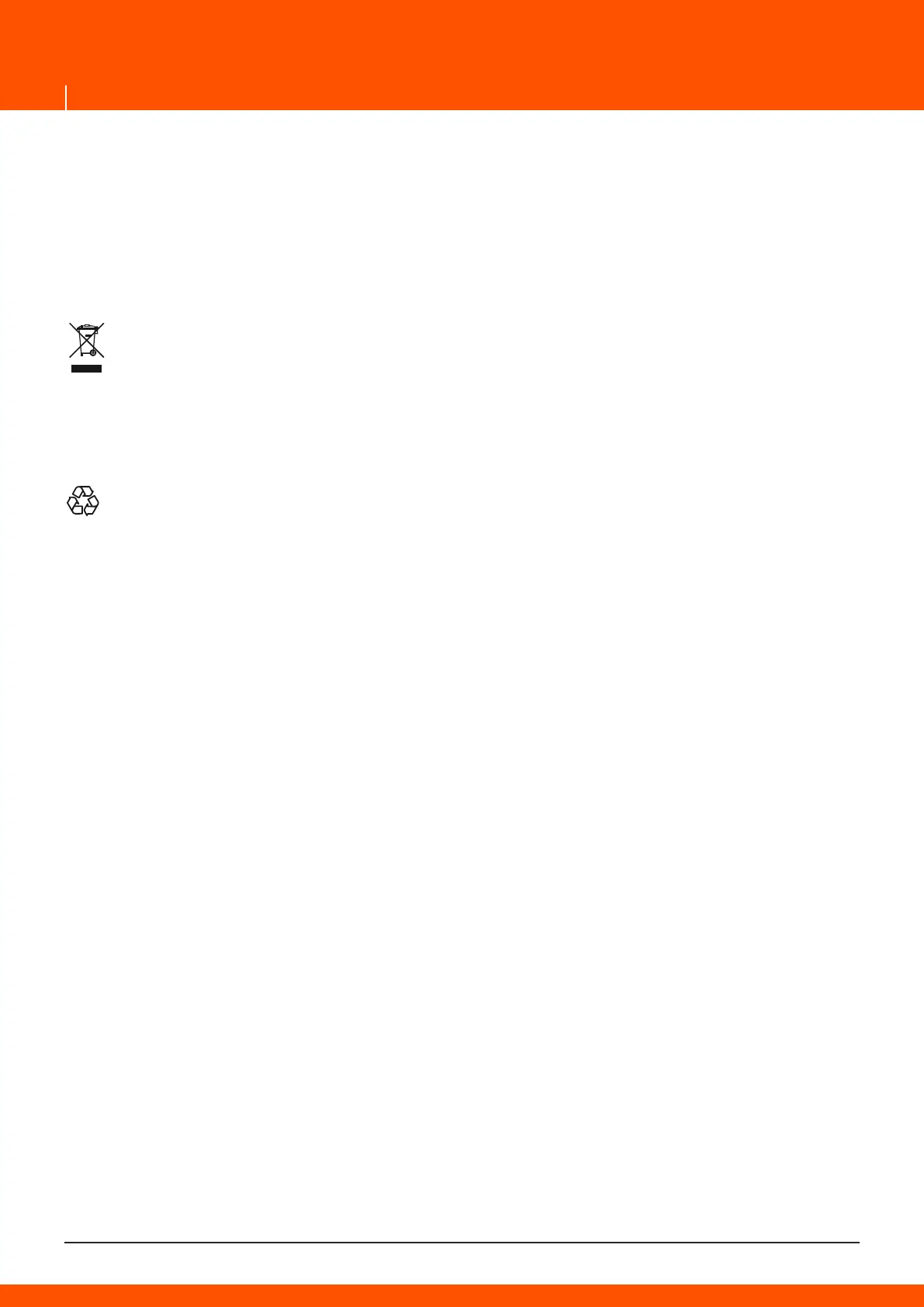
Disposal of the appliance Appliances which are labelled with the adjacent symbol must not
be disposed of in household waste. You must dispose of such old electrical and electronic
equipment separately.
– Please check with your local authority about the possibilities for correct disposal.
Through separate disposal you send old equipment for recycling or for other forms of re-use. You
will thus help to avoid in
some cases that damaging material gets into the environment.
Disposal of the packaging The packaging consists of card- board and correspondingly
marked plastics that can be recycled.
– Make these materials available for recycling.
10. TECHNICAL DATA
Voltage/Frequency 230 V/50 Hz
Power 1800 W
Protection class II
Cutting speed 13 m/s
No load speed 6500 rpm
Bar length 16” (405 mm)
Oil tank capacity 150 ml
*) The specified values are emission values and do not necessarily represent safe workplace
values. Although there is a correlation between emission and immission levels, this cannot be used
to infer whether additional safety measures are necessary or not. Factors which affect the current
immission levels at the workplace, include the type of room, other sources of noise, e. g. the number
of machines operating and other processes taking place in the vicinity. Permitted workplace values
can differ from country to country. This information is designed to help the user to better assess the
dangers and risks.
**) The specified vibration emission value was measured in accordance with a normed test procedu-
re and can be used in order to compare one tool with another. The specified vibration emission
value can also be used for an introductory evaluation of the exposure. The vibration emission value
may fluctuate from the specified value during actual use of the power tool. These fluctuations will
depend on the way in which the power tool is used. Try to keep vibrations to a minimum. One
method of reducing the vibration load is, for example, limiting the length of time you work with the
tool. All parts of the operating cycle must be taken into account for this purpose (for example, also
including times in which the power tool is switched off and times in which it is switched on, but is
running without load).



 To Next Page