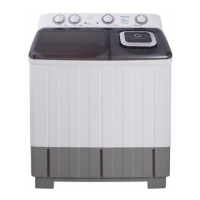
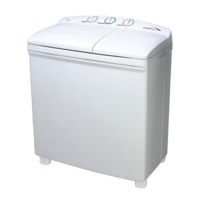
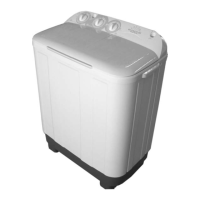
This document provides the instruction manual for DAEWOO Washing Machines, models DW-500M and DW-501M. It covers essential information regarding the washer's operation, installation, maintenance, and troubleshooting.
Function Description
The DAEWOO DW-500M and DW-501M are twin-tub washing machines designed for washing, rinsing, and spin-drying laundry. They feature separate tubs for washing/rinsing and spin-drying, allowing for sequential or simultaneous operations of these functions. The machine is equipped with various controls to manage wash time, wash action (wash/rinse, drain, off), and spin time (spin, off). Safety features include a brake system that stops the spin basket when the spin dryer lid is opened during operation, and a safety cover for the spin basket.
Important Technical Specifications
The manual provides specifications for both non-pump and pump models, as well as single and dual voltage configurations.
- Dimensions (WxDxH):
- 680x406x857 mm (for one variant)
- 680x406x887 mm (for another variant)
- Weight:
- 17 Kg (NON-PUMP model)
- 18 Kg (PUMP model)
- Water Consumption:
- LOW: 27 liters
- HIGH: 37 liters
- Power Source: Refer to the specification label on the unit.
- Rating Time:
- Washing: 1 hour
- Spinning: 15 minutes
Electrical Specifications (Examples from Wiring Diagrams):
- Single Voltage, Non-Pump Model:
- Rating Voltage: 100V, 110V, 220V, 240V
- Frequency: 50/60 Hz (for 100V, 220V), 60 Hz (for 110V), 50 Hz (for 240V)
- Capacitor (A): 26 µF (for 100V, 110V), 6.5 µF (for 220V), 4 µF (for 240V)
- Capacitor (B): 12.4 µF (for 100V), 9 µF (for 110V), 2.6 µF (for 220V), 2.2 µF (for 240V)
- Single Voltage, Pump Model: Similar electrical specifications to the non-pump model, with the addition of a drain pump.
- Dual Voltage, Non-Pump Model:
- Rating Voltage: 110/220V, 127/220V
- Capacitor (A): 26/2.5 µF (for 110/220V), 26/6.5 µF (for 127/220V)
- Capacitor (B): 12.4 µF (for 110/220V), 7.6 µF (for 127/220V)
- Connector settings for 220V and 110V/127V.
- Dual Voltage, Pump Model: Similar electrical specifications to the dual voltage non-pump model, with the addition of a drain pump.
Usage Features
- Control Panel:
- TIMER: Used to set desired time for washing, rinsing, spinning (1-15 minutes), and draining (for DRAIN PUMP models).
- WASH SELECTOR:
- "WASH RINSE": For washing and rinsing.
- "DRAIN": To drain water.
- "OFF": To stop washing, rinsing, and draining.
- SPIN SELECTOR:
- "SPIN": For spinning.
- "OFF": To stop spinning.
- Washing Procedure:
- Preparation: Lay down the drain hose (or place in sink/bath for DRAIN PUMP models), connect power.
- Wash/Rinse Setting: Set WASH SELECTOR to "WASH RINSE".
- Water Fill & Detergent: Fill wash tub to desired level, add detergent.
- Load Laundry: Put laundry into the wash tub.
- Wash Timer: Set WASH TIMER (1-15 minutes).
- Draining (after wash): Set WASH SELECTOR to "DRAIN" and TIMER to appropriate time.
- Spin Dry Procedure:
- Transfer Laundry: Move clothes to the spin basket, arrange evenly.
- Safety Cover: Place safety cover on laundry, close inner lid.
- Close Lid: Close the spin dryer lid.
- Spin Selector: Set SPIN SELECTOR to "SPIN".
- Spin Timer: Set TIMER (1-5 minutes).
- Rinse Procedure:
- Wash Selector: Set WASH SELECTOR to "WASH RINSE".
- Water Supply: Supply water without overflowing.
- Rinse Timer: Set TIMER (2-3 minutes).
- Draining (after rinse): Set WASH SELECTOR to "DRAIN" and TIMER to appropriate time. Repeat 2-3 cycles until drain water is clean.
- Overflow Rinse Procedure:
- Wash Selector: Set WASH SELECTOR to "WASH RINSE".
- Continuous Water Supply: Keep supplying water, adjusting pressure to match drain rate.
- Rinse Timer: Set TIMER (6-8 minutes).
- Turn Off Water: Turn off water tap when TIMER shuts off or water is clear.
- Draining (after rinse): Set WASH SELECTOR to "DRAIN" and TIMER to appropriate time.
- Laundry Guide:
- Washing Time & Action Table: Provides recommended wash times based on fabric type and soil level (e.g., extremely soiled heavy fabric: 10-15 min; ordinary clothes: 7 min; wool/delicates: 2-5 min).
- Water Level & Detergent: Recommends detergent amounts for LOW (27L) and HIGH (37L) water levels (27g and 37g respectively), advising to follow detergent package instructions and fabric type.
- Spin Dry Time: Recommends spin times based on laundry type (e.g., thin synthetic: 1 min; wool: 1-2 min; cotton: 3-5 min; thick cotton: 5 min).
- Loading Spin Basket: Emphasizes pressing laundry evenly and using the safety cover.
Maintenance Features
- Cleaning the Drain Filter: Remove lint from the drain filter using a soft brush in case of incomplete draining.
- Cleaning the Washer Body: Wipe stains with a soft cloth. Avoid benzene, thinner, cleanser, or wax as they can damage plastic parts.
- Cleaning the Overflow Filter: Insert a finger into hole "A" and pull the filter in the direction of the arrow to remove.
- Cleaning the Wash Tub: Fill the wash tub to "L" level, run a wash cycle for 1-2 minutes, then drain the water and close the lid.
Installation Guidelines:
- Location & Environment:
- Leave at least 10cm space between the washer and the wall.
- Place on a sturdy, flat surface (max. 2° inclination).
- Avoid steamy rooms, direct rain, direct sunlight, or proximity to heating devices (heaters, boilers) to prevent electrical shock, damage to plastic parts, and freezing.
- Avoid cold places (below 0°C/32°F) to prevent freezing damage.
- Leg Setting: Slide the leg into the opening underneath the base and push.
- Inlet Hose Setting: Attach the water inlet hose to the water inlet pipe.
- Drain Hose Setting:
- Connect the drain hose to the drain outlet at the rear of the washer.
- Direct the other end of the drain hose towards a bath or sinkhole.
- Install the drain hose under 85cm from the ground (for DRAIN PUMP models).
- Electrical Connection (Dual Voltage Model): Ensure the electric connector is set for the available voltage. Instructions are provided to change the voltage by removing the back cover and resetting the connector. The unit is factory-set for 220V (240V).
Safety Precautions:
- Grounding: Ensure the washer is properly grounded using a metal pipe. Do not ground with gas pipes or telephone lines to avoid explosion or lightning strike.
- Spin Dryer Safety: Do not put hands into the spin dryer basket when it is spinning. Always use the safety cover on laundry before spinning. Turn off the SPIN Timer immediately if excessive noise or vibration occurs.
- Children Safety: Never allow children to operate or play with the washer.
- Power Cord: Disconnect the power cord when not in use. If the supply cord is damaged, it must be replaced by a manufacturer-appointed repair shop.
- Ventilation: Ensure ventilation openings are not obstructed by carpeting.
- Water Temperature: Do not use excessively hot water (below 50°C) to prevent deformation/damage to plastic parts and clothing.
- Pocket Check: Check all pockets before washing to remove nails or pins that could damage the washer or clothes.
- Water Pressure: Close the water tap slightly if water pressure is too high.
- Water Splashes: Close the wash tub lid to avoid water splashes. Never splash water on the control panel.
Troubleshooting (Before You Call For Service):
- Washer does not work: Check power cord connection, power stoppage.
- Clothes do not move freely: Check for laundry overload.
- Incomplete spinning: Check if laundry is arranged evenly, if the spin dryer lid is closed completely.
- Incomplete draining: Check if the drain filter is clogged with lint, power stoppage.

 Need help?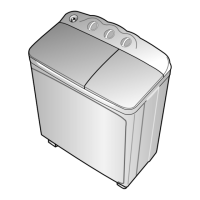

 To Next Page
 General