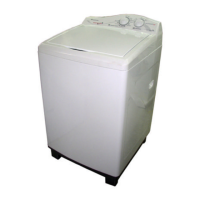
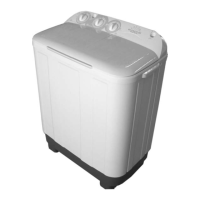
This document is a Service Manual for a Daewoo Washing Machine, Model DW-1411, with S/M No.: DW200C0001, published in July 2008.
The washing machine is a pulsator type, centrifugally separated washing machine designed for household laundry.
Technical Specifications
Power:
The washing machine supports various power sources and frequencies:
- AC 110V, 60Hz
- AC 220V, 50Hz
- AC 127/220V, 60Hz
- AC 110/220V, 50Hz
- AC 220V, 60Hz
- AC 240V, 50Hz
- AC 127V, 60Hz
Power Consumption:
- Pump model: 610W (60Hz), 650W (50Hz)
- Non-pump model: 580W (60Hz), 600W (50Hz)
Dimensions (WxDxH):
- Net: 924x542x1025 mm
- Packed up: 938x558x1040 mm
Weight:
- Pump model: Net 39kg, Packed up 42.5kg
- Non-pump model: Net 38kg, Packed up 41.5kg
Washing Course:
Water Level:
- High: 90 liters
- Medium: 80 liters
- Low: 70 liters
- Small: 60 liters
Revolution Per Minute:
- Wash: 100 rpm
- Spin: 1700 rpm (60Hz), 1400 rpm (50Hz)
Timer:
- Wash: Max. 15 min., Manual operation
- Spin: Max. 5 min., Manual operation
Maximum Mass of Textile:
- Wash: 10.0 kg
- Spin: 7.0 kg
Water Supply:
Spin Rinse:
Outlet of Drain Hose:
Lint Filter:
Usage Features
The washing machine features a control panel with several user-adjustable settings:
Wash Timer:
- Used to select the desired time for washing or rinsing, with settings from 0 to 15 minutes.
Wash Action:
- Allows selection of wash intensity: "STRONG", "NORMAL", or "SOFT".
Lever Water Supply Selector:
- Directs water supply to either the WASH TUB (left position) or the BASKET SPIN (right position).
Inlet Water:
- Connects the inlet hose to supply water to the WASH TUB or BASKET SPIN.
Valve Selector:
- Selects "WASH, RINSE" for washing and rinsing, and "DRAIN" to drain water. For pump models, "DRAIN" activates the drain pump. "OFF" turns off the drain pump (pump models only).
Spin Timer:
- Used to select the desired time for spinning, with settings from 0 to 5 minutes.
Principles of Operation
Wash Timer:
The wash timer operates through a mechanical system involving cams, springs, and reeds to control the washing duration and action. It includes a time part, an on/off part, and a conversion part for strong, medium, and weak wash settings. The timer's internal mechanism ensures that the wash motor operates for the selected duration and then stops.
Spin Timer:
The spin timer is a spring-type time switch that powers the SPIN MOTOR (and DRAIN PUMP MOTOR for pump models) for a set spin dry time. When turned, the main shaft winds a spring, and the unwinding force, controlled by gears and an angle assembly, determines the spin duration. Contact points turn ON when the spring is wound and OFF when it unwinds completely.
Brake System:
When the spin door is opened, a LINK BRAKE loosens, and a BRAKE BAND touches the DRUM COUPLING assembly, stopping the BASKET SPIN. This is facilitated by a SPRING in the BRAKE FIX PLATE assembly.
- Brake Band Gap Control: Optimal braking occurs when the gap between the brake band and the drum coupling is about 2mm when the spin door is closed. The PLATE CONTROL WIRE can be adjusted to maintain this gap.
Wash Decelerator Assembly:
The WASH MOTOR's initial deceleration occurs through the PULLEY MOTOR and PULLEY PULSATOR. Secondary deceleration and increased revolution strength are provided by the gear in the GEAR HOUSING. This system delivers a strong yet soft water current to the PULSATOR, preventing damage to laundry.
- Motor Wash: About 1,700rpm (60Hz), 1,400rpm (50Hz)
- Pulley Pulsator: About 600rpm (60Hz), 600rpm (50Hz)
- Pulsator: About 100rpm (60Hz), 100rpm (50Hz)
Gear Housing Assembly:
This transmission device turns the PULSATOR at a 6:1 lowered speed. The GEAR SHAFT UNIT receives power, which is then transmitted through the gear unit assembly. The GEAR SHAFT UNIT and GEAR SHAFT 1 are supported by OILLESS BEARINGS and OIL SEALS within the GEAR HOUSING ASSEMBLY.
Bellows Assembly:
A wrinkled rubber device at the bottom of the BASKET SPIN, called the BELLOWS ASSEMBLY, provides a waterseal and an oilless metal interior to prevent leakage and ensure smooth operation of the BASKET SPIN.
Safety Features
Safety Device for Basket Spin:
To ensure safety during the high-speed centrifugal separation (approx. 1,700rpm for 60Hz), the washing machine incorporates:
- Door Switch: Cuts off power to the SPIN MOTOR when the spin door is opened.
- Brake System: Stops the rotating BASKET SPIN.
Door Switch Operation:
When the DOOR SPIN is opened during spinning, the DOOR SWITCH LEVER disengages from its contact, interrupting power to the SPIN MOTOR.
Maintenance Features
Lint Filter:
A lint filter is provided on the upper part of the FILTER OVERFLOW to capture lint from wash water, minimizing its re-adherence to clothes. Regular use of the lint filter is recommended.
Cleaning the Lint Filter:
- Remove the FILTER AS from the FILTER OVERFLOW by pressing it downwards.
- Turn the FILTER AS inside out and wash off lint with water.
- Return the FILTER AS to its original position and fix it to the FILTER OVERFLOW.
Troubleshooting Guide
The manual provides a detailed troubleshooting guide for common issues related to wash, spin, and drainage functions.
Concerning Wash (Pulsator does not rotate):
- Power connection: Check if the power is properly connected.
- Motor sound: Listen for a whirring sound from the wash motor.
- Condenser connection: Verify if the condenser is properly connected.
- Motor temperature: If the motor is hot, the thermal protector may have cut off power.
- Wiring: Check the wiring according to the wiring diagram.
- Wash Timer contact: Ensure the wash timer contact is good.
- Wash load: Verify if the wash load is appropriate (not exceeding 8.0kg/10.0kg).
- Pulsator and Motor Pulleys: Check if they are securely assembled.
- V-Belt: Inspect for a worn-out or slipping V-Belt.
- Impurities: Remove any impurities between the pulsator.
Concerning Wash (Pulsator does not rotate smoothly or rotates in one direction):
- Gear Housing Shaft: Check if it rotates properly when the pulsator is disassembled.
- Gear Housing: Inspect for a defective gear housing.
- Wash condenser wiring: Verify proper connection.
- Wash Timer wiring: Ensure proper connection.
- Impurities/Noise: Address strange noises from the tub or impurities between the pulsator and tub.
- Pulsator assembly: Ensure the pulsator is properly assembled.
- Contact with rotating parts: Adjust parts to prevent contact with the pulsator pulley, motor pulley, or other rotating components.
Concerning Spin (Basket Spin does not rotate):
- Door Spin: Ensure the door spin is closed, as the door switch contact will be open if it's open.
- Motor sound: Listen for a whirring sound from the spin motor.
- Brake Band: Check if the brake band is touching the drum coupling assembly (indicating a long brake wire).
- Brake Spring: Inspect for a broken brake spring.
- Motor temperature: If the motor is hot, the thermal protector may have cut off power.
- Wiring: Check the wiring according to the wiring diagram.
- Door Switch Lever: Verify proper placement and connection.
- Spin Timer contact: Ensure the spin timer contact is good.
- Defective components: Replace defective spin timer or spin motor if necessary.
Concerning Spin (Strange noise and severe vibration during spinning):
- Wash load balance: Reload clothes for proper balance.
- Safety Cover/Clothes: Ensure clothes or the safety cover are not sticking out of the basket spin.
- Assembly looseness: Tighten the bolt drum coupling assembly if the assembly between the drum coupling assembly and spin motor or basket spin is loose.
- Basket Spin unbalance: Replace the basket spin if it's unbalanced.
- Bellows Assembly: Replace the bellows assembly if the waterseal or oilless metal is worn out.
Concerning Drainage (Pump Model):
- Drain Selector: Ensure the drain selector is in the DRAIN position.
- Pump Motor wiring: Verify proper connection.
- Spin Timer/Pump Motor wiring: Check wiring for both components.
- Spin Timer contact: Ensure the spin timer contact is good.
- Defective components: Replace defective pump motor or spin timer if necessary.
Concerning Drainage (Non-Pump Model):
- Drain Strainer: Remove impurities from the drain strainer.
- Valve Housing/Inlet Joint: Remove impurities or replace components if necessary.
- Drain Hose: Remove impurities blocking the drain hose.
- Drain Selector: Ensure the drain selector is not in the DRAIN position if water keeps draining during wash.
- Valve Housing/Bellows: Remove impurities or replace the valve housing if there are impurities between the valve housing and valve bellows.

 Need help?

 To Next Page
 General