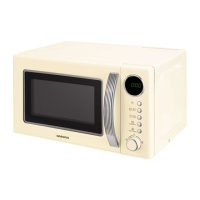
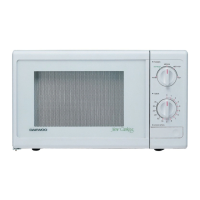
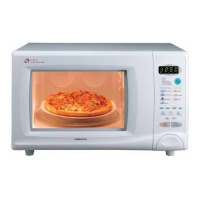
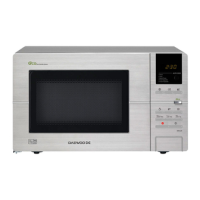
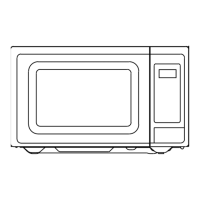
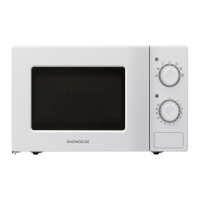
This document describes the DAEWOO Microwave Oven, models KOR-6S20C-1, KOR-6S20K-1, KOR-6S20R-1, and KOR-6S20W-1. This appliance is designed for heating food and beverages using microwave energy.
Function Description
The microwave oven operates by generating microwave energy to heat food. It features a control panel with a power knob to select desired power levels (Low, M.Low, Med, M.High, High) and a timer knob for setting cooking duration, including a defrost function. The oven automatically starts cooking after the power level and time are set. Upon completion, the unit will emit a "Dong" sound, and the timer will return to "0". The appliance is intended for household use and similar applications such as staff kitchen areas in shops, offices, and other working environments; by clients in hotels, motels, and other residential type environments; farm houses; and bed and breakfast type environments. It is designed to be freestanding.
Important Technical Specifications
- Model: KOR-6S20C-1 / KOR-6S20W-1 / KOR-6S20R-1 / KOR-6S20K-1
- Rated Voltage: 230V~ 50Hz
- Rated Input Power (Microwave): 1050W
- Rated Output Power (Microwave): 700W
- Oven Capacity: 20 L
- Turntable Diameter: Ø 255 mm
- External Dimensions: 439.5x358.3x258.2mm
- Net Weight: Approx. 10.3 kg
- Power Levels and Applications:
- Low (17% micro.): Soften ice cream
- M. Low (Defrost) (33% micro.): Soup stew, soften butter or defrost
- Med. (55% micro.): Stew, fish
- M. High (77% micro.): Rice, fish, chicken, ground meat
- High (100% micro.): Reheat, milk, boil water, vegetables, beverage
Usage Features
Safety Precautions:
- Do not attempt to operate the oven with the door open as this can result in harmful exposure to microwave energy.
- Do not place any object between the oven front face and the door or allow soil or cleaner residue to accumulate on sealing surfaces.
- If the door or door seals are damaged, the oven must not be operated until it has been repaired by a competent person.
- This appliance can be used by children aged from 8 years and above and persons with reduced physical, sensory or mental capabilities or lack of experience and knowledge if they have been given supervision or instruction concerning use of the appliance in a safe way and understand the hazards involved. Children shall not play with the appliance. Cleaning and user maintenance shall not be made by children unless they are older than 8 and supervised. Children less than 8 years of age shall be kept away unless continuously supervised.
- Keep the appliance and its cord out of reach of children less than 8 years.
- If the supply cord is damaged, it must be replaced by the manufacturer, its service agent or similarly qualified persons in order to avoid a hazard.
- Ensure the appliance is switched off before replacing the lamp to avoid the possibility of electric shock.
- It is hazardous for anyone other than a competent person to carry out any service or repair operation that involves the removal of a cover which gives protection against exposure to microwave energy.
- Liquids and other foods must not be heated in sealed containers since they are liable to explode.
- When heating food in plastic or paper containers, keep an eye on the oven due to the possibility of ignition.
- Only use utensils that are suitable for use in microwave ovens.
- If smoke is emitted, switch off or unplug the appliance and keep the door closed in order to stifle any flames.
- Microwave heating of beverages can result in delayed eruptive boiling, therefore care must be taken when handling the container.
- The contents of feeding bottles and baby food jars shall be stirred or shaken and the temperature checked before consumption, in order to avoid burns.
- Eggs in their shell and whole hard-boiled eggs should not be heated in microwave ovens since they may explode, even after microwave heating has ended.
- The oven should be cleaned regularly and any food deposits removed.
- Failure to maintain the oven in a clean condition could lead to deterioration of the surface that could adversely affect the life of the appliance and possibly result in a hazardous situation.
- The appliance must not be installed behind a decorative door in order to avoid overheating. (This is not applicable for appliances with decorative door.)
- Only use the temperature probe recommended for this oven. (for ovens provided with a facility to use a temperature-sensing probe.)
- The microwave oven shall not be placed in a cabinet unless it has been tested in a cabinet.
- The microwave oven must be operated with the decorative door open. (for ovens with a decorative door.)
- Drying of food or clothing and heating of warming pads, slippers, sponges, damp cloth and similar may lead to risk of injury, ignition or fire.
- Metallic containers for food and beverages are not allowed during microwave cooking.
- The appliance shall not be cleaned with a steam cleaner.
- The rear surface of appliances shall be placed against a wall.
Grounding Installation:
- This appliance must be grounded. In the event of an electrical short circuit, grounding reduces the risk of electric shock by providing an escape wire for the electric current.
- The appliance is equipped with a cord having a grounding wire with a grounding plug. The plug must be plugged into an outlet that is properly installed and grounded.
- Consult a qualified electrician or serviceman if the grounding instructions are not completely understood or if doubt exists as to whether the appliance is properly grounded.
- If it is necessary to use an extension cord, use only a 3-wire extension cord.
- A short power-supply cord is provided to reduce the risks resulting from becoming entangled in or tripping over a longer cord.
- If a long cord set or extension cord is used:
- The marked electrical rating of the cord set or extension cord should be at least as great as the electrical rating of the appliance.
- The extension cord must be a grounding-type 3-wire cord.
- The long cord should be arranged so that it will not drape over the countertop or tabletop where it can be pulled on by children or tripped over unintentionally.
Installation:
- Select a level surface that provides enough open space for the intake and/or outlet vents.
- The minimum installation height is 85cm.
- The rear surface of appliance shall be placed against a wall.
- Leave a minimum clearance of 30cm above the oven, a minimum clearance of 20cm is required between the oven and any adjacent walls.
- Do not remove the legs from the bottom of the oven.
- Blocking the intake and/or outlet openings can damage the oven.
- Place the oven as far away from radios and TV as possible. Operation of microwave oven may cause interference to your radio or TV reception.
- Plug your oven into a standard household outlet. Be sure the voltage and the frequency is the same as the voltage and the frequency on the rating label.
- Do not install oven over a range cooktop or other heat-producing appliance. If installed near or over a heat source, the oven could be damaged and the warranty would be void.
- The accessible surface may be hot during operation.
Turntable Installation:
- Never place the glass tray upside down. The glass tray should never be restricted.
- Both glass tray and turntable ring assembly must always be used during cooking.
- All food and containers of food are always placed on the glass tray for cooking.
- If glass tray or turntable ring assembly cracks or breaks, contact your nearest authorized service center.
Utensils:
- Materials you can use: Browning dish (bottom of browning dish must be at least 3/16 inch (5mm) above the turntable), Dinnerware (microwave-safe only), Glass jars (always remove lid, use only to heat food until just warm), Glassware (heat-resistant oven glassware only), Oven cooking bags (do not close with metal tie), Paper plates and cups (for short-term cooking/warming only), Paper towels (to cover food for reheating and absorbing fat), Parchment paper (as a cover to prevent splattering or a wrap for steaming), Plastic (microwave-safe only, use "Microwave Safe" labeled containers), Plastic wrap (to cover food during cooking), Thermometers (microwave-safe only, meat and candy thermometers), Wax paper (to prevent splattering and retain moisture).
- Materials to be avoided: Aluminum tray (may cause arcing), Carton with metal handle (may cause arcing), Metal or metal-trimmed utensils (metal shields the food from microwave energy, metal trim may cause arcing), Metal twist ties (may cause arcing and could cause a fire in the oven), Paper bags (may cause a fire in the oven), Plastic foam (may melt or contaminate the liquid inside when exposed to high temperature), Wood (will dry out when used in the microwave oven and may split or crack).
Maintenance Features
Cleaning:
- Be sure to unplug the appliance from the power supply.
- Clean the cavity of the oven after using with a slightly damp cloth.
- Clean the accessories in the usual way in soapy water.
- The door frame and seal and neighbouring parts must be cleaned carefully with a damp cloth when they are dirty.
- Do not use harsh abrasive cleaners or sharp metal scrapers to clean the oven door glass since they can scratch the surface, which may result in shattering of the glass.
- Cleaning Tip: For easier cleaning of the cavity walls that the food cooked can touch: Place half a lemon in a bowl, add 300ml (1/2 pint) water and heat on 100% microwave power for 10 minutes. Wipe the oven clean using a soft, dry cloth.
Troubleshooting:
- Microwave oven interfering TV reception: Radio and TV reception may be interfered when microwave oven operating. It is similar to the interference of small electrical appliances, like mixer, vacuum cleaner, and electric fan. It is normal.
- Dim oven light: In low power microwave cooking, oven light may become dim. It is normal.
- Steam accumulating on door, hot air out of vents: In cooking, steam may come out of food. Most will get out from vents. But some may accumulate on cool place like oven door. It is normal.
- Oven started accidentally with no food in: It is forbidden to run the unit without any food inside. It is very dangerous.
- Oven can not be started:
- Possible Cause: Power cord not plugged in tightly. Remedy: Unplug. Then plug again after 10 seconds.
- Possible Cause: Fuse blowing or circuit breaker works. Remedy: Replace fuse or reset circuit breaker (repaired by professional personnel of our company).
- Possible Cause: Trouble with outlet. Remedy: Test outlet with other electrical appliances.
- Oven does not heat:
- Possible Cause: Door not closed well. Remedy: Close door well.
WEEE Directive:
According to Waste of Electrical and Electronic Equipment (WEEE) directive, WEEE should be separately collected and treated. If at any time in future you need to dispose of this product please do NOT dispose of this product with household waste. Please send this product to WEEE collecting points where available.

 Need help?
 General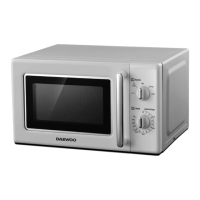

 To Next Page