
 Need help?
Do you have a question about the Dahua DH-IPC-HFW1420SP and is the answer not in the manual?
Explains the camera's external cables and ports, including LAN and DC power input.
Presents the camera's physical dimensions and structural layout for installation planning.
Step-by-step guide for mounting the camera, covering drilling, expansion bolts, and securing.
Details how to change the camera's IP address using configuration tools for network access.
Instructions for accessing and logging into the camera's web interface for management.
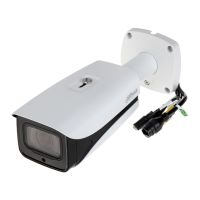
This document provides a quick start guide for the Dahua HD Mini IR Waterproof Bullet Network Camera, outlining its framework, installation, and network configuration. It also includes important safeguards and warnings to ensure proper and safe operation.
The camera is designed for network surveillance, offering a robust and reliable solution for various environments. Its primary function is to capture and transmit video over a network, with features like infrared (IR) for low-light conditions and a waterproof design for outdoor use.
The camera is equipped with a standard Ethernet port for network connectivity, supporting standard Ethernet cables. It also has a DC 12V power input port. Some models may not support Power over Ethernet (PoE), so it's important to check the device label for specific power requirements. The installation process involves mounting the camera on a wall or ceiling, ensuring the surface can support at least three times the camera's weight, including its bracket. The device comes with self-tapping screws and expansion bolts for secure installation. After mounting, the camera's sunshade can be adjusted, and its monitoring direction can be set by loosening and tightening an adjusting screw.
A key feature is the waterproof connector for the network port, which ensures the device's integrity in challenging weather conditions. The installation of this connector involves several steps: first, installing a rubber ring into the network port with the convex groove outward, then installing a fixing rubber ring into the main body of the waterproof connector. The network cable, without its crystal head, is then pulled through the main body of the waterproof connector, fixing rubber ring, and waterproof locking cover. After making the crystal head, it is inserted into the network cable. Finally, the main body of the waterproof connector is rotated clockwise to firmly lock it onto the network port, and the waterproof locking cover is rotated clockwise to lock the waterproof connector and cover.
For network configuration, the camera comes with a default IP address (192.168.1.108). To integrate it into an existing network, the IP address needs to be modified to fit the network segment. This can be done using a "Quick Configuration Tool" provided on the accompanying CD. The tool allows users to log in with default credentials (username: admin, password: admin, port: 37777) and modify the IP address, subnet mask, and gateway. After modifying the IP address, users can access the camera's web interface through a web browser (e.g., Internet Explorer) by entering the modified IP address in the address bar. The web interface provides further configuration options, and it is strongly recommended to change the administrator password immediately after the first login for security purposes.
The manual emphasizes several critical maintenance practices to ensure the longevity and optimal performance of the camera. Electrical safety is paramount; all installations and operations must comply with local electrical safety codes. The power supply must meet the requirements of SELV (Safety Extra Low Voltage) and Limited Power Source, typically 12V DC, DC5V, or AC24V, as specified on the device label. An easy-to-use power-off device should be installed for emergency power disconnection. Users must prevent the line cord from being trampled or pressed, especially at the plug, power socket, and device junction. It is crucial not to connect two power supply sources to the device simultaneously, as this can cause damage. The manufacturer disclaims liability for fires or electrical shocks resulting from improper handling or installation and for problems caused by unauthorized modifications or repairs.
Environmental considerations are also highlighted. The device should not be aimed at strong light sources like direct sunlight, as this can cause overexposure and reduce the lifespan of the CCD or CMOS sensor. It must be transported, used, and stored within the specified humidity and temperature ranges. The camera should not be kept in wet, dusty, extremely hot, or extremely cold environments, or areas with strong electromagnetic radiation or unstable lighting. Water or other liquids must not be allowed to fall into the camera to prevent damage to internal components. Indoor devices should be protected from rain or dampness to prevent fire or lightning. Adequate ventilation is necessary to prevent heat accumulation. During transportation, storage, and installation, the device should be packed in its standard factory packaging or material of equivalent quality, and heavy stress, violent vibration, or water splashes must be avoided.
Regarding daily maintenance, users are advised not to touch the heat dissipation components directly to avoid burns. The device should not be dismantled by users, as this can lead to water leakage or poor image quality due to unprofessional handling. Using a thunderproof device is recommended to enhance protection, and grounding the product's grounding holes further improves reliability. The CCD (CMOS) optic component should not be touched directly. Dust or dirt on the lens surface can be cleaned with a blower, or gently wiped with a dry cloth moistened with alcohol if necessary. For general cleaning, a dry, soft cloth should be used. If there is excessive dust, a mild detergent diluted with water can be used, followed by wiping with a dry cloth. Volatile solvents like alcohol, benzene, thinner, or strong abrasive detergents should be avoided as they can damage the surface coating and reduce performance. The dome cover, being an optical device, should not be touched or wiped directly during installation or use. For dirt on the dome cover, an oil-free soft brush or hair dryer can be used to gently remove it. For grease or fingerprints, a soft cloth can be used to gently wipe away water or oil, followed by an oil-free cotton cloth or paper soaked in alcohol or detergent, wiping from the lens center outward, changing the cloth and repeating if needed.
The manual also warns against using non-standard accessories and stresses that installation and fixing should be performed by professional engineers. The device surface should be protected from laser beam radiation if laser devices are in use. Providing two or more power supply modes simultaneously is prohibited, as it can damage the device. The manual serves as a reference, and the actual product may have minor deviations. The content will be updated regularly without prior announcement. For any issues or questions, users should contact the supplier or customer service for the latest procedures and documentation. The company is not liable for losses caused by operations not following the manual.
 General
| Resolution | 1920 x 1080 |
|---|---|
| Image Sensor | 1/3" CMOS |
| Effective Pixels | 2MP |
| Scanning System | Progressive |
| Minimum Illumination | 0.01 Lux |
| IR Distance | Up to 30m |
| IR On/Off Control | Auto/ Manual |
| Lens Type | Fixed |
| Focal Length | 4mm |
| Max. Aperture | F2.0 |
| Focus Control | Fixed |
| Smart Codec | H.265+/H.264+ |
| Streaming Capability | Dual stream |
| Bit Rate Control | CBR/VBR |
| Gain Control | Auto/Manual |
| Noise Reduction | 3D DNR |
| Motion Detection | Yes |
| Region of Interest | Yes |
| Ethernet | RJ-45 (10/100Base-T) |
| Streaming Method | Unicast / Multicast |
| Max. User Access | 20 users |
| Ingress Protection | IP67 |
| Sensor Type | CMOS |
| Sensor Size | 1/3" |
| Video Compression | H.265/H.264 |
| Day/Night | ICR |
| BLC Mode | BLC / HLC |
| White Balance | Auto/Manual |
| Protocol | HTTP; HTTPS; TCP; ARP; RTSP; RTP; UDP; SMTP; FTP; DHCP; DNS; DDNS; PPPOE; IPv4/v6; QoS; UPnP; NTP; Bonjour; ICMP; IGMP |
| Interoperability | ONVIF |
| Edge Storage | Micro SD card |
| Power Supply | DC 12V |
| Operating Conditions | -30°C to +60°C |
| Network Interface | RJ-45 |


 To Next Page