EasyManua.ls Logo

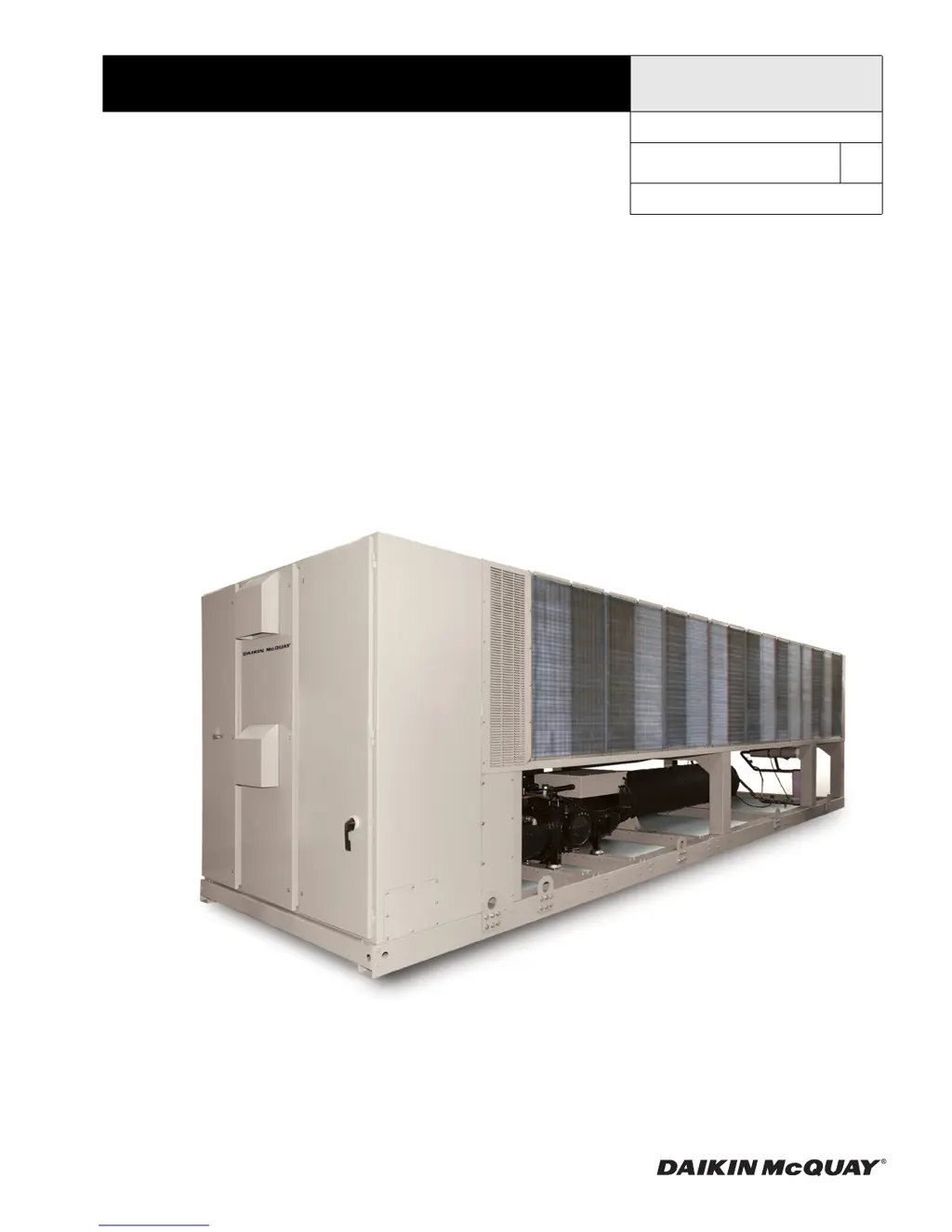
Daikin McQuay AWS190BDS VFD - User Manual

Default Icon
216 pages
Print Icon
To Next Page IconTo Next Page
Loading...
Installation Manual IM 1167
Pathfinder
®
Air Cooled Chillers
Group: Chillers
Part Number:
IM 1167
REV
00
Date: December, 2012
© 2012 McQuay International
Model AWS-B (Rev 0B)
Standard, High, & Premium Efficiencies
Includes models with VFD and models with Remote Evaporator
170 to 550 tons • 600 to 1930 kW • R-134a • 60Hz

Questions and Answers

  • T
    Timothy WeberAug 18, 2025
    Why is Daikin McQuay AWS190BDS VFD compressor overload tripped or circuit breaker tripping?
    • C
      Christopher JonesAug 18, 2025
      If the Daikin McQuay Chiller compressor overload is tripped, the circuit breaker trips, or fuses are blown, it could be due to several reasons: * Low voltage during high load condition. Check the supply voltage for excessive voltage drop. * Loose power wiring. Check and tighten all connections. * A power line fault causing unbalanced voltage. Check the supply voltage. * Defective or grounded wiring in the motor. Check the motor and replace it if defective. * High discharge pressure. Refer to corrective steps for high discharge pressure.
  • D
    Darren LutzAug 21, 2025
    What causes high discharge pressure in Daikin McQuay AWS190BDS VFD?
    • T
      Tony StewartAug 21, 2025
      High discharge pressure in a Daikin McQuay Chiller can be caused by: * Noncondensables in the system. Remove them from the condenser coil after shutdown, following EPA regulations. * Fans not running. Check fan fuses and electrical circuits. * Fan control out of adjustment. Ensure the fan setup in the controller matches the unit fan number and check the Microtech III condenser pressure sensor for proper operation. * System overcharged with refrigerant. Check discharge superheat and condenser subcooling, and remove any excess charge. * Dirty condenser coil. Clean the condenser coil. * Air recirculation from the fan outlet into the unit coils. Remove the cause of recirculation. * Air restriction into the unit. Remove obstructions near the unit.
  • J
    Jacqueline MasonAug 25, 2025
    Why is Daikin McQuay AWS190BDS VFD compressor noisy or vibrating?
    • P
      Philip ZamoraAug 26, 2025
      A noisy or vibrating Daikin McQuay Chiller compressor can stem from a few potential issues: * Inadequate oil injection. Verify that the oil sight glass shows visible oil during steady operation and check the pressure drop across the oil filter and oil separator sight glasses. * Liquid slugging. Check suction and discharge superheat.
  • W
    wendylopezAug 31, 2025
    How to troubleshoot Daikin McQuay AWS190BDS VFD Chiller compressor that will not load or unload?
    • N
      nlopezAug 31, 2025
      To troubleshoot a Daikin McQuay Chiller compressor that won't load or unload: * Check the capacity control solenoids for proper operation. Refer to the capacity control section for detailed instructions.
  • J
    John WilsonSep 3, 2025
    Why is the discharge pressure low in my Daikin McQuay Chiller?
    • B
      Benjamin FernandezSep 4, 2025
      Low discharge pressure in your Daikin McQuay Chiller could be due to: * Wind effect or a low ambient temperature. Protect the unit against excessive wind into vertical coils. * Incorrect condenser fan control. Ensure the fan setup in the Microtech III controller matches the unit fan number and check the VFD fan if the unit has a VFD option. * Low suction pressure. Refer to the corrective steps for low suction pressure. * The compressor operating unloaded. See the corrective steps for failure to load. * A compressor problem, such as the compressor not pumping properly. Repair or replace the compressor.
  • V
    Victoria ClarkSep 7, 2025
    What causes low oil level trip in Daikin McQuay Chiller?
    • C
      Christopher WilcoxSep 7, 2025
      A low oil level trip in a Daikin McQuay Chiller can be triggered by: * Insufficient oil. Check the oil line and separator sight glasses. * Low discharge pressure. Faulty EXV. * Low discharge superheat. Check and correct the cause of low DSH.
  • K
    Kenneth KingSep 10, 2025
    What causes high suction pressure in Daikin McQuay Chiller?
    • V
      Valerie CollinsSep 10, 2025
      High suction pressure in a Daikin McQuay Chiller can be caused by: * Excessive load - high water temperature. Reduce the load or add additional equipment. * Compressor unloaders not loading the compressor. Refer to corrective steps for failure of compressor to load. * Superheat is too low. Check the superheat on the Microtech III display and inspect the suction line sensor installation and the sensor itself. * System overcharged. Check the charge, as an overcharge raises suction pressure. * Compressor bypassing gas. Check evaporator, suction, and discharge pressures.
  • L
    Louis CruzNov 14, 2025
    What to do if Daikin McQuay AWS190BDS VFD compressor will not run?
    • M
      Miranda SimmonsNov 14, 2025
      If the Daikin McQuay Chiller compressor won't run, here's what to check: * Ensure the main power switch is closed. * Verify the unit system switch is closed by checking the MicroTech III display. * Confirm the circuit switch is not in the pumpdown position, also via the MicroTech III display, and check pump operation for flow. * Make sure the chilled water flow switch is closed, using the MicroTech display and checking the chilled water pump. * Close any open circuit breakers. * Inspect for blown fuses or tripped circuit breakers, checking for shorts, grounds, overloading, or loose connections. Reset breakers or replace fuses after fixing any faults. * Reset the compressor overload at the button and clear the alarm on the Microtech III display. * Check the compressor conta...
  • K
    kathrynholmesNov 27, 2025
    What causes low suction pressure in Daikin McQuay AWS190BDS VFD?
    • H
      Holly Wood MDNov 27, 2025
      Low suction pressure in a Daikin McQuay Chiller can result from: * Inadequate refrigerant charge quantity. Check the liquid line sight glass for charge, inspect the unit for leaks, repair any leaks, and recharge the system to clear the sight glass at full load with all fans on and a minimum outdoor air temperature of 75°F. * A clogged liquid line filter-drier. Check the pressure drop across the filter-drier and replace it if necessary. * A malfunctioning expansion valve. Check the valve's superheat and opening position. Replace the valve only if you're certain it's not working. * Insufficient water flow to the evaporator. Check the water pressure drop across the evaporator and adjust the gallons per minute (GPM) accordingly. * Water temperature leaving the evaporator is too low....

Summary

Installation Manual

Hazard Identification

DANGER Warning

Crucial warnings for situations that could cause death or serious injury.

WARNING Warning

Warnings for potentially hazardous situations leading to property damage or severe injury.

CAUTION Warning

Cautions for potentially hazardous situations resulting in personal injury or equipment damage.

Introduction

Unit Inspection Upon Receipt

Guidelines for inspecting the unit upon arrival and reporting shipping damage.

Installation and Startup

Handling Safety Warnings

Safety warnings related to handling the unit, including sharp edges and coil surfaces.

Clearance Requirements

Minimum clearances needed for unit operation, airflow, and maintenance access.

Refrigerant Diagram - Standard Efficiency

Schematic of refrigerant flow for standard efficiency AWS models, showing one circuit.

Restricted Air Flow Management

Features and considerations for managing restricted airflow to the chiller unit.

Chilled Water Piping Design

Recommendations for designing chilled water piping systems, including minimum requirements.

Flow Switch Requirements

Requirement for a flow switch in the chilled water system to ensure adequate water flow and prevent freeze-up.

Electrical Connections

Guidelines for making electrical connections in accordance with local and national codes.

Handling and Lifting Safety

Critical safety instructions for proper lifting and handling to prevent damage and injury.

Refrigerant Diagram - High;Premium Efficiency

Schematic of refrigerant flow for high/premium AWS models with economizer, showing one circuit.

Chilled Water Pump Control

Information on controlling the chilled water pumps via the chiller's microprocessor for optimal operation.

Glycol Solutions for Freeze Protection

Calculations and considerations for using glycol solutions for freeze protection.

Unit Location Requirements

Guidelines for selecting an appropriate outdoor location for the chiller unit.

Evaporator Freeze Protection

Methods and considerations for protecting the evaporator from freezing, including glycol use and immersion heaters.

Physical Data - Non-VFD Models

Physical Data - VFD Models

Lifting & Mounting Weights (I-P Units)

Lifting & Mounting Weights (SI Units)

Isolator Locations and Kit Numbers

Electrical Data

Field Wiring Requirements

Requirements for field wiring, emphasizing compliance with codes and specifications.

Wiring Diagram

Field Wiring Diagram

Diagram illustrating the field wiring connections for the chiller unit.

Field Wiring Diagram (Continued)

Continuation of the field wiring diagram, showing communication interface details.

Multipoint Electrical Data - Non-VFD

Multipoint Field Wiring Data - Non-VFD

Terminal Amps - Single;Multi-Point (non-VFD)

Single-point Electrical Data - Non-VFD

Single-point Field Wiring Data - Non-VFD

Multipoint Electrical Data - VFD Models

Terminal Amps - Single;Multi-Point (VFD)

Single-point Electrical Data - VFD

Single-point Field Wiring Data - VFD

Pressure Drop Data

Evaporator Pressure Drop - 170;190 Standard

Evaporator pressure drop curves for AWS 170/190 Standard Efficiency models.

Evaporator Pressure Drop - 200;225 Standard & 230;250 High

Evaporator pressure drop curves for AWS 200/225 Standard and 230/250 High Efficiency models.

Evaporator Pressure Drop - 280;300 High Efficiency

Evaporator pressure drop curves for AWS 280/300 High Efficiency models.

Evaporator Pressure Drop - 350;375 Standard & 330-410 High

Evaporator pressure drop curves for AWS 350/375 Standard and 330/350/390/410 High Efficiency models.

Evaporator Pressure Drop - 240;265 Premium

Evaporator pressure drop curves for AWS 240/265 Premium Efficiency models.

Evaporator Pressure Drop - 470-550 Standard & 475-530 High

Evaporator pressure drop curves for AWS 470-550 Standard and 475-530 High Efficiency models.

Evaporator Pressure Drop - 290;310 Premium

Evaporator pressure drop curves for AWS 290/310 Premium Efficiency models.

Evaporator Pressure Drop - 250;260 Standard

Evaporator pressure drop curves for AWS 250/260 Standard Efficiency models.

Evaporator Pressure Drop - 290;310 Standard

Evaporator pressure drop curves for AWS 290/310 Standard Efficiency models.

Evaporator Pressure Drop - 400;425;450 Standard & High

Evaporator pressure drop curves for AWS 400/425/450 Standard and 450 High Efficiency models.

Remote Evaporators

Remote Evaporator Field Wiring Notes

Notes on field wiring for solenoid valves, sensors, and transducers for remote evaporators.

Refrigerant Piping Design

Guidelines for designing refrigerant piping for proper system operation, oil return, and pressure drop.

Remote Evaporator Lifting & Mounting Weights

Remote Evaporator Isolators

Remote Evaporator (Non-VFD) Physical Data

Troubleshooting Chart

Compressor Will Not Run Troubleshooting

Troubleshooting steps for a compressor that is not running, covering power, circuit, and protection issues.

Low Suction Pressure Troubleshooting

Troubleshooting steps for low suction pressure, covering refrigerant charge, filters, expansion valves, and water flow.

Compressor Noise or Vibration Troubleshooting

Troubleshooting steps for a noisy or vibrating compressor, addressing internal issues, oil, and slugging.

Low Oil Level Trip Troubleshooting

Troubleshooting steps for a low oil level trip, addressing oil, discharge pressure, and superheat.

Compressor Load;Unload Failure Troubleshooting

Troubleshooting steps for compressor capacity control or unloader mechanism failures.

High Suction Pressure Troubleshooting

Troubleshooting steps for high suction pressure, including excessive load, unloaders, and system charge.

High Discharge Pressure Troubleshooting

Troubleshooting steps for high discharge pressure, including noncondensables, fan issues, and refrigerant charge.

Low Discharge Pressure Troubleshooting

Troubleshooting steps for low discharge pressure, addressing wind effect, fan control, and refrigerant charge.

Daikin McQuay AWS190BDS VFD Specifications

General IconGeneral
BrandDaikin McQuay
ModelAWS190BDS VFD
CategoryChiller
LanguageEnglish

Related product manuals