
 Need help?
Do you have a question about the Daikin 2MXM68N2V1B and is the answer not in the manual?
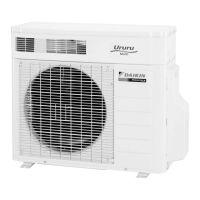
Document describes installation instructions for the outdoor unit and its target audience.
Safety precautions for connecting refrigerant piping, including no brazing on site.
Safety warnings regarding checking refrigerant piping for leaks and vacuum drying.
Warnings about flammable refrigerant and safe charging practices.
Safety precautions for electrical installation, compliance with legislation, and wiring practices.
Details the contents of the outdoor unit package and how to remove accessories.
Guidelines for selecting and preparing the installation site for the outdoor unit.
Spacing guidelines and site requirements for the outdoor unit installation.
Precautions for outdoor unit installation in cold climates to prevent snow issues.
Instructions on how to provide the installation structure and mount the outdoor unit.
Guidance on using vibration-proof rubber and anchor bolts for unit installation.
Steps for physically installing the outdoor unit.
Instructions for providing proper drainage and handling condensate in cold areas.
Requirements for refrigerant piping, including material, diameter, and insulation.
Specifies suitable piping materials, diameters, and insulation types for refrigerants.
Details on the type and thickness of polyethylene foam insulation for refrigerant piping.
Guidelines on maximum refrigerant piping length and height differences for system performance.
Instructions for connecting refrigerant piping between indoor and outdoor units, including reducer usage.
Details on using reducers for connecting indoor and outdoor units of different capacities.
Procedures for checking refrigerant piping for leaks using bubble tests and vacuum drying.
Steps for performing a leak test on refrigerant piping connections using bubble solution.
Instructions for vacuum drying the system to remove moisture before operation.
Information about refrigerant type (R32), GWP, and handling precautions.
Guidance on calculating the required additional refrigerant based on piping length.
How to calculate the total refrigerant charge needed for a complete recharge.
Procedures and warnings for charging additional refrigerant into the system.
Table listing specifications for power supply and interconnection cables, and recommended breakers.
Step-by-step instructions for connecting electrical wiring to the outdoor unit.
Steps for insulating piping, fixing wires, and installing covers to complete the outdoor unit installation.
Description of the standby electricity saving function and its operation.
Steps to enable the standby electricity saving function by adjusting a switch.
Explanation of the priority room function for managing indoor unit operation.
Instructions for setting the priority room function for specific indoor units.
Description of the night quiet mode for reducing outdoor unit noise.
Steps to enable the night quiet mode by adjusting a switch.
Explanation of the heat mode lock function to restrict operation to heating.
Steps to enable the heat mode lock function by adjusting a switch.
Explanation of the cool mode lock function to restrict operation to cooling.
Steps to enable the cool mode lock function by short-circuiting specific pins.
Pre-checks to perform after installation and before powering up the unit.
Checklist items to perform during the commissioning process.
Procedures for trial operation and testing the unit's functions.
Information on the wiring error check function for automatic correction of wiring issues.
Steps to perform a test run for the unit, including temperature checks.
Guidance on starting up the outdoor unit after commissioning.
Reference to the wiring diagram and its legend for understanding electrical connections.
Explanation of symbols used in the wiring diagrams for electrical components.
Diagram illustrating the piping layout for the outdoor unit and component classifications.



 To Next Page
 General