
 To Next Page

J
Jose BakerSep 12, 2025
What to do if a switch or a button often fails to work properly on Daikin Air conditioning?
- SSamuel MillerSep 12, 2025
If a switch or button often fails to work properly, turn the breaker OFF and call the service shop.

What to do if a switch or a button often fails to work properly on Daikin Air conditioning?
If a switch or button often fails to work properly, turn the breaker OFF and call the service shop.
What to do if the safety breaker, a fuse, or the earth leakage breaker cuts off the operation frequently for Daikin Air conditioning?
If the safety breaker, a fuse, or the earth leakage breaker cuts off the operation frequently, turn the breaker OFF and call the service shop.
What to do if the power cord of Daikin Air conditioning is abnormally hot or damaged?
If the power cord is abnormally hot or damaged, turn the breaker OFF and call the service shop.
Why is my Daikin Air conditioning cooling/heating effect poor?
The cooling or heating effect might be poor due to several reasons. Check if the air filters are clean. Ensure there is nothing blocking the air inlet or outlet of the indoor and outdoor units. Verify that the temperature setting is appropriate. Make sure the windows and doors are closed. Confirm that the airflow rate and direction are set correctly. Also, check if the unit is set to INTELLIGENT EYE mode.
What to do if my Daikin Air conditioning does not operate and the OPERATION lamp is off?
If your Daikin air conditioner isn't operating and the OPERATION lamp is off, check the following: Has a breaker turned OFF or a fuse blown? Is there a power failure? Are batteries properly set in the remote controller? Is the timer setting correct?
What to do if Daikin FTXD60BVMA Air Conditioner has an abnormal functioning during operation?
If your Daikin Air Conditioner malfunctions during operation, it may be due to lightning or radio waves. Turn the breaker OFF, then turn it ON again, and try operating the air conditioner with the remote controller.
Why Daikin FTXD60BVMA operation stops suddenly and OPERATION lamp is on?
If your Daikin Air Conditioner stops suddenly during operation and the OPERATION lamp is on, it may be due to a sudden large voltage fluctuation. For system protection, the air conditioner may stop operating. It should automatically resume operation in about 3 minutes.
How to improve cooling (heating) effect of Daikin FTXD60BVMA?
If your Daikin Air Conditioner's cooling or heating effect is poor, check the air filters to ensure they are clean. Also, check for any obstructions blocking the air inlet or outlet. Make sure the temperature setting is appropriate, windows and doors are closed, the air flow rate and direction are set correctly, and the unit is not set to INTELLIGENT EYE mode.
How to stop the bad odor from my Daikin Air conditioning indoor unit?
If the indoor unit gives out an odor, it is recommended to have the indoor unit washed by a technician. Consult the service shop where you bought the air conditioner.
What to do if an abnormality (such as a burning smell) occurs with Daikin Air conditioning?
If an abnormality, such as a burning smell, occurs, turn the breaker OFF and call the service shop.
Explains the meaning of WARNING and CAUTION labels for safety.
Details precautions against fire, explosion, and physical injury during operation.
Covers earthing requirements and protection of sensitive items from unit effects.
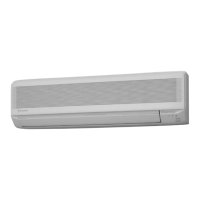
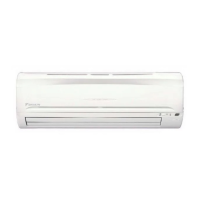
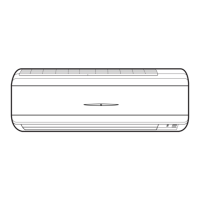
Identifies key components of the indoor air conditioner unit.
Details the buttons and indicators on the main control panel.
Identifies key components of the outdoor air conditioner unit.
Explains the display screen and functions of each button on the remote control.
Step-by-step guide for inserting batteries into the remote controller.
Instructions on how to operate the remote controller and its limitations.
Steps for mounting the remote controller holder on a wall.
Tips for maintaining the remote controller and addressing sensitivity issues.
Procedure for setting the current time on the air conditioner.
How to turn on the air conditioner using the main breaker.
Advice on optimizing energy consumption during operation.
Guide to choosing between AUTO, DRY, COOL, HEAT, and FAN modes.
Instructions for turning the unit on and off.
How to change the desired temperature for cooling or heating.
Steps to change the fan speed for different modes.
Information on activating quiet mode for reduced noise.
Instructions on how to adjust the direction of airflow.
How to adjust the horizontal flap for airflow direction.
How to adjust the vertical louvers for airflow direction.
How to enable and disable 3D airflow for room circulation.
Important considerations regarding louver angles and their impact.
How to quickly maximize cooling or heating effect.
Steps to turn off the Powerful Operation mode.
Notes on when Powerful Operation is available and its effects.
How to reduce outdoor unit noise, ideal for nighttime.
Steps to turn off the Outdoor Unit Silent Operation.
Conditions and restrictions for using Silent Operation.
How to start the Home Leave function to record preferences.
Steps to turn off the Home Leave function.
Guide to setting preferred temperature and airflow for Home Leave.
Explains energy saving and favorite mode uses for Home Leave.
Key notes on mode availability, priority, and limitations of Home Leave.
How to start the infrared sensor-based operation.
Steps to turn off the Intelligent Eye function.
Illustrates how the sensor detects presence and adjusts operation.
How Intelligent Eye contributes to energy saving.
Details the application range and factors affecting sensor sensitivity.
Warnings regarding sensor placement and potential misdetections.
Guide to program the unit to turn off automatically.
Steps to deactivate the programmed Off Timer.
Information on timer memory and the Night Set Mode feature.
Guide to program the unit to turn on automatically.
Steps to deactivate the programmed On Timer.
Example of setting both On and Off timers simultaneously.
Situations requiring timer settings to be reset.
How to select modes in a multi-unit system with priority settings.
Using Silent Operation across multiple indoor units.
Forcing units to a specific mode in multi-system setups.
Details on how priority rooms affect operation mode selection.
How Powerful Operation affects capacity distribution in multi systems.
How Silent Operation affects the entire system in multi-unit setups.
Safety guidelines to follow before cleaning the air conditioner unit.
Step-by-step instructions for opening, cleaning, and reattaching the front grille.
Instructions for removing, cleaning, and replacing air filters.
Guidelines for cleaning and renewing the air purifying filter.
Essential checks for the unit's base, fittings, and airflow.
Steps for preparing the unit when it will not be used for an extended time.
Information on filter performance and how to order replacements.
Explains common situations that may seem like problems but are normal operations.
Steps to check when the air conditioner does not start.
Checks to perform when cooling or heating performance is inadequate.
Guidance for diagnosing sudden shutdowns where the operation lamp flashes.
Actions to take for unusual functioning or malfunctions.
Identifies critical symptoms requiring immediate service.
Actions after power failure and safety measures for lightning.
Advice on periodic professional servicing for optimal performance.
 General
| Cooling Capacity | 6.0 kW |
|---|---|
| Heating Capacity | 7.0 kW |
| Power Supply | 220-240V, 50Hz |
| Energy Efficiency Ratio (Cooling) | 3.21 |
| Refrigerant | R32 |
| Noise Level (Indoor) | 45 dB(A) (High) / 28 dB(A) (Low) |
| Type | Split System Air Conditioner |
| Energy Efficiency Rating (EER) | 3.21 (Cooling) |