
 To Next Page

S
Samantha MccarthySep 23, 2025
Why does my Daikin Air Conditioner operation not start soon?
- CCarol MayoSep 23, 2025
If your Daikin Air Conditioner operation does not start immediately, please wait for approximately 3 minutes. This delay is normal.

Why does my Daikin Air Conditioner operation not start soon?
If your Daikin Air Conditioner operation does not start immediately, please wait for approximately 3 minutes. This delay is normal.
What to do if Daikin Air conditioning operation stops suddenly and the OPERATION lamp flashes?
If the Daikin air conditioning stops suddenly and the OPERATION lamp flashes, clean the air filters or remove any obstacles. Then, turn the breaker OFF, turn it ON again, and try operating the air conditioner with the remote controller.
What to do if water leaks from the indoor unit of Daikin Air conditioning?
If water leaks from the indoor unit, turn the breaker OFF and call the service shop.
Why my Daikin Air conditioning operation does not start soon?
You should wait for about 3 minutes.
What to do if Daikin FTXE35BVMA operation stops suddenly and OPERATION lamp flashes?
If your Daikin Air Conditioner stops suddenly and the OPERATION lamp is flashing, clean the air filters or remove any obstructions. Then, turn the breaker OFF, and turn it ON again. Try operating the air conditioner with the remote controller.
Why did my Daikin Air conditioning operation stop suddenly, but the OPERATION lamp is on?
The unit automatically resumes operation in about 3 minutes.
What to do if a switch or a button often fails to work properly on Daikin Air conditioning?
If a switch or button often fails to work properly, turn the breaker OFF and call the service shop.
What to do if an abnormal functioning happens during Daikin Air conditioning operation?
If an abnormal functioning happens during operation, turn the breaker OFF, turn it ON again, and try operating the air conditioner with the remote controller.
Why does hot air not flow out soon after starting Daikin Air Conditioner heating?
If hot air does not flow out immediately after starting the heating operation on your Daikin Air Conditioner, allow 1 to 4 minutes for the unit to begin heating.
How to stop the bad odor from my Daikin Air conditioning indoor unit?
If the indoor unit gives out an odor, it is recommended to have the indoor unit washed by a technician. Consult the service shop where you bought the air conditioner.
Distinguishes between WARNINGS and CAUTIONS for user safety.
Precautions to avoid fire, explosion, or injury during operation.
Warnings and precautions against electric shock, fire, or injury.
Safety regarding proper earthing and avoiding quality deterioration.
Safety measures for the outdoor unit and general appliance use.
Safety during cleaning, electrical connections, and earth leakage breakers.
Guidelines for installation, drainage, and minimizing neighbor disturbance.
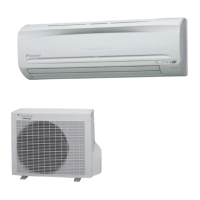
Labels and numbers identifying parts on the indoor unit.
Detailed description of indoor unit parts like filters, sensors, and controls.
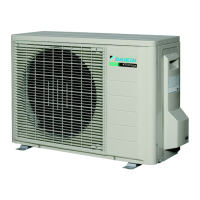
Identification and description of outdoor unit parts like inlet, outlet, and piping.
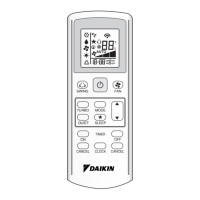
Explanation of the remote's signal transmitter and display functions.
Detailed explanation of all buttons on the remote control.
Instructions for inserting batteries into the remote controller.
Important notes and recommendations regarding battery usage and replacement.
Guidelines for aiming the remote and its operating distance.
Instructions for mounting the remote controller holder.
Important points about handling the remote controller, avoiding sunlight and dust.
Steps to set the current time on the remote controller.
Instructions for turning on the main power breaker.
Advice on energy-saving practices like temperature settings and window coverings.
Steps to select an operation mode and start the unit.
Instructions for turning off the air conditioner.
How to adjust the temperature for different modes.
How to adjust the fan speed for different modes.
Specific notes regarding heating, dry mode, and auto operation.
Steps to swing the horizontal flaps using the remote.
How to manually adjust the vertical louvres.
Information on flap swing range and attention points for louvre adjustment.
Instructions to activate the POWERFUL operation mode.
Instructions to deactivate the POWERFUL operation mode.
Notes specific to POWERFUL operation in different modes.
Instructions to activate the quiet operation for the outdoor unit.
Instructions to deactivate the quiet operation for the outdoor unit.
Notes on using SILENT operation with multi-systems and mode availability.
Steps to activate the HOME LEAVE operation.
Steps to deactivate the HOME LEAVE operation.
How to set preferred temperature and air flow for HOME LEAVE.
How HOME LEAVE saves energy by adjusting temperature.
Using HOME LEAVE to recall frequently used settings.
Notes and limitations for HOME LEAVE operation.
Steps to activate the sensor-based operation.
Steps to deactivate the sensor-based operation.
Illustrates how the unit reacts to human presence.
How to adjust the sensor's detection angle.
How INTELLIGENT EYE contributes to energy saving.
Application range and limitations of the sensor.
Precautions to avoid sensor damage or misdetection.
How to set the timer to automatically turn off the unit.
Steps to cancel the OFF timer.
General notes regarding timer settings and memory.
Explanation of the NIGHT SET MODE feature.
How to set the timer to automatically turn on the unit.
Steps to cancel the ON timer.
Example of setting both timers for scheduled operation.
Cases where timer settings need to be reset.
Definition of a system with one outdoor unit connected to multiple indoor units.
Rules for selecting operation modes with multiple indoor units.
Information on the NIGHT QUIET mode for cooling in multi-systems.
How SILENT operation works with multi-systems.
Forcing units to a specific mode in multi-systems.
How the priority room affects operation mode selection.
How priority room affects POWERFUL operation.
How priority room affects SILENT operation.
Guidelines for cleaning indoor/outdoor units and the remote.
Steps for opening, cleaning, and reattaching the front grille.
Safety warnings and precautions during cleaning.
Steps to access and remove air filters.
Instructions for cleaning air filters with water or vacuum.
Maintenance and replacement of the green air purifying filter.
Maintenance and replacement of the gray deodorizing filter.
Routine checks to ensure proper unit functioning.
Steps for storing the unit when not in use for extended periods.
Notes on filter performance, replacement, and ordering part numbers.
Explanations for normal operating conditions that may seem like issues.
Reasons for delayed start-up or slow response.
Reasons for heating stops, sounds, and outdoor unit water/steam.
Reasons for odor from indoor unit and outdoor fan rotation when idle.
Checks for no operation when the lamp is off.
Checks for issues causing reduced cooling or heating effectiveness.
Troubleshooting steps for sudden stops or flashing operation lamps.
Critical symptoms requiring immediate call to a service shop.
Emphasizes not attempting repairs due to risk of shock or fire.
Recommendation for professional maintenance to ensure optimal performance.
 General
| Cooling Capacity | 3.5 kW |
|---|---|
| Heating Capacity | 4.0 kW |
| Weight (Outdoor Unit) | 32 kg |
| Power Supply | 220-240V, 50Hz |
| Type | Split System |