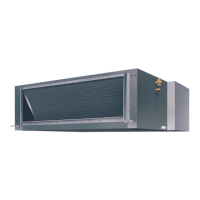
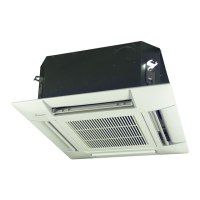
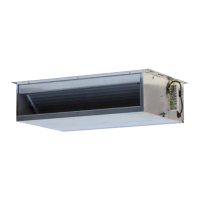
This document is an operation manual for Daikin VRV Outdoor-Air Processing Units, specifically models FXMQ125NFRV16, FXMQ200NFRV16, and FXMQ250NFRV16. It provides detailed instructions for safe and effective use, maintenance, and troubleshooting of these units.
Function Description:
The Daikin VRV Outdoor-Air Processing Unit is designed to process outdoor air, either cooling or warming it, and then supplying it indoors. It is intended for use in commercial settings such as shops, light industry, farms, or by expert/trained users. This unit does not directly control room temperature; for room temperature control, it needs to be installed in conjunction with an indoor unit for room air conditioning. The unit operates by taking in outdoor air, processing it through a heat exchanger (either cooling or heating), and then discharging it indoors. It can operate in cooling, heating, automatic, or fan-only modes.
Important Technical Specifications:
- Refrigerant Type: R410A
- GWP Value: 1975
- Cooling Operation Range:
- Outdoor Temperature (DB): 19 to 43°C
- Humidity: 30% to 90% (Long-term operation above 90% humidity may cause condensation and dripping).
- Outdoor Temperature (WB): 32°C or below
- Heating Operation Range:
- Outdoor Temperature (DB): -5 to 15°C
- Set Temperature (Factory Default): 18°C for cooling, 25°C for heating.
- Adjustable Set Temperature Range: 13 to 25°C for cooling, 18 to 30°C for heating (adjustable via remote controller by a dealer).
- Timer Programming: Up to 72 hours for start and stop operations.
Usage Features:
- Remote Controller (BRC1A62): The unit is controlled via a remote controller, which features an on/off button, operation lamp, and various display indicators for operation mode, programmed time, inspection/test operation, and centralized control.
- Operation Modes:
- Cooling: Outdoor air is cooled and supplied indoors.
- Heating: Outdoor air is warmed and supplied indoors.
- Automatic: Automatically switches between cooling and heating based on conditions.
- Fan Only: Outdoor air is supplied indoors as is.
- Timer Function: Allows users to program the system to start or stop after a set period (up to 72 hours). Both start and stop times can be programmed simultaneously.
- Master Remote Controller Setting: In systems with multiple outdoor-air processing units or a combination of outdoor-air processing units and indoor units for room air conditioning, one remote controller must be designated as the master. Only the master can select heating, cooling, or automatic operation. Slave controllers will follow the master's operation mode but can be switched to fan-only mode independently.
- Defrost Operation (Heating Mode): When the outdoor unit coil freezes during heating, the system automatically enters defrost operation, stopping the indoor fan and displaying " / " on the remote controller. This lasts for a maximum of 12 minutes before returning to heating.
- Hot Start (Heating Mode): To prevent cold air from blowing out at the start of heating, the indoor fan is automatically stopped, and " ح " is displayed on the remote controller.
- Safety Precautions: The manual emphasizes critical safety warnings, including turning off power during malfunctions, consulting dealers for repairs, using correct fuses, and avoiding flammable materials or solvents near the unit. It also highlights the importance of proper earthing and installation by qualified personnel.
Maintenance Features:
- Air Filter Cleaning: The remote controller displays " " (time to clean air filter) when cleaning is required. Filters can be cleaned using a vacuum cleaner or by washing with water and a neutral detergent. After cleaning, the filter sign reset button on the remote controller must be pressed.
- Air Outlet Cleaning: The air outlet should be cleaned with a soft cloth, or with water and neutral detergent for stubborn stains.
- Professional Maintenance: Only qualified service personnel are allowed to perform maintenance, especially for electrical parts, heat exchangers, fan motors, auxiliary electric heaters, and drain pumps. Power supply circuits must be interrupted before accessing terminal devices.
- Periodic Inspections: Depending on Indian or local legislation, periodical inspections for refrigerant leaks may be required.
- Troubleshooting: The manual provides a section for common symptoms that are not system troubles (e.g., delayed start, fan speed changes, white mist, various noises) and a troubleshooting guide for actual malfunctions, including instructions on how to identify and report malfunction codes displayed on the remote controller.

 Need help?

 To Next Page
 General