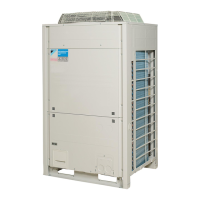
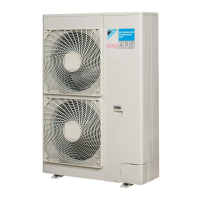
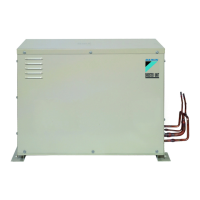
This document is an operation manual for Daikin air-cooled refrigeration condensing units, specifically covering models LREQ5B7Y1, LREQ6B7Y1, LREQ8B7Y1, LREQ10B7Y1, LREQ12B7Y1, LREQ15B7Y1, and LREQ20B7Y1. It provides essential information for the safe and proper use, installation, and maintenance of these units.
Function Description
The Daikin air-cooled refrigeration condensing unit is designed to provide cooling for various applications, primarily in commercial settings such as showcases and refrigeration units. It operates as part of a larger refrigeration system, working in conjunction with indoor units (unit coolers, showcases) to maintain desired temperatures for stored commodities. The unit utilizes R410A refrigerant, a fluorinated greenhouse gas, and is designed to operate within specific temperature ranges for both evaporation and outdoor conditions.
Important Technical Specifications
The manual details several key technical specifications for the different models:
- Refrigerant Type: R410A, with a Global Warming Potential (GWP) value of 2087.5.
- Power Supply: 3 phase 50 Hz 380~415 V for all listed models.
- Operating Conditions:
- Evaporating Temperature (Te): -45°C to +10°C.
- Outdoor Temperature: -20°C to +43°C.
- Outer Dimensions (H×W×D):
- LREQ5, LREQ6: 1,680 x 635 x 765 mm
- LREQ8, LREQ10, LREQ12: 1,680 x 930 x 765 mm
- LREQ15, LREQ20: 1,680 x 1,240 x 765 mm
- Product Mass:
- LREQ5, LREQ6: 166 kg
- LREQ8, LREQ10, LREQ12: 242 kg
- LREQ15: 331 kg
- LREQ20: 337 kg
- Connecting Refrigerant Piping:
- Liquid Pipe: Ø9.5 mm for LREQ5, LREQ6; Ø12.7 mm for LREQ8, LREQ10, LREQ12, LREQ15, LREQ20 (Note: piping size can be decreased by one grade if connected piping length is shorter than 50 m).
- Gas Pipe: Ø22.2 mm for LREQ5, LREQ6; Ø28.6 mm for LREQ8, LREQ10, LREQ12; Ø34.9 mm for LREQ15, LREQ20.
- Sound Pressure Level (dB(A)) (measured at 1 m in front and 1.5 m height):
- LREQ5: 55 dB
- LREQ6: 56 dB
- LREQ8: 57 dB
- LREQ10: 59 dB
- LREQ12: 61 dB
- LREQ15: 62 dB
- LREQ20: 63 dB
- Design Pressure:
- High-pressure side: 38 bar (3.8 MPa)
- Low-pressure side: 25 bar (2.5 MPa)
- Connection Piping Length (piping equivalent length):
- 130 m or lower (Te = -20°C ~ +10°C)
- 100 m or lower (Te = -45°C ~ -20°C)
- 35 m or lower (if condensing unit is installed higher than refrigeration-side)
- Max. difference in height between indoor and outdoor units:
- 10 m or lower (condensing unit higher than refrigeration-side)
- 10 m or lower (condensing unit lower than refrigeration-side)
- Connectable minimum load capacity:
- 2.0 kW or higher (Te = -20°C ~ +10°C)
- 1.6 kW or higher (Te = -45°C ~ -20°C)
- Refrigeration oil: Daphne FVC68D.
Usage Features
The operation manual emphasizes safe and proper usage:
- Starting and Stopping: The unit is started by setting the operation switch to ON and stopped by setting it to OFF. It is crucial to allow the unit to complete its stop movement before powering off the breaker. A remote switch is recommended for frequent stopping.
- Power Management: If the unit is not operated for a long time, it should be powered off to save energy, though it consumes a few watts even when idle. However, for machine protection, it must be powered on for at least 6 hours before resuming operation after a long shutdown.
- Alarm System: The unit includes a terminal for an alarm signal output. Installing an alarm is highly recommended to promptly address operational errors and prevent damage to stored commodities.
- Safety Precautions: The manual outlines extensive safety precautions, categorized as WARNING and CAUTION. These include:
- Never expose oneself to direct airflow for prolonged periods.
- Immediately turn off power and contact a dealer if the unit malfunctions (e.g., burning odor).
- Only qualified personnel should perform installation, modification, repair, and maintenance.
- Avoid placing objects into the air inlet or outlet to prevent injury from fan blades.
- Do not touch the air outlet or horizontal blades during swing flap operation.
- In case of refrigerant leakage, turn off the unit and contact the dealer, as refrigerant in contact with a naked flame can generate hazardous compounds.
- Ensure proper ventilation if installed in a small room to prevent oxygen depletion from refrigerant leakage.
- Use only manufacturer-specified accessories.
- Use fuses with the correct ampere rating and install an earth leakage breaker.
- Ensure the unit is properly earthed, not to utility pipes or lightning conductors.
- Do not operate the unit after natural disasters like floods or typhoons.
- Always use the remote controller to start/stop the unit, not the power circuit breaker.
- Do not use the product in flammable environments or near heat sources.
- Do not use the product for purposes other than its intended use.
- Do not use the unit for water cooling.
- Do not remove the fan guard.
- Do not locate the unit where it may get wet.
- Do not allow children to mount or play on the outdoor unit.
- Do not place water containers or other objects on the unit.
- Do not obstruct air inlets or outlets.
Maintenance Features
The manual provides guidelines for maintenance and after-sale service:
- Cleaning: Regular cleaning is essential. Before cleaning, turn off the power and ensure the fan has stopped. Do not touch aluminum fins directly. Use a soft cloth and water for cleaning; avoid harsh chemicals.
- Troubleshooting: A dedicated section helps users identify common issues that are not malfunctions (e.g., sound of flowing refrigerant, fan stopping) and provides steps to check before requesting service (e.g., power supply, breaker, air filter cleanliness, temperature settings).
- Maintenance Inspection: The interior of the unit can become dirty over time, degrading performance. Annual pressure-containing parts checks are recommended, and professional maintenance inspections are advised for disassembly and internal cleaning.
- Relocation and Disposal: Contact the dealer for relocation and disposal, as these processes require technical expertise and adherence to regulations for handling fluorocarbon refrigerants.
- Warranty and Repairs:
- Inform the dealer with model name, serial number, installation date, and a precise description of the defect when requesting repairs.
- Repairs after the warranty period are possible if the unit can regain original functions.
- The dealer's warranty may not cover malfunctions resulting from unauthorized disassembly or cleaning.
- Onerous Repairs (Outside Scope of Warranty Coverage): This section details conditions under which repairs are not covered by warranty, including:
- Use beyond specified limits (e.g., evaporating temperature, outdoor temperature, voltage regulation, frequency regulation, connection piping length, height difference).
- Applications other than the designed purpose or modification.
- Failures related to model selection (e.g., unsuitable model for storage, cooling overloading/underloading).
- Installation failures (e.g., unstable installation, poor ventilation, corrosive environments).
- Work failures (e.g., insufficient vacuum drying, refrigerant leakage, contamination of piping, on-site modification).
- Operational failures (e.g., incorrect temperature settings, neglected maintenance, simultaneous starting/stopping of multiple units).
- Accidents due to natural disasters or lightning.
- Use without heat insulation work on piping.
- Failure to adhere to showcase restrictions (e.g., proper installation of thermostatic expansion valve, thermal insulation of feeler tube, proper piping outlet direction).



 To Next Page


 General