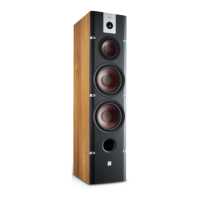
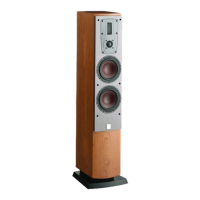
Even small changes in the listening room can affect the sound.
8
English
Both the amount and quality of the deep bass depend on the size and
shape of the room, and the position of the speakers. If positioned near a
side or back wall, this will accentuate the bass. A corner location will accen-
tuate it even more, but will also increase the reections. The decision is
yours, so experiment with different positions to nd which provides the
ideal sound for you.
As a general guide, avoid large, hard reective surfaces immediately
around the speakers, as these will act like an eccho effect and weaken the
spatial perspective of the sound image. Try placing a tapestry behind the
speakers, laying a rug in front or placing a large plant at the side - it's sur-
prising how much this can affect the precision of the sound image.
Once you are happy with the positioning of your speakers, it is important
to ensure that they are completely stable. For oor models it is essential
that you use the accompanying base.
Power and acoustic pressure
How loud a speaker is able to play and still sound good is completely
dependent on the signal it has to reproduce. So, in practice, you cannot
dene an unequivocal level for use in comparing different speakers.
Obviously, lots of pure, undistorted output from a large amplier is better
than a distorted signal from a small amplier stretched beyond its capac-
ity. The signal from a distorting (clipping) amplier contains much more
high-frequency information than an undistorted signal, and therefore puts
a heavy strain on the treble unit. Consequently, speak-ers are most often
damaged by small ampliers having to work too hard - and very rarely by
large ampliers, which are practically running idle.



 To Next Page
 Loading...