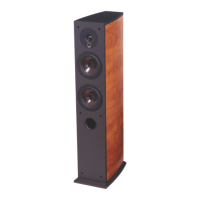
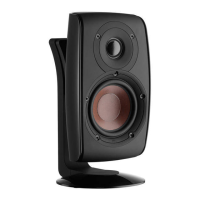
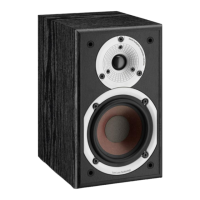
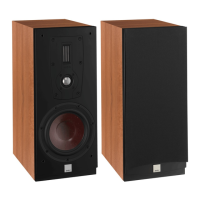
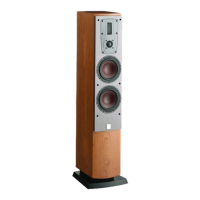
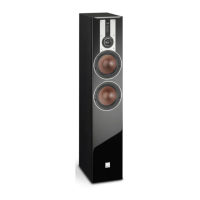
This document is an owner's manual for the DALI Suite series of loudspeakers, manufactured in Denmark. It provides comprehensive instructions and guidelines for connecting, placing, and optimizing the performance of these speakers in both stereo and surround sound setups.
Function Description:
The DALI Suite loudspeakers are designed to convert incoming electrical signals into acoustic energy with high accuracy, aiming to deliver exceptional sound quality for both musical and cinematic enjoyment. The series includes various models tailored for different roles within an audio system: Suite Center, Suite Rear, Suite 1.5, Suite 2.5, and Suite 3.5. These speakers are intended for use in home audio systems, ranging from traditional stereo configurations to multi-channel surround sound environments. The manual emphasizes that the quality of the entire audio chain, from the recorded material and source components (turntable/DVD) to interconnects, amplifiers, speaker cables, and the listening room itself, all contribute to the final sound experience.
Important Technical Specifications:
The manual provides a table of useful numbers for the DALI Suite models, highlighting key specifications:
- Frequency Response (+/- 3 dB [Hz]):
- Suite Center: 61 - 24000
- Suite Rear: 71 - 24000
- Suite 1.5: 41 - 24000
- Suite 2.5: 33 - 25000
- Suite 3.5: 33 - 25000
- Impedance [ohm]: All models are rated at 4 ohms.
- Bass Reflex System Resonance [Hz]:
- Suite Center: 56
- Suite Rear: - (not specified)
- Suite 1.5: 43.5
- Suite 2.5: 37.5
- Suite 3.5: 38.0
- Crossover Frequency [Hz]:
- Suite Center: 2500
- Suite Rear: 2900
- Suite 1.5: 3000
- Suite 2.5: 3500
- Suite 3.5: 3500
- Recommended Amplifier Power (8 ohm) [W]:
- Suite Center: 40 - 150
- Suite Rear: 20 - 80
- Suite 1.5: 40 - 160
- Suite 2.5: 30 - 150
- Suite 3.5: 30 - 200
- Sensitivity (@2.83V/1m) [dB]:
- Suite Center: 91.0
- Suite Rear: 88.0
- Suite 1.5: 89.0
- Suite 2.5: 90.0
- Suite 3.5: 91.5
- Max. SPL [dB]:
- Suite Center: 112
- Suite Rear: 105
- Suite 1.5: 109
- Suite 2.5: 111
- Suite 3.5: 113
- Placement:
- Suite Center: Above/below television
- Suite Rear: Wall
- Suite 1.5, 2.5, 3.5: Floor
- Recommended Distance from Rear Wall [cm]:
- Suite Center, Rear: - (not specified)
- Suite 1.5: 10 - 60
- Suite 2.5, 3.5: 20 - 120
- Dimensions (Height x Width x Depth [cm]):
- Suite Center: 17.6 x 50.0 x 25.8
- Suite Rear: 37.0 x 20.4 x 12.0
- Suite 1.5: 88.0 x 18.0 x 25.0
- Suite 2.5: 103.5 x 20.5 x 31.8
- Suite 3.5: 115.0 x 22.6 x 35.3
- Weight [kg/lbs]:
- Suite Center: 8.5/18.8
- Suite Rear: 3.8/8.4
- Suite 1.5: 14.0/31
- Suite 2.5: 19.5/43
- Suite 3.5: 24.5/54
The manual emphasizes the importance of sensitivity and impedance specifications. High sensitivity allows for dynamic passages without requiring a high-powered amplifier, while the linear impedance of DALI loudspeakers ensures ideal, stress-free operating conditions for amplifiers.
Usage Features:
- Connection Options:
- Normal Stereo Connection: Connects one pair of terminals per speaker to the amplifier, ensuring correct polarity (red to red, black to black) for "in phase" connection. Incorrect phasing leads to a diffuse stereo image and weak bass. Metal straps should be in place for this setup.
- Surround Connection: For multi-channel systems, center, front, and rear surround loudspeakers are connected to a surround amplifier. The manual advises positioning speakers according to their designated roles (Left, Right, Center, Surround).
- Bi-wiring: Improves sound quality by separating high and low frequency signals. Requires removing metal straps and connecting two sets of cables from the amplifier to the two terminal pairs on each speaker. This reduces intermodulation distortion and enhances coherence and openness.
- Bi-amping: Further improves sound quality by using two identical stereo amplifiers per speaker, one for high frequencies and one for low frequencies. This offers increased dynamics in addition to the benefits of bi-wiring.
- Placement Guidelines:
- General: Even small differences in placement significantly impact performance, especially soundstage focus and bass quality. Experimentation is crucial.
- Obstructions: Avoid placing objects between speakers and the listening position to prevent uneven frequency response and poor stereo imaging.
- Listening Position: The distance between Left/Right speakers and the central listening position should be identical. A central listening position is recommended for critical listening.
- Toe-in: DALI loudspeakers should generally face directly ahead with no toe-in, except for center and rear channel speakers.
- Center Speaker: Specifically tuned for placement near a TV screen. It should be placed on the supplied support mat, directly upon or on a shelf just below the television, with its front edge aligned with the TV screen. The support mat allows angling the speaker up or down towards the listening position, with its three fins oriented towards the rear.
- Listening Room Acoustics: The room itself is a critical component of the audio chain. Speakers perform best in rooms with normal furnishings. Avoid large, hard, flat surfaces near speakers. Closing curtains can help if the sound is too bright. Rugs or carpets damp unwanted reflections from hardwood floors.
- Bass Quality: Bass quantity and quality depend on room size and shape. Placement near side or rear walls reinforces bass; corner placement offers substantial bass boost. Experiment to find the best balance.
- Leveling: Speakers should be perfectly level and stable. Spikes can be used to couple speakers more effectively to the floor, especially on thick carpeting, to tighten bass response and sharpen stereo image focus.
- Power Handling:
- The manual clarifies that maximum power handling is difficult to define due to the complex nature of music signals.
- It states that large amounts of clean, undistorted power from a big amplifier are preferable to distorted output from a small amplifier pushed beyond its limits, as more speakers are damaged by small amps working too hard.
- Tone controls should be used sparingly and for occasional adjustments to older or poor recordings, not as a permanent compensation for system weaknesses. Overloading is heard as distortion (clipping) and loss of clarity; keeping levels below this point prevents damage.
- Dynamics: DALI speakers are designed to convey natural musical and cinematic dynamics, meaning the ability to reproduce sudden changes in level rapidly, cleanly, and accurately. Good dynamics provide a realistic sense of weight and scale even at low volumes.
- Surround Sound Level Adjustment: Follow instructions from the surround amplifier to match power levels so all speakers sound equally loud at the listening position. A Sound Pressure Level meter can aid in precise calibration.
Maintenance Features:
- Cable Connections: Ensure all connections are securely tightened to prevent cables from slipping out. Verify that no loose strands of wire are sticking out and that wires connected to one terminal do not touch wires connected to any other terminal.
- Break-in Period: Loudspeakers require an extended initial period of normal use (break-in) during which sound quality will gradually improve.
- Longevity: Regular use is not a problem and will extend the life of DALI loudspeakers.
- Post-Storage Break-in: After a long period without use, speakers may require a short break-in period again.
- Amplifier Care: Always turn the amplifier off before connecting or disconnecting any cables to prevent damage.
- Cable Quality: The manual advises investing in the best cable quality one can reasonably afford, as it significantly impacts system performance.

 Need help?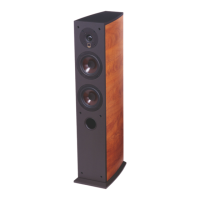

 To Next Page
 General