
 Need help?
Do you have a question about the DAS E-nergy E-4 and is the answer not in the manual?
Details amplifier construction, design, and quality control processes.
Lists general features such as balanced inputs, cooling, and low distortion.
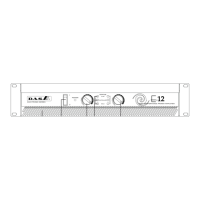
Explains front panel controls, indicators, and their functions.
Describes the power switch operation and turn-on delay.
Details the fan grill's purpose for cooling and maintenance.
Explains the clip LED indication of signal saturation or overload.
Describes the safeguard LED and its role in protection circuits.
Explains the idle LED indicating the amplifier is powered on.
Details how to adjust input gain using level control knobs.
Describes the signal presence LED for specific amplifier models.
Explains the serial number's relation to quality control verification.
Details the mains lead wiring and color coding for power connection.
Describes XLR input connectors, pin coding, and impedance.
Details 1/4" phone jack inputs, connection methods, and impedance.
Provides guidance for mounting amplifiers in a standard 19-inch rack.
Explains the cooling system, fan operation, and rack ventilation needs.
Details speaker cable connection methods and selection criteria.
Explains AC power connection, fuse location, and voltage selection.
Provides power consumption data for various models, loads, and power levels.
Presents heat emission data in BTU and calories for air conditioning calculations.
Explains the function and use of input level rotary potentiometers for gain adjustment.
Details the correct sequence for powering sound system components on and off.
Explains the clip LED's indication of signal distortion and potential speaker damage.
Describes input connectors, signal feeding, and recommended connection types.
Explains the use, settings, and benefits of the high-pass filter.
Discusses the built-in limiters and their recommended use to prevent clipping.
Describes how to operate the amplifier in bridge mode for increased power.
Explains the default stereo mode where each channel receives a separate signal.
Describes parallel mode for feeding the same signal to both channels.
Explains impedance concepts, parallel connections, and load recommendations.
Describes overheating protection, indicators, and troubleshooting steps.
Lists detailed technical specifications including power, distortion, and dimensions.
Discusses the amplifier's design for simple modular servicing.
Contains important observations and warnings for operating and servicing.
Describes warranty coverage, terms, and responsibilities for malfunctions.
Provides detailed step-by-step instructions for setting up bridge mode.

 To Next Page
 General