Product Manual - DM991 Series V Family - 204.4092.08 70
16. G.703 - G.704
Here are described the structures defined by the G.704 recommendation. Note that a G.703 signal at
2048kbits/s with an according frame structure with the G.704 is also called E1 signal.
16.1. G.704 Frame structure
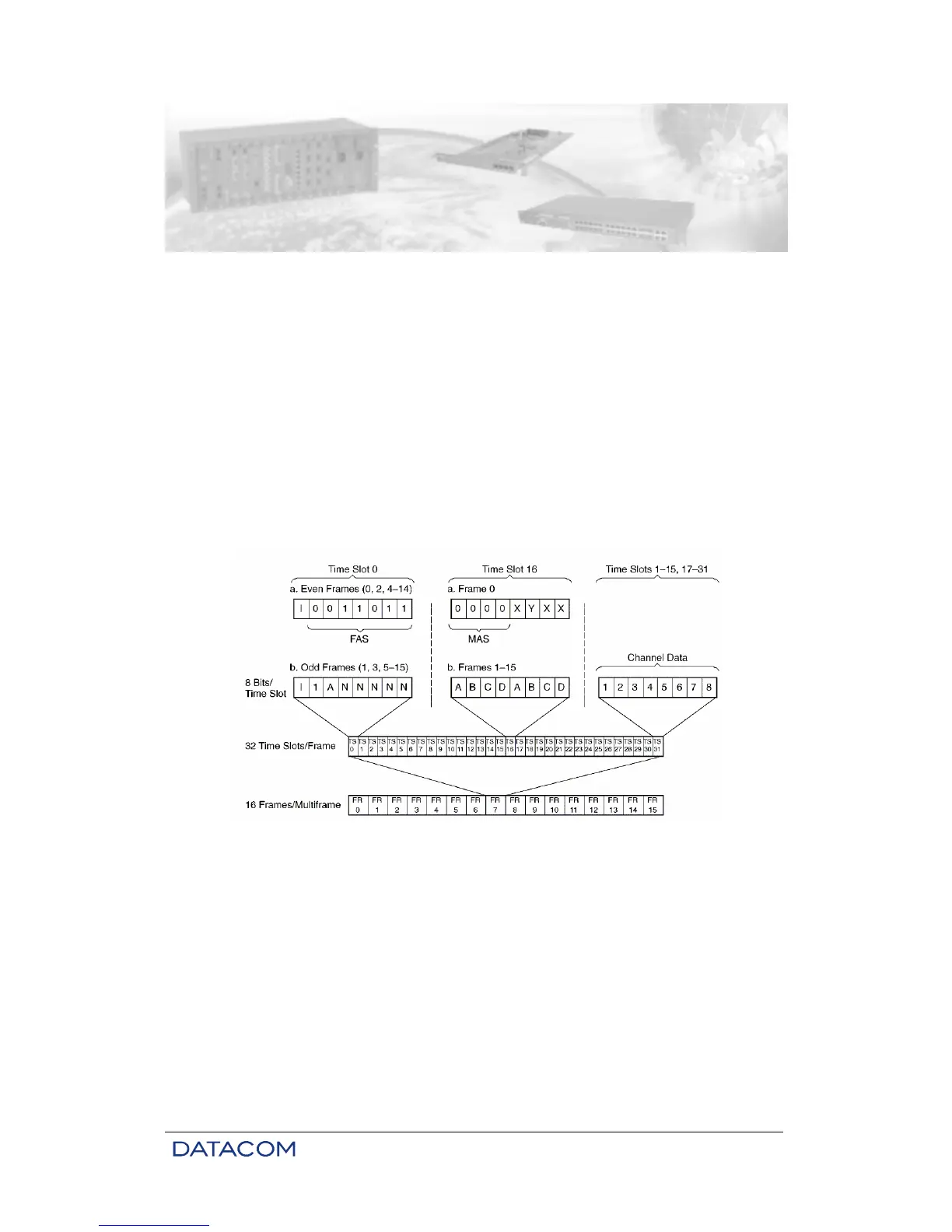
The interface operates at a nominal speed of 2048kbit/s, with bits grouped in frames. Each frame is made
of 256bits, arranged in 32 timeslots, each of 8 bits. The frame repetition rate is 8000 times per second,
resulting in a 64kbit/s rate for each timeslot. The number of user available timeslots for the user is at most
31, because timeslot 0 is used for frame synchronism. In telephony applications employing channel
associated signaling (CAS), only 30 timeslots are available, for timeslot 16 transports CAS signaling.
The frame structure can be seen on Figure 33.
Figure 33. ITU-T G.707 E1 frame structure recommendation
Frames are organized in larger structures, called multiframe. Every E1 signal is organized in two frames
multiframes. The first frame carries the FAS signal and the second frame contains no frame alignment
signal (NFAS).


 To Next Page