Salad and Vegetable Drier Service and Installation Manual
For customer service, call (800) 733-8829, (800) 733-8821, Fax (989) 773-3210, www.deleld.com
4
Salad and Vegetable Drier Service and Installation Manual
5
For customer service, call (800) 733-8829, (800) 733-8821, Fax (989) 773-3210, www.deleld.com
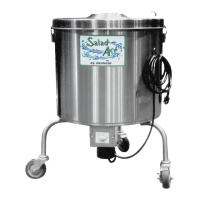
Interior surface of tank
1. Remove the remaining food debris with a sponge.
2. Wash the interior tank liner with warm, detergent-sanitizing
solution designed to clean stainless steel surfaces that are in
contact with food.
3. Rinse with clean water. Air dry before placing on lid.
Exterior surface of tank
1. Use a clean, damp cloth to wipe the wash solution from
surface. Allow to air dry.
2. Any commercial stainless steel polish can be used to shine
clean surfaces.
Inner liner and lids
1. Wash in warm, detergent-sanitizing solution designed for use
with plastic materials in contact with food.
2. Rinse in clean water. Allow to air dry. Never steam clean the
liner or lids.
Do not overload inner liner. Weight in excess of
20 lbs. will cause lid and motor failure.
Drain Maintenance
Each unit has a drain located inside the unit which removes the
water to an appropriate drain location or container. Drain size
is 1 1/4”. Be sure all drain lines are free of obstructions, food
product can cause water to back up.
CLEANING INSTRUCTIONS
Stainless Steel Care and Cleaning
To prevent discoloration of rust on stainless steel several
important steps need to be taken. First, we need to understand
the properties of stainless steel. Stainless steel contains 70-
80% iron which will rust. It also contains 12-30% Chromium
which forms an invisible passive lm over the steel’s surface
which acts as a shield against corrosion. As long as the
protective layer is intact, the metal is still stainless. If the lm
is broken or contaminated, outside elements can begin to
breakdown the steel and begin to form rust of discoloration.
Proper cleaning of stainless steel requires soft cloths or plastic
souring pads.
NEVER USE STEEL PADS, WIRE BRUSHES OR
SCRAPERS!
Cleaning solutions need to be alkaline based or non-chloride
cleaners. Any cleaner containing chlorides will damage
the protective lm of the stainless steel. Chlorides are also
commonly found in hard water, salts, and household and
industrial cleaners. If cleaners containing chlorides are
used be sure to rinse repeatedly and dry thoroughly upon
completion.
Routine cleaning of stainless steel can be done with soap and
water. Extreme stains or grease should be cleaned with a
non-abrasive cleaner and plastic scrub pad. It is always good
to rub with the grain of the steel. There are also stainless steel
cleaners available which can restore and preserve the nish of
the steels protective layer.
Early signs of stainless steel breakdown can consist of small
pits and cracks. If this has begun, clean thoroughly and start
to apply stainless steel cleaners in attempt to restore the
passivity of the steel.
Never use an acid based cleaning solution!
Many food products have an acidic content
which can deteriorate the nish. Be sure to
clean the stainless steel surfaces of ALL food
products. Common items include, tomatoes,
peppers and other vegetables.


 To Next Page
 Loading...
