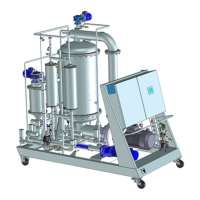
The provided document is an instruction manual for DELLA TOFFOLA NF 5 filters, along with supplementary manuals for CSF Inox centrifugal pumps, which are components of the filter system.
DELLA TOFFOLA NF 5 Filters
Function Description:
The DELLA TOFFOLA NF 5 series kieselguhr filters are designed for the filtration of wine and liquid foods. They operate by introducing the liquid to be filtered into an airtight tank containing a filtration group. This group consists of horizontal filtering discs with a central hole, threaded and spaced on a hollow shaft. The liquid passes under pressure through a pre-formed kieselguhr cake on the upper part of the discs, then through the disc's interior, and finally into the central collector shaft before exiting the tank. At the end of filtration, the residual cake (kieselguhr and impurities) is removed from the filter unit by centrifugation, with pasty residues evacuated through a hole at the bottom of the tank. The filter is equipped with a kieselguhr dosing tank, a dosing pump, and a centrifugal feed pump.
Important Technical Specifications:
- Operating Temperature: -10°C (14°F) to +50°C (122°F).
- Power Supply: Three-phase, 400 V 3~50 Hz (customer-requested 50 or 60 Hz versions available).
- Maximum Permissible Pressure (PS): 8 bar.
- Running Pressure: 7.2 bar.
- Filter Vessel Volume: 325 liters.
- Dosing Vessel Volume: 240 liters.
- Centrifugal Pump Power: 7.5 kW.
- Dosing Pump Power: 0.37 kW.
- Discharge Motor Power: 3 kW.
- Total Installed Power: 10.87 kW.
- Washing Water Consumption: 300/400 liters.
- Sound Pressure Level: 84.7 dB(A) (average at 1 meter distance).
- Weight: 700 kg.
- Kieselguhr Dosage: Maximum 6 kg per square meter of filtering surface (including precoat and filtration doses). Higher dosages can damage filter discs.
- Safety Valves: Equipped with two safety valves (28 and 53) to protect against overpressure.
- Emergency Stop: "Punch" type emergency stop button.
Usage Features:
- Installation: Requires careful attention to minimum distances for operation and maintenance (e.g., 900 mm for operation, 1600 mm for maintenance, 2000 mm minimum height for normal operation, 2700 mm for maintenance). Proper lifting and handling with slings and cranes are crucial.
- Electrical Connection: Must be performed by a specialized technician, ensuring correct phase connections and earthing. Phase imbalance should not exceed 3% to avoid voiding the warranty.
- Hydraulic Connections: Pipes must be correctly sized, compatible with the liquid, able to withstand mechanical stresses, and fixed independently of the filter to prevent vibrations. Flexible joints are recommended.
- Pre-commissioning: Ensure correct liquid flow direction (from filter tank to outlet valves) to prevent damage. Manual priming may be required if the supply tank is below the pump axis.
- Water Filling: All valves and drain hole 23 must be closed before filling. Specific valves are opened sequentially for delivery, venting, doser filling, and supply.
- Precoat Formation: Kieselguhr is slowly poured into the dispenser while the agitator (37) is running. Dust extraction is recommended during manual loading.
- Filtration: Kieselguhr dosing pump flow is adjusted using knob 1, observing inlet pressure gauge 5. Filtration is complete when the liquid is exhausted, the allowed kieselguhr quantity is used, or the filter reaches saturation pressure.
- Final Filtration (Optional): Can be performed with compressed gases (CO2 or N2) on certified machines, observing strict pressure limits.
- Brief Interruptions/Stoppage: Specific valve operations (opening 12, closing 14 and 10, stopping dosing pump 38, closing 16, opening 18) are required to maintain cake stability and clean the dosing pump. For prolonged shutdowns with cold product, all internal circuit valves must be left open to prevent component breakage due to thermal expansion.
Maintenance Features:
- General Safety: All maintenance operations must be performed by specialized and authorized personnel, strictly following safety instructions.
- PPE: Mandatory use of protective gloves, safety shoes, glasses/protective mask, and protective clothing.
- Washing with Detergents: Recommended monthly, or before prolonged inactivity, to prevent filter disc clogging. Use hot water and caustic soda-based detergents (max 2% of filter volume). Three washing cycles with increasing temperatures (40°C, 55°C, 70°C) are recommended, followed by rinsing.
- Safety Valve Cleaning: During washing cycles, lever 66 must be pulled 5-6 times to clean safety valve 53 effectively.
- Lubrication: Check and grease the drain valve 23 seat and the lower bearings of the disc-holder shaft (using grease nipples A) during continuous use.
- Mechanical Seal: Centrifugal pump mechanical seals may wear and leak. Contact assistance for replacement.
- Exceptional Maintenance: Operations not covered in the manual (e.g., seal, bearing, gasket replacement) are considered "exceptional" and must be performed by authorized technicians.
- Demolition and Disposal: Must be carried out by trained personnel, separating materials (plastics, metals, electrical parts, rubber, synthetic parts) and disposing of special waste (oil/acid contaminated components) through authorized centers.
CSF Inox Centrifugal Pumps (CS-series)
Function Description:
The CSF Inox CS-series pumps are single-stage centrifugal pumps with axial suction, open centrifugal impeller, and trapezoidal volute. They are fitted with threaded connections (DIN 11851 standards) and mechanical seals chosen based on the pumped liquid. These pumps are assembled with three-phase electric motors (IP 55 protection). They are intended for professional use, specifically for pumping non-polluted, non-chemically aggressive liquids at temperatures between -30°C and +140°C, where contact with the external environment must be avoided.
Important Technical Specifications:
- Motor Protection: IP 55 (unless otherwise specified).
- Temperature Range: -30°C to +140°C.
- Mechanical Seals: Various types available:
- "T" (Standard): Internal mechanical seal within the product, housed behind the impeller for lubrication.
- "W" (Circulation): Internal mechanical seal with forced circulation of pumped liquid.
- "WH" (Protected, Balanced, Bidirectional): Internal mechanical seal with forced circulation, easily washable, ideal for sanitary/pharmaceutical uses.
- "Y" (External): Mechanical seal where the structure is not in contact with the pumped product, avoiding sanitary issues or corrosion.
- "V" (Internal): External liquid circulation chamber creates a protective barrier for aggressive/toxic liquids, aiding lining cleaning and limiting wear.
- "Q" (Compact Double Mechanical Seal): Double mechanical seal with circulation of washing/cooling liquid. The washing liquid must be clean.
- Elastomers: NBR-EPDM-FLUORINE (VITON)-PTFE.
- Materials: Body, pump cover, impeller in Aisi 316L stainless steel; shaft, impeller nut in stainless steel; motor in aluminum, cast iron, copper. No asbestos or lead components.
- NPSH: Net Positive Suction Head values must be observed to prevent cavitation. A safety margin of 0.5 m is added to the required NPSH value.
- Suction Pipe Speed: Maximum 3 m/s, recommended 1-2 m/s.
Usage Features:
- Installation: Pumps are aligned on the base at the factory. After installation, foundation fixing, and pipe connection, alignment must be re-checked using a gauge and thickness gauge (half-joint distance 2-3 mm, coaxiality check). Calibrated shims are used to correct alignment errors.
- Piping: Suction and delivery pipes must be connected without forcing, independently supported, and with internal diameters matching pump fittings. Use large radius curves and reduction cones to avoid air bubbles. Suction pipe should be short and slightly uphill (for suction from tank) or downhill (for loaded operation).
- Electrical Connection: Must comply with EN 60204-1, including power disconnection, overcurrent/overload protection, and prevention of spontaneous restarts. Voltage and frequency must match motor specifications. Cables must be adequately sized and earthed.
- Preliminary Operations: Check free rotation, clamp tightness (use wrench, not hand), and direction of rotation (clockwise from motor side). Fill pump and suction pipe with liquid.
- Starting: Close delivery valve, open suction valve, start pump, and re-check rotation. Adjust delivery valve to stabilize flow and head.
- Operation Checks: Monitor pump head, flow, and vibrations. Avoid dry running and prolonged operation with the discharge valve closed. Check mechanical seal for leaks.
- Foreseeable Uses Not Allowed: Do not use with higher suction pressure than expected (0.5 times prevalence developed by pump) or in environments requiring a higher degree of protection than the motor's rating.
Maintenance Features:
- Long Stop: Completely empty and wash the pump to prevent deposits.
- Pump Cleaning: Regular washing cycles are usually sufficient. Wash before prolonged stoppages, especially with crystallizing liquids. Compatibility of washing liquid with process liquid and pump materials must be checked.
- Bearing Maintenance (CS series up to motor size 132): Shielded bearings, no lubrication needed.
- Bearing Maintenance (CS-CSX series with support size 160-200): Bearings dimensioned for 20,000 hours. Lubricate at regular intervals (grease nipples available). Dismantle, clean, and fill crowns to half volume with new grease (SKF LGHP2 recommended). First oil change after 300-500 hours, then every 8000 hours (or annually if operating temperature up to 60°C).
- Bearing Maintenance (CSK series): Splash lubricated in an oil bath. Fill with oil through the filler cap (74) and rotate the constant level oil bulb (76). Check oil level periodically.
- Cleaning Procedure: Use a stainless steel pump cleaning procedure involving alternating rinsing with clean water and treatment with acid/alkaline detergents. Avoid chlorine/hypochlorite. Recommended procedure: pre-wash (cold water), rinse (hot water), alkaline cleaning (70-95°C), intermediate rinse (hot/cold water), acid cleaning (nitric acid, citric acid, or phosphoric acid), final rinse (cold water).
- Sterilization: Can be done with superheated water or steam. Pump must not be running during steam sterilization. Respect maximum sterilization temperatures for elastomers.
- Impeller Nut Cleaning: Clean before mounting (ultrasonic or detergent), rinse, and sterilize (steam at 143°C or chemical agents; avoid chlorine-based solutions).
- Disposal: Disconnect current and hydraulic connections. Dismantle components for separate disposal according to country regulations.

 Need help?
 General

 To Next Page