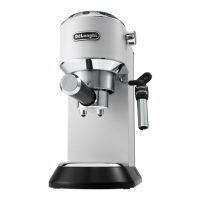
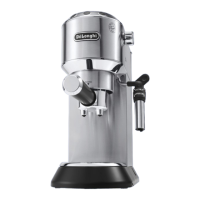
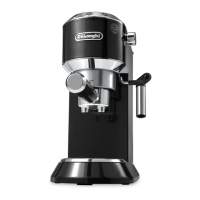
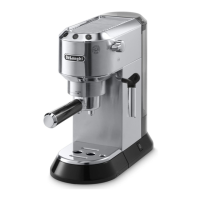
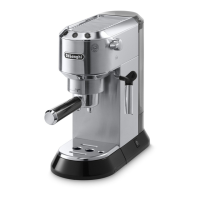
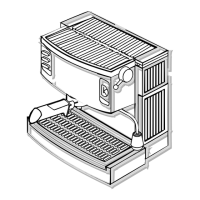
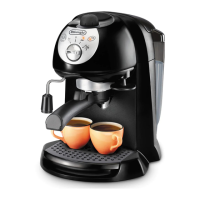
This document outlines the operation, maintenance, and safety guidelines for an espresso coffee machine, designed for household use.
Function Description
The appliance is primarily designed to prepare espresso coffee, hot water, and to heat and froth milk using steam for beverages like cappuccino. It features a water tank, a boiler, and a steam dial for controlling hot water and steam delivery. The control panel includes buttons for single and double espresso shots, and a steam button, each with corresponding ON lights. A descale light indicates when maintenance is required.
The machine allows for the preparation of espresso using either pre-ground coffee or ESE (Easy Serving Espresso) pods. For pre-ground coffee, users select between a 1-cup or 2-cup filter and fill it with the appropriate amount of coffee, pressing it lightly with the provided tamper. For ESE pods, a specific pod filter is used, and the pod is centered within it. After preparing the coffee, the filter holder is attached to the appliance, and the desired coffee button is pressed to initiate delivery. The machine automatically stops delivery, but users can manually interrupt it or extend the coffee quantity within a short timeframe after delivery.
For cappuccino preparation, espresso is made first, followed by frothing milk using the cappuccino maker. The cappuccino maker has a selection ring to switch between "CAPPUCCINO" and "HOT MILK" positions. Milk is frothed by immersing the cappuccino maker in a container of cold milk and turning the steam dial to deliver steam. The machine produces creamy, frothy milk, which is then added to the espresso. Hot milk without froth can also be prepared by positioning the selection ring to "HOT MILK."
The appliance also provides hot water on demand, delivered through the cappuccino maker spout by turning the steam dial.
Usage Features
The device offers several customizable settings accessible through a programming menu. Users can adjust the coffee temperature (low, medium, high) to suit their preference. The water hardness can also be set (soft, medium, hard), which influences the frequency of descaling reminders. An auto-off (stand-by) function is available to save energy, with options for 9 minutes, 30 minutes, or 3 hours of inactivity before the appliance turns off. All settings can be reset to default values if needed.
Before first use, it is recommended to wash all accessories and the water tank with warm water and to rinse the internal circuit by delivering several cycles of hot water through the boiler outlet and steam spout. The water tank can be filled either by extracting it or by pouring water directly into it from a jug. It is crucial never to operate the appliance without water in the tank.
For optimal espresso, users are advised to warm their cups before use and to heat the filter holder by running hot water through it without coffee. The cup warmer on top of the appliance also helps keep cups warm during operation. When using pre-ground coffee, proper pressing of the coffee is essential for a good espresso; too firm a press results in slow, strong coffee, while too light a press yields quick, weak coffee.
The appliance is equipped with a polarized alternating current line plug for safety, ensuring it fits into the power outlet only one way.
Maintenance Features
Regular cleaning is vital for the appliance's longevity and performance. The drip tray, coffee filters, boiler outlet, water tank, and cappuccino maker must be cleaned regularly. The drip tray has a red level indicator that signals when it needs to be emptied to prevent overflow. Coffee filters should be rinsed under running water, and any blocked holes should be cleared with a pin. The boiler outlet should be rinsed after every 200 coffees by delivering water without ground coffee. The water tank should be cleaned monthly with a damp cloth and mild washing-up liquid, especially when replacing the water softener filter (if present).
The cappuccino maker requires cleaning after every use for hygiene reasons. This involves delivering a little steam to clear any milk residue, allowing it to cool, then detaching and disassembling it to clean the components, including the rubber steam connection nozzle and ensuring the two holes are not blocked.
Descaling is a critical maintenance task, indicated by an orange flashing light. The process involves filling the water tank with a descaler solution (De'Longhi descaler is recommended), positioning a recipient under the hot water spout and boiler outlet, and initiating the descale program. The machine performs a series of rinses and pauses until the tank is empty. After descaling, a thorough rinse cycle with clean water is necessary to eliminate any remaining descaler solution. If the descaling cycle is interrupted or the water tank is not filled to the MAX level, the appliance may request further rinses. Damage caused by limescale is not covered under warranty unless regular descaling is performed.
When cleaning the exterior of the appliance, it should be turned off, unplugged, and allowed to cool. Only a soft damp cloth should be used; solvents, abrasive detergents, alcohol, or metal objects are not recommended as they can damage surfaces. If the appliance is not used for more than a week, a rinse cycle is recommended before using it again. The coffee maker should never be immersed in water as it is an electrical appliance.



 To Next Page
 General