w$\
piWi
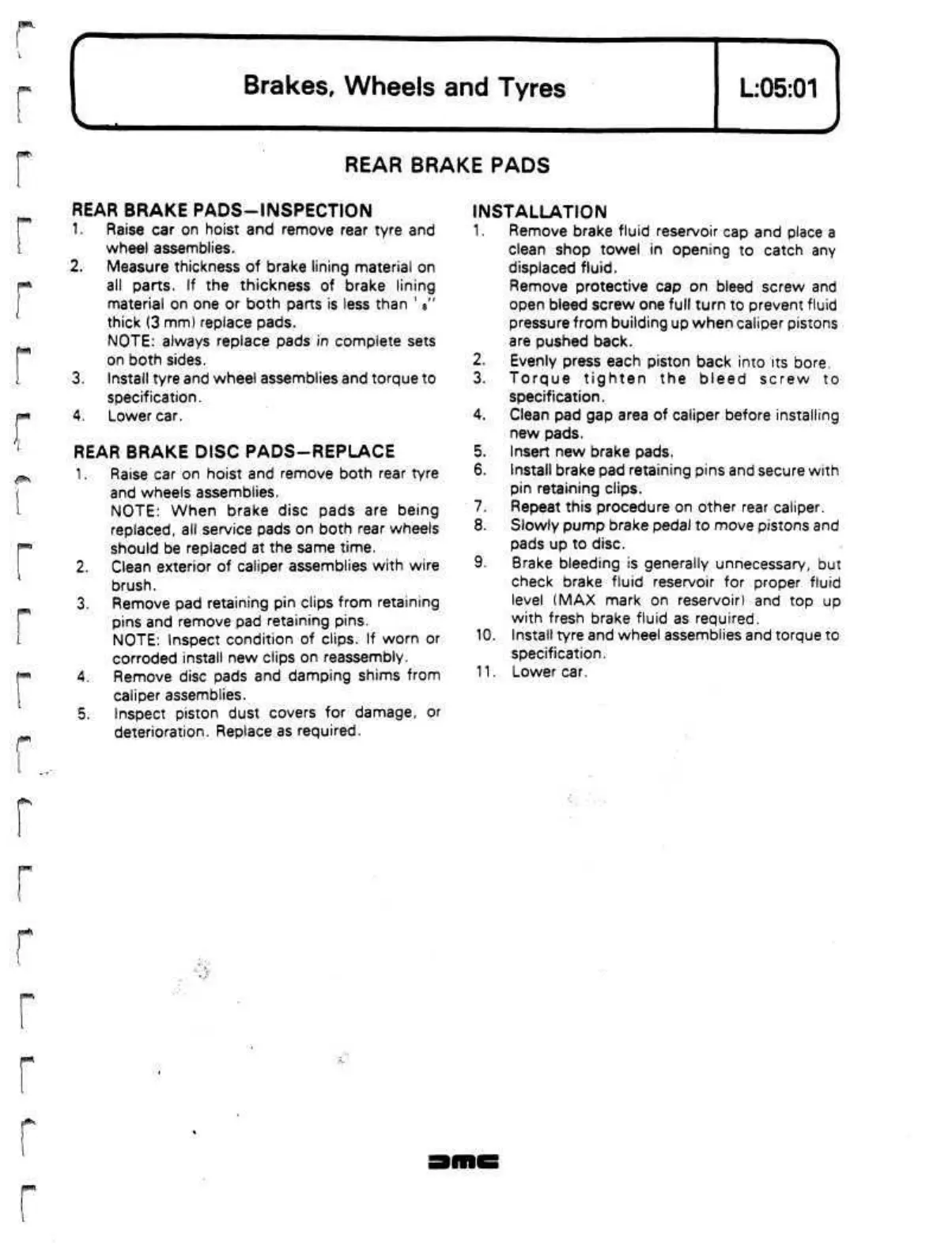
REAR BRAKE PADS
|"T^T3
REAR BRAKE PADS-INSPECTION
1.
Raise car on hoist and remove rear tyre and
wheel assemblies.
2.
Measure thickness of brake lining material on
all parts. If the thickness of brake lining
material on one or both parts is less than '
B
"
thick (3 mm) replace pads.
NOTE:
always replace pads in complete sets
on both sides.
3. Install tyre and wheel assemblies and torque to
specification.
4.
Lower car.
REAR BRAKE DISC PADS-REPLACE
1.
Raise car on hoist and remove both rear tyre
and wheels assemblies.
NOTE:
When brake disc pads are being
replaced,
all service pads on both rear wheels
should be replaced at the same time.
2.
Clean exterior of caliper assemblies with wire
brush.
3. Remove pad retaining pin clips from retaining
pins and remove pad retaining pins.
NOTE:
Inspect condition of clips. If worn or
corroded install new clips on reassembly.
4.
Remove disc pads and damping shims from
caliper assemblies.
5. Inspect piston dust covers for damage, or
deterioration. Replace as required.
INSTALLATION
1
2.
3.
4.
5.
6.
7.
8.
10.
11.
Remove brake fluid reservoir cap and place a
clean shop towel in opening to catch any
displaced
fluid.
Remove protective cap on bleed screw and
open bleed screw one full turn to prevent fluid
pressure from building up when caliper pistons
are pushed back.
Evenly press each piston back into its bore.
Torque tighten the bleed screw to
specification.
Clean pad gap area of caliper before installing
new pads.
Insert new brake pads.
Install brake pad retaining pins and secure with
pin retaining clips.
Repeat this procedure on other rear caliper.
Slowly pump brake pedal to move pistons and
pads up to disc.
Brake bleeding is generally unnecessary, but
check brake fluid reservoir for proper fluid
level (MAX mark on reservoir) and top up
with fresh brake fluid as required.
Install tyre and wheel assemblies and torque to
specification.
Lower car.
•f^N,


 To Next Page
 Loading...