Appendix D Use of Application Instructions|DOP-EXIO Series
D-2
Revision March, 2008, Doc. Name: 2007PDD23000014
Mnemonic Operands Function
CJ
S
Conditional Jump
Bit Devices Word Devices
X Y M S K H KnX KnY KnM KnS T C D E F
y Note:
1. Operand S can designate P.
2. P can be modified by index register E, F.
16-bit instruction (3 Steps)
CJ
Continuous
execution
32-bit instruction
- - - -
y Flags: None
Operands:
S
: The destination pointer of conditional jump
Explanations:
1. When the user does not wish a particular part of DOP-EXIO program in order to shorten the scan
time and execute dual outputs, CJ instruction or CJP instruction can be adopted.
2. When the program designated by pointer P is prior to CJ instruction, WDT timeout will occur and
DOP-EXIO will stop running. Please use it carefully.
3. CJ instruction can designate the same pointer P repeatedly. However, CJ and CALL cannot
designate the same pointer P; otherwise an error will occur.
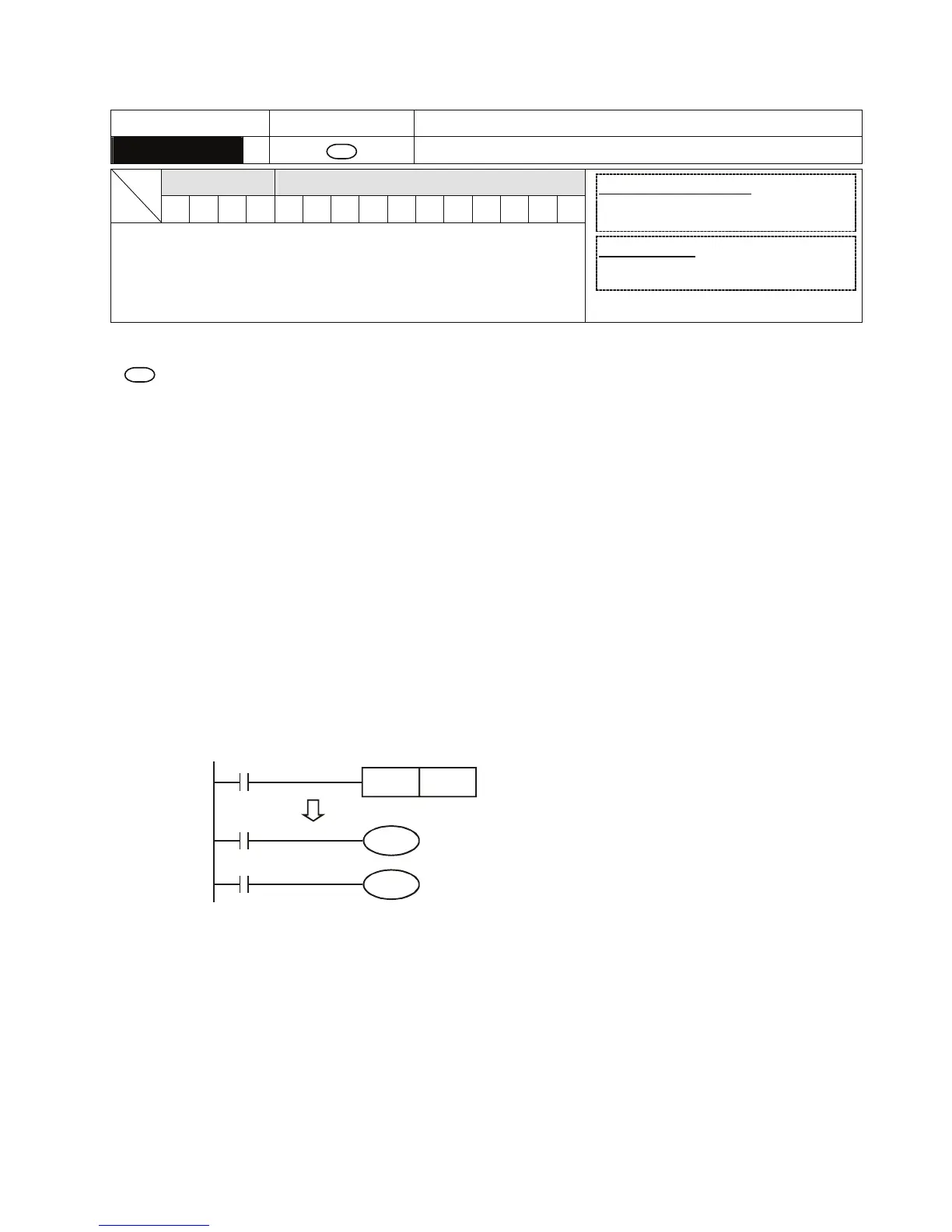
Program Example 1:
1. When X0 = On, the program automatically jumps from address 0 to N (the designated label P1)
and keeps its execution. The addresses between 0 and N will not be executed.
2. When X0 = Off, as an ordinary program, the program keeps on executing from address 0. CJ
instruction will not be executed at this time.
X0
X1
X2
CJ P1
Y1
Y2
0
NP1
P***
()
CJ instruction
Program Example 2:
1. CJ instruction can be used in the following 5 conditions between MC and MCR instructions.
a)
Without MC ~ MCR.
b) From without MC to within MC. Valid in the loop P1 as shown in the figure below.
c) In the same level N, inside of MC~MCR.
d) From within MC to without MCR.
e) Jumping from this MC ~ MCR to another MC ~ MCR


 To Next Page
 Loading...