TEMPERATURE MEASUREMENT
Immersion temperature measurements are performed by introducing the probe to a minimum
depth of 60 mm into the liquid in which you want to take the measurement; the sensor is housed in
the end of the probe.
To take measurements in air, the probe must be pointed in a transverse direction to the air flow.
In both cases, to ensure correct measurement avoid contact of the probe with the walls of the con-
tainer holding the liquid or of the duct in which the air to be measured is passing.
When taking penetration measurements the tip of the probe must be inserted at a depth of at least
60 mm; the sensor is housed in the end of the probe. When taking measurements on frozen blocks
it is convenient to use a mechanical tool to make a cavity in which to insert the pointed probe.
To perform a contact measurement correctly the surface must be flat and smooth and the probe
must be perpendicular to the measuring plain.
To obtain a correct measurement, the application of a little heat-conductive paste or a drop
of oil (water or solvents must absolutely not be used) helps to improve the response time.
Light intensity measurements
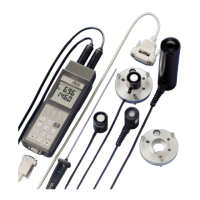
Different photometric or radiometric measurements may be made using the LP 9021 series of pro-
bes. Each type of probe has a distinct field of application, according to type and spectrum, the
instrument recognises each model and allows representation of the measurement only in the units
contemplated for the connected probe.
For the order codes of the different probes, see the special paragraph.
100
ENGLISH
TYPE OF MEASUREMENT UNITS ALLOWED CONVERSION FACTORS
Illuminance (spectral correction
according to CIE) (PHOT)
Radiance (RAD,UVA,UVB,UVC)
(in the respective spectral fields)
Active radiation in the field of
photosynthesis µmol/m
2
s
Luminance (Cd)
Lux
Fcd (foot-candle)
W/m
2
µW/cm
2
µmol/m
2
s
Cd/m
2
1 lux= 0.0929 fcd
1 fcd= 10.764 lux
1 W/m
2
= 100 µW/cm
2
1 µW/cm
2
= 0.01 W/m
2


 To Next Page
 Loading...