
 To Next Page
S
shawjoshuaAug 4, 2025
What causes water leaking at the pump of Delta DTH2450-1?
- CCassie JacksonAug 4, 2025
If water is leaking at the pump of your Delta Pressure Washer, check for loose connections and tighten them.

What causes water leaking at the pump of Delta DTH2450-1?
If water is leaking at the pump of your Delta Pressure Washer, check for loose connections and tighten them.
Why Delta DTH2450-1 engine will not start?
If your Delta Pressure Washer engine won't start, it could be due to several reasons: * There's no fuel. Add fuel. * The choke lever is in the “No Choke” position. Move it to the “Choke” position. * The spark plug wire isn't attached. Attach it. * The engine ON/OFF switch is in the OFF position. Place it in the ON position. * The choke lever is in the “Choke” position on a hot engine. Move it to the “No Choke” position. * The fuel valve is closed. Move the fuel valve lever to the “Open” position.
What to do if Delta Pressure Washer will not draw chemicals?
If your Delta Pressure Washer isn't drawing chemicals, here are a few things to check: * Ensure the spray wand is set to low pressure. * The chemical filter may be clogged. Clean it. * Make sure the end of the chemical hose is fully submerged in the cleaning solution. * The chemical might be too thick. Try diluting it. * The pressure hose could be too long. Use a longer water supply hose instead.
What causes water leaking at gun/spray wand connection of Delta DTH2450-1 Pressure Washer?
If you notice water leaking at the gun/spray wand connection of your Delta Pressure Washer, it could be due to: * A worn or broken o-ring. Check and replace it if necessary. * A loose hose connection. Tighten the connection.
Why does my Delta DTH2450-1 Pressure Washer pump pulsate?
If your Delta Pressure Washer pump pulsates, the following issues require attention from an Authorized Warranty Service Center (AWSC): * Piston packings worn. * Worn or broken o-rings. * Pump head or tubes damaged from freezing. Also, check if the nozzle is obstructed.
What to do if Delta DTH2450-1 Pressure Washer has no or low pressure after normal use?
If your Delta Pressure Washer has no or low pressure after a period of normal use, the following issues require attention from an Authorized Warranty Service Center (AWSC): * Worn seal or packing. * Worn or obstructed valves. * Worn unloader piston. * Worn E-Z start valve.
Explains DANGER, CAUTION, WARNING symbols for hazard identification.
Covers product regulations and spark arrester requirements, especially for California.
Emphasizes the importance of reading and retaining the manual for future reference.
Details potential fire hazards and prevention methods related to fuel and operation.
Discusses dangers of exhaust fumes and cleaning fluids to respiratory health.
Warns about high-pressure fluid injection injuries and necessary immediate medical attention.
Details risks associated with chemical usage and preventative measures.
Warns about electrical shock hazards and how to avoid them.
Alerts users to burn risks from hot engine parts and exhaust components.
Addresses general unsafe practices and their consequences, including kickback.
Focuses on projectile hazards from spray and necessary safety gear.
Itemizes all parts included in the packaging for assembly.
Step-by-step guide for assembling the pressure washer components.
Guidance on adding engine oil before initial use as per manual.
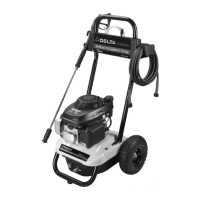
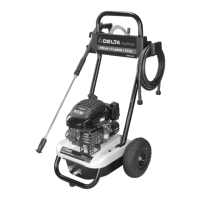
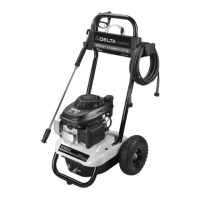
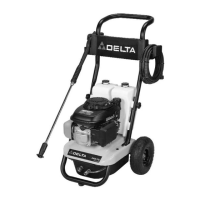
Identifies and describes key components of the pressure washer unit.
Explains the function of essential engine controls and parts.
Defines key terms like PSI, GPM, and CU for understanding specifications.
Details methods for lowering pressure by adjusting distance or nozzle spray.
Crucial safety warnings for high-pressure spray, fueling, and ventilation.
Cautions on bypass mode duration and hose contact with hot surfaces.
Explains selecting high/low pressure and adjusting spray patterns.
Step-by-step guide for applying cleaning solutions and rinsing the system.
Warns about potential surface damage from high-pressure spray and advises pre-checks.
Covers fueling, oil check, water connection, and engine start.
Details procedures for rinsing, engine shutdown, and pressure relief.
Safety warnings before performing any maintenance or repair.
Detailed steps for cleaning a clogged nozzle using provided tools.
Instructions on how to check and clean the water inlet filter screen.
Instructions for draining hoses, gun, and storing components safely.
Recommends using pump protector or RV antifreeze for storage and includes the procedure.
Lists common causes and corrections for when the engine will not start.
Addresses issues causing no or low pressure during initial operation.
Explains how hose length can affect pressure and provides a recommendation.
Identifies issues preventing the unit from drawing cleaning solutions.
Diagnoses causes for pressure loss after a period of normal operation.
Addresses leaks at gun/wand connection, pump, and causes of pump pulsation.
Outlines the warranty coverage periods for different product components.
Details what the original purchaser must do to process a warranty claim.
Lists common exclusions from the product warranty coverage.
This document is an instruction manual for a DELTA 5.5 Horsepower Pressure Washer, model DTH2450, with 5880 Cleaning Units. The manual provides essential information for safe operation, assembly, maintenance, and troubleshooting of the device.
The DELTA DTH2450 is a gasoline-powered pressure washer designed for cleaning various surfaces. It utilizes a high-pressure pump driven by a 5.5 horsepower engine to deliver pressurized water, which can be mixed with cleaning agents for enhanced effectiveness. The unit is designed for consumer applications, specifically personal residential household usage.
The manual emphasizes critical safety warnings, including risks of explosion/fire (due to spilled fuel, hot engine components, flammable liquids), breathing hazards (exhaust fumes, cleaning fluid vapors), fluid injection (high-pressure spray can penetrate flesh), chemical burns (from improper cleaning agents), electrical shock (spraying electrical outlets), hot surfaces (engine exhaust), and injury/property damage during transport/storage (fuel/oil leaks). Users are instructed to wear ANSI approved Z87 safety glasses and protective clothing, avoid pointing the wand at people or animals, secure the trigger lock, and never permanently secure the trigger in the open position.
 General
| Brand | Delta |
|---|---|
| Model | DTH2450-1 |
| Category | Pressure Washer |
| Language | English |