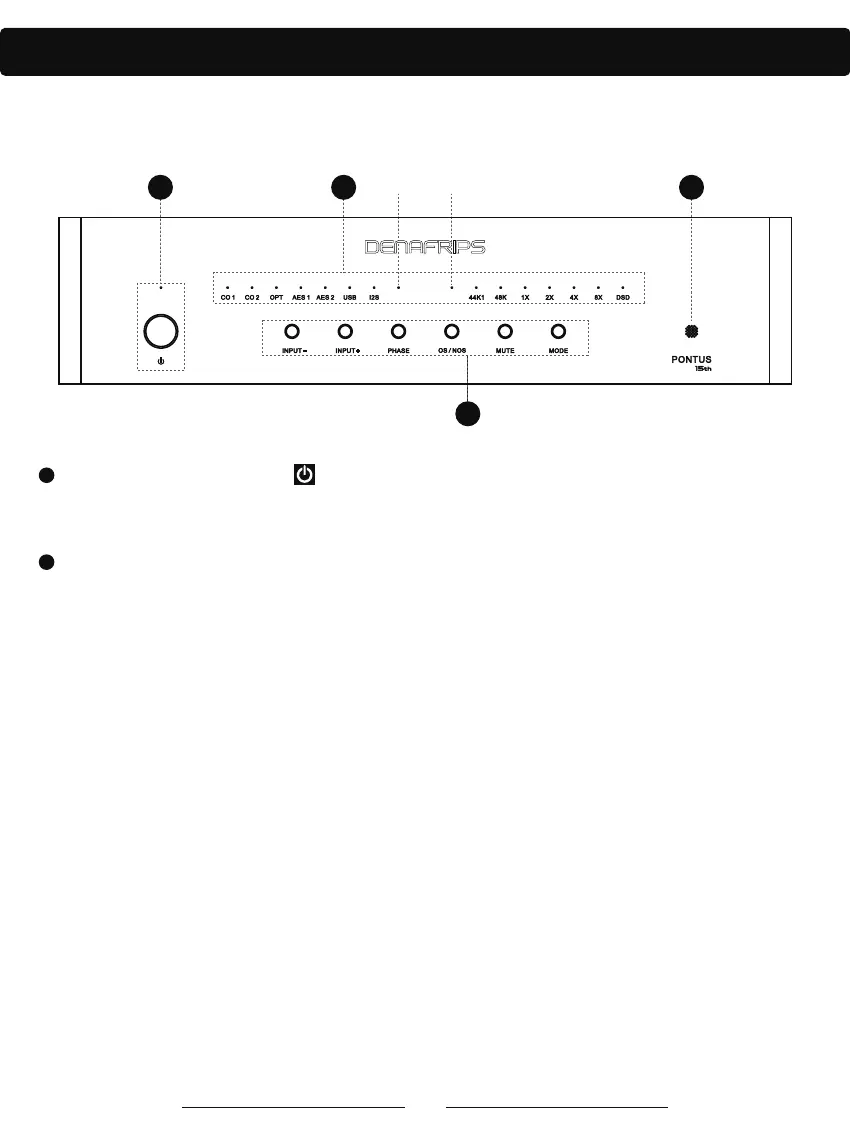
Panel Function Introduction
Indicators on the DAC panel (showing input source, sample rate, audio format and mode).
a. Signal Source Indicators: CO1, CO2, OPT, AES1, AES2, USB, I2S. These indicators represent the
different input ports. When an input source is selected, the corresponding indicator will light up.
b. Sample Rate Indicators: 44.1K (44.1 KHz sample rate); 48K (48 KHz sample rate). These indicators
indicate the current sampling rate of the input audio signal.
c. Multiplier Indicators: 1X (original sample rate); 2X (2 times the sample rate); 4X (4 times the sample
rate); 8X (8 times the sample rate). These indicators indicate the multiplier of the current input audio
signal (e.g., a multiple of the original sampling rate, as described in the chart below).
d. Audio Format Indicator: DSD when the light is on, PCM when the light is off.
e. PHASE indicator: in-phase when the light is on, inverted when the light is off.
f. OS/NOS indicator: NOS when the light is on, OS when the light is off.
In OS mode, the DAC processes the incoming digital audio signal to increase the sampling rate.
Oversampling adds more data points through an interpolation algorithm thatthereby improving the audio
quality.
In NOS mode, the DAC processes the input digital audio signal directly without any sample rate
processing. This mode preserves the audio signal's originalcharacteristics of the audio signal.
Figure 1
6
4
2
⑤ ⑥
1 3
Standby button and indicator
When the power of the unit is turned on, the standby indicator light is on, indicating that it is in standby
mode. Press the standby button, the standby indicator goes out and the DAC starts to work.
1
2



 To Next Page