EasyManua.ls Logo

Denon DCD-3300 - Page 6

Denon DCD-3300
45 pages
Print Icon
To Next Page IconTo Next Page
To Previous Page IconTo Previous Page
Loading...
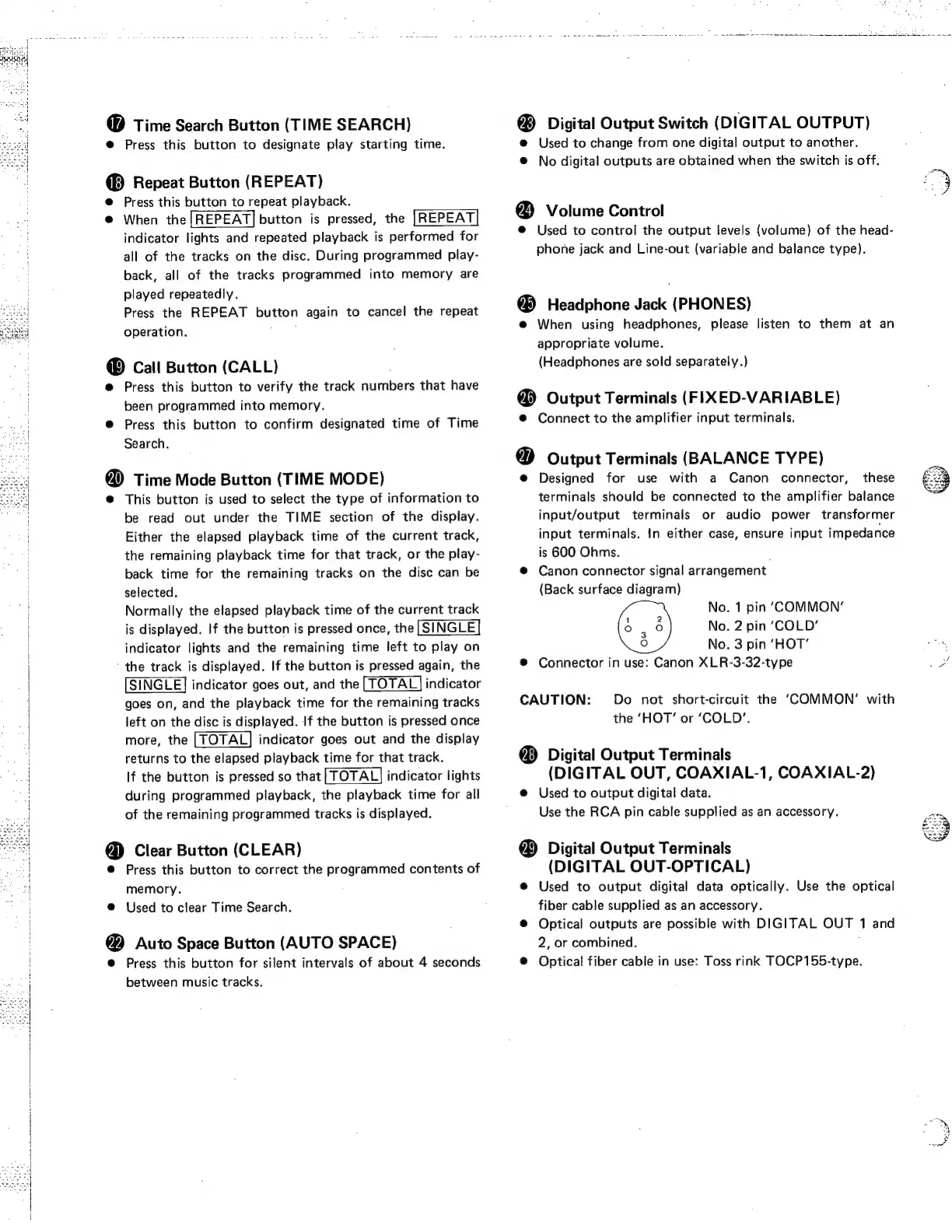
Time
Search
Button
(TIME
SEARCH)
@
Press
this
button
to
designate
play
starting
time.
®
Repeat
Button
(REPEAT)
Press
this
button
to
repeat
playback.
@
When
the
[REPEAT]
button
is
pressed,
the
indicator
lights
and
repeated
playback
is
performed
for
all
of
the
tracks
on
the
disc.
During
programmed
play-
back,
all
of
the
tracks
programmed
into
memory
are
played
repeatedly.
Press
the
REPEAT
button
again
to
cancel
the
repeat
operation.
Call
Button
(CALL)
e@
Press
this
button
to
verify
the
track
numbers
that
have
been
programmed
into
memory.
®@
Press
this
button
to
confirm
designated
time
of
Time
Search.
@
Time
Mode
Button
(TIME
MODE)
®@
This
button
is
used
to
select
the
type
of
information
to
be
read
out
under
the
TIME
section
of
the
display.
Either
the
elapsed
playback
time
of
the
current
track,
the
remaining
playback
time
for
that
track,
or
the
play-
back
time
for
the
remaining
tracks
on
the
disc
can
be
selected.
Normally
the
elapsed
playback
time
of
the
current
track
is
displayed.
If
the
button
is
pressed
once,
the
[SINGLE]
indicator
lights
and
the
remaining
time
left
to
play
on
the
track
is
displayed.
If
the
button
is
pressed
again,
the
indicator
goes
out,
and
the
indicator
goes
on,
and
the
playback
time
for
the
remaining
tracks
left
on
the
disc
is
displayed.
If
the
button
is
pressed
once
more,
the
indicator
goes
out
and
the
display
returns
to
the
elapsed
playback
time
for
that
track.
If
the
button
is
pressed
so
that
indicator
lights
during
programmed
playback,
the
playback
time
for
all
of
the
remaining
programmed
tracks
is
displayed.
@
Clear
Button
(CLEAR)
@
Press
this
button
to
correct
the
programmed
contents
of
memory.
@
Used
to
clear
Time
Search.
@
Auto
Space
Button
(AUTO
SPACE)
@
Press
this
button
for
silent
intervals
of
about
4
seconds
between
music
tracks.
Digital
Output
Switch
(DIGITAL
OUTPUT)
e@
Used
to
change
from
one
digital
output
to
another.
@
No
digital
outputs
are
obtained
when
the
switch
is
off.
24)
Volume
Control
@
Used
to
control
the
output
levels
(volume)
of
the
head-
phone
jack
and
Line-out
(variable
and
balance
type).
@
Headphone
Jack
(PHONES)
@
When
using
headphones,
please
listen
to
them
at
an
appropriate
volume.
(Headphones
are
sold
separately.)
@
Output
Terminals
(FIXED-VARIABLE)
@
Connect
to
the
amplifier
input
terminals.
@
Output
Terminals
(BALANCE
TYPE)
@
Designed
for
use
with
a
Canon
connector,
these
terminals
should
be
connected
to
the
amplifier
balance
input/output
terminals
or
audio
power
transformer
input
terminals.
In
either
case,
ensure
input
impedance
is
600
Ohms.
@
Canon
connector
signal
arrangement
(Back
surface
diagram)
No.
1
pin
‘COMMON’
No.
2
pin
‘COLD’
No.
3
pin
‘HOT’
@
Connector
in
use:
Canon
XLR-3-32-type
CAUTION:
Do
not
short-circuit
the
‘COMMON’
with
the
‘HOT’
or
‘COLD’.
@
Digital
Output
Terminals
(DIGITAL
OUT,
COAXIAL-1,
COAXIAL-2)
e@
Used
to
output
digital
data.
Use
the
RCA
pin
cable
supplied
as
an
accessory.
@
Digital
Output
Terminals
(DIGITAL
OUT-OPTICAL)
@
Used
to
output
digital
data
optically.
Use
the
optical
fiber
cable
supplied
as
an
accessory.
@
Optical
outputs
are
possible
with
DIGITAL
OUT
1
and
2,
or
combined.
®
Optical
fiber
cable
in
use:
Toss
rink
TOCP155-type.
SS
oy
3
3
wt

Related product manuals