8
1.5 Intended Use
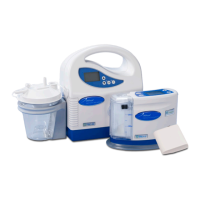
These negative pressure wound therapy systems are indicated for patients that would
benefit from a suction device particularly as the device may promote wound healing by
removal of wound exudate, debris, and infectious material or for the aspiration and removal
of surgical fluids, tissue (including bone), gases, bodily fluids or infectious material from the
patient's airway or respiratory support system. These devices may be used during surgery
or at the patient's bedside and are indicated for home use.
1.5.1 Indications
• Chronic Wounds
• Acute Wounds
• Subacute Wounds
• Traumatic Wounds
• Dehisced Wounds
• Partial Thickness Burns
• Ulcers (Such as diabetic or pressure)
• Flaps
• Grafts
1.5.2 Contraindications
The PRO-II
®
and PRO-III
®
devices are contraindicated for the following applications:
• Necrotic tissue with eschar present
• Unexplored or non-enteric fistulas
• Untreated osteomyelitis
• Wounds containing malignant tissue
• Exposed arteries, nerves (including vagus nerve), blood vessels, veins, or internal
organs
• Exposed anastomotic site
1.5.3 Precautions
Precautions must be taken in the following circumstances:
• Patients who receive anticoagulants and have active bleeding
• Patients with complicated wound hemostasis
• Use of the device in direct proximity to blood vessels, organs, muscles and fascias
• Irradiated vessels and tissues
• Bone fragments
• Non-compliant/non-responsive patients
• Untreated malnutrition
• Paralysis associated with the affected area or spinal cord injuries
• Circumferential dressing application
• Take extreme caution when the negative pressure wound therapy system is applied
in close proximity to friable vessels or potentially infected blood vessels.
• Infected wounds should be closely monitored and may require more frequent
dressing changes than non-infected wounds. View exudates for any sign of
infection, worsening infection, or other complications.
• Before using the negative pressure wound therapy system, all exposed or superficial
organs and vessels, nerves, tendon and ligaments in or around wound must be
completely covered and protected to avoid direct contact with wound dressing.
• When using the negative pressure wound therapy system, clinicians or caregivers
must keep written record of the type and number of wound dressing pieces that are
placed in the wound.
• Use of the negative pressure wound therapy system in a hyperbaric oxygen
chamber is prohibited. Negative pressure wound therapy is not suitable in this
environment and may be a fire hazard.
9
• In the event defibrillation is required, disconnect the DeRoyal negative pressure
wound therapy device from the wound dressing prior to defibrillation. Remove the
wound dressing if it will interfere with defibrillation.
• The patient height and weight should be considered before prescribing the DeRoyal
negative pressure wound therapy system. Infants, children, some small adults and
elderly patients should be closely monitored for excessive fluid loss and dehydration.
In addition, patients with heavily exudating wounds or large wounds should be
monitored carefully because they may have a risk of excessive fluid loss and
dehydration.
• NPWT must not be placed in proximity to the vagus nerve to minimize the risk of
bradycardia.
• If the patient appears to have autonomic dysreflexia (sudden changes in blood
pressure or heart rate stimulated by the sympathetic nervous system), immediately
stop negative pressure wound therapy to minimize the sensory stimulation and
immediately call for medical assistance.
• Protect fragile periwound skin with adhesive sealing films, hydrocolloid, or
transparent film dressing. Do not cover intact skin with gauze/foam dressing to
avoid risk of maceration or injury to tissue.
• Check the wound dressings at shift change or every 8 hours. Look for a wrinkled
appearance at the surface of the dressing, which indicates an occlusive
environment, thus maintaining proper suction.
1.5.4 Restrictions on use
• In medical rooms where potential equalization is necessary (e.g. heart surgery)
• In hazardous areas
• When patients use the device outside or outdoors, advise to not drop, overly shake
or permit the device to get wet or be exposed to other elements.
1.6 Basic Safety Instructions
CAUTION!
Health risks due to the handling of infectious liquids or pathogenic
germs.
Infectious and pathogenic germs in the wound exudate cause health risks.
• Perform wound treatment carefully.
• Follow the hygiene, cleaning and decontamination instructions.
WARNING!
Risk of damage due to improper power supply.
Improper operation causes overvoltage in the device, which may be
transmitted to the operator.
• Ensure prior to startup that the power supply is designed to operate at
supply voltages of 100-240 V alternating current.
• Ensure prior to startup in UL listed markets such as the USA and
Canada that the main supply is designed to operate at a supply
voltage of 120 V alternating current.
• Only operate the device with the provided power supply unit.
• Never connect the power supply unit to defective power sockets.
ATTENTION!
Risk of damage due to electromagnetic phenomena.
Medical electrical equipment is subject to special precautionary measures
regarding electromagnetic compatibility and must be installed and operated in
accordance with the EMC information provided in the accompanying
documentation (see chapter 7.3).


 To Next Page