Need help?
Do you have a question about the DeWalt DW294 and is the answer not in the manual?
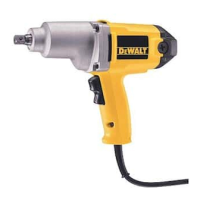
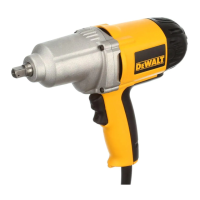
This document describes the DEWALT DW292, DW293 1/2" Impact Wrench and DW294 3/4" Impact Wrench, providing essential information for safe operation, usage, and maintenance.
The DEWALT impact wrenches are power tools designed for driving and removing fasteners. They operate by generating impact torque, which is particularly effective for tasks requiring high fastening or loosening force. The tools are equipped with a rocker switch that allows for both forward (right-hand thread) and reverse motor direction, enabling users to efficiently fasten and loosen various types of bolts and nuts. The reverse function is also useful for "rocking" fasteners to break them loose. These impact wrenches are designed to deliver consistent output torque, making them suitable for a range of applications where reliable fastening is critical.
To ensure safe and effective use, several features and guidelines are provided. The tools are designed for use with impact accessories, and users are cautioned against using non-impact accessories, which could break and create a hazardous condition. Before installing an accessory, users should inspect it for cracks. Accessories are installed by aligning the hole in the accessory with the detent pin on the anvil and pressing until the pin engages. Removal involves depressing the detent pin with a small, pointed object and pulling the accessory off.
The fastening torque generated by the impact wrench can vary due to several factors, including voltage, accessory size, bolt size, bolt condition (presence of rust or debris), material type, surface finish, and fastening time. Users are advised to always check the torque with a torque wrench to ensure proper fastening and prevent overstressing, stripping, or damaging fasteners. Low voltage, for instance, caused by a generator or a long extension cord, can reduce fastening torque. Similarly, using an incorrect accessory size will also lead to a reduction in torque. Larger bolt diameters generally require higher fastening torque, and the fastening torque will also vary based on the bolt's length, grade, and torque coefficient. Ensuring that all threads are free of rust and debris is crucial for achieving proper fastening torque. The type and surface finish of the material being worked on will also affect the fastening torque. Longer fastening times result in increased fastening torque, but using a longer time than recommended can overstress, strip, or damage fasteners.
For outdoor operation, an extension cord suitable for outdoor use is recommended to reduce the risk of electric shock. If operating in a damp location is unavoidable, a ground fault circuit interrupter (GFCI) protected supply should be used to further reduce the risk of electric shock. Personal safety is emphasized, requiring users to stay alert, use common sense, and avoid operating the tool while tired or under the influence of drugs, alcohol, or medication. Personal protective equipment, including eye protection, dust masks, non-skid safety shoes, hard hats, and hearing protection, should always be worn. Preventing unintentional starting is critical, so users must ensure the switch is in the off position before connecting to a power source or battery pack, picking up, or carrying the tool. Any adjusting keys or wrenches must be removed before turning the power tool on to prevent personal injury. Users should maintain proper footing and balance and dress properly, avoiding loose clothing, jewelry, or long hair that could get caught in moving parts. If dust extraction and collection facilities are provided, they should be connected and properly used to reduce dust-related hazards.
Regular maintenance is essential to ensure the safety and reliability of the impact wrench. Users are warned to turn off the unit and disconnect it from the power source before performing any adjustments, changing accessories, or making repairs to prevent accidental start-ups and potential injury.
Cleaning the tool involves blowing dirt and dust out of all air vents with clean, dry air at least once a week. This practice minimizes the risk of eye injury, and users should always wear ANSI Z87.1 approved eye protection when performing this task. It is crucial to avoid using solvents or other harsh chemicals for cleaning the non-metallic parts of the tool, as these chemicals can weaken the plastic materials. Instead, a cloth dampened with only water and mild soap should be used. Users must never allow any liquid to get inside the tool or immerse any part of it in liquid.
For repairs, maintenance, and adjustments, including brush inspection and replacement, it is recommended that these tasks be performed by a DEWALT factory service center, a DEWALT authorized service center, or other qualified service personnel. Only identical replacement parts should be used to ensure the safety and integrity of the power tool. The manual also emphasizes that accessories not offered by DEWALT have not been tested with the product, and their use could be hazardous. Therefore, only DEWALT recommended accessories should be used to reduce the risk of injury. Users are also reminded to use only impact accessories and to inspect them for cracks before use to prevent hazardous conditions.
 General
| Brand | DeWalt |
|---|---|
| Model | DW294 |
| Category | Impact Driver |
| Language | English |


 To Next Page