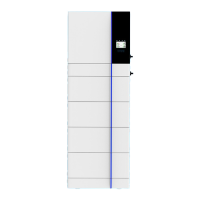
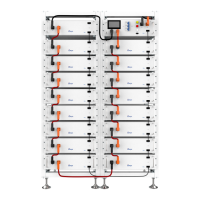
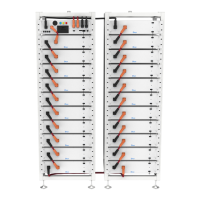
The Deye GE-F60 is a high-voltage lithium iron phosphate (LiFePO4) battery energy storage system (BESS) designed for reliable power supply in various equipment and systems, particularly suitable for high-rate cyclic charging and discharging scenarios.
Function Description:
The GE-F60 integrates a local management system that monitors and manages voltage, current, temperature, humidity, and smoke. Its Battery Management System (BMS) balances battery capacity to extend the system's cycle life. The system supports black start functionality and off-grid operation. It also features a built-in aerosol fire suppression device and a combustible gas detection exhaust system for safety. Multiple GE-F60 units can be expanded in parallel to meet greater capacity and longer power support duration requirements. The internal air conditioner uses steam compression refrigeration to cool the battery modules within the energy storage cabinet.
Important Technical Specifications:
System Specification (GE-F60):
- Nominal Output Power/UPS Power: 50000 W
- AC Output Frequency and Voltage: 50/60Hz; 3L/N/PE 220/380, 230/400Vac
- Grid Type: Three phase
- Energy Configuration: 61.4 kWh
- Dimension (W x D x H): 735x1050x2250 mm (no inverter contained)
- Weight (Approx.): 1015 kg (battery) + 80 kg (inverter)
- AC Output Rated Current: 75.8 A
- Battery Operating Voltage: 500~700 V
- Max. charging/discharging efficiency: 91%
- Battery Chemistry: LiFePO4
- IP Rating of Enclosure: IP55
- Installation Style: Floor-Mounted
- Warranty: 10 years
- Battery Module Certification: CE, IEC62619, IEC62040, UN38.3
Battery Module Specifications:
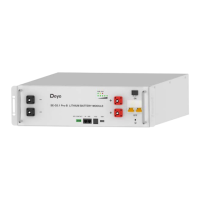
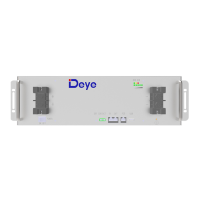
- Battery Type: LiFePO4 (LFP)
- Nominal Voltage: 51.2 Vdc
- Rated Capacity: 100 Ah
- Rated Energy: 5.12 kWh
- Nominal Charge/Discharge Current: 100 A
- Peak Discharge Current: 125 A
- Charge Temperature: 0~55°C
- Discharge Temperature: -20℃~55°C
- Storage Temperature: 0℃~35°C
- Ingress Protection: IP20
- Dimension (W/D/H): 440570133 mm
- Weight Approximate: 44 kg
- Operating Temperature Range: Charge: 0~55°C / Discharge: -20℃~55℃
- Cycle Life: ≥6000 (@25℃±2℃, 0.5C/0.5C, 70%EOL)
Air-conditioner Specifications (DY-CNA20-BP):
- Rated Voltage: 220V~
- Rated Frequency: 50Hz
- Rated Cooling Capacity: 2100W
- Rated Heating Capacity: 1650W
- Rated Cooling Power Input: 900W
- Rated Heating Power Input: 1650W
- Rated Cooling Current: 4.15A
- Max. Power: 1800W
- Max. Current: 8.3A
- Max Operating Pressure: 2.7Mpa
- Max. Suction Pressure: 1.6Mpa
- Max. Discharge Pressure: 2.7Mpa
- Air Flow Volume: 630m³/h
- Electric Shock Prevention: I
- Water-proof Class: IP55
- Dimension (W×H×D): 478×798×304mm
- Net Weight: 47kg
Usage Features:
- External Design: The cabinet features an indicator light (green for run, red for alarm), an air inlet for outdoor air to the air conditioner, an emergency stop switch to halt the BESS if the air conditioner malfunctions, a water outlet for external incoming water and condensed water, a flammable gas outlet, a door switch for access, and a cable outlet for parallel operation or inverter connection.
- Internal Design: Key internal components include the air conditioner for cooling, an aerosol fire suppression device (emits aerosol if fire is detected), a travel switch to check if the door is closed, a smoke detector (alarms upon smoke detection), and a heat detector (alarms upon excessive temperature). Other internal components include a fan for combustible gas emission, a combustible gas sensor (detects gases and notifies fire suppression), a serial relay (control system), terminal lines for cables, a switching mode power supply, and a temperature and humidity sensor.
- Power Distribution Unit (PDU): The PDU includes connections for battery negative (B-) and positive (B+), an air switch to manually control connection between the battery rack and external devices, ALRM and HV light indicators for fault and high-voltage hazards, PCS negative (PCS-) and positive (PCS+) connections, a USB port for BMS upgrade and storage expansion, OUT COM and IN COM for PDU communication, PCS COM for charging/discharging equipment communication, a START switch for 12VDC power, and COMM1/COMM2 for cabinet and battery module communication.
- Installation: Requires a dry, well-ventilated site away from toxic/harmful gases, flammable/explosive/corrosive materials, and residential areas. The foundation must be compact, raised (≥300mm recommended), and include drainage. Cable routing and conduit pre-embedding are essential. The inverter rack is installed on the BESS using M12 screws, and the inverter is then fixed to the rack.
- Transportation: Can be transported by cars, trains, and ships. Requires locked doors, appropriate crane/lifting tools with sufficient load capacity, and adherence to safety regulations (e.g., no standing in lifting area, stopping work in bad weather). Forklifts with a rated load >1500kg and sufficient foot length are recommended for flat site movement. The battery is classified as UN3480, Class 9 Miscellaneous Dangerous Goods, and requires specific labels for transport.
- Activation (Power-on/off): Power-on involves turning on miniature circuit breakers for MASTER, CONTROL, HVAC, opening the air switch, pressing the PDU start button, and opening the BMS miniature circuit breaker. Power-off is the reverse sequence.
- Upgrade: Supports USB upgrade (FAT32 format, files in "upgrade" folder) and PC upgrade via the Deye LVESS Monitor software or the PowerView website.
Maintenance Features:
- General: Installation should be completed within 3 months of arrival. Batteries should not be disassembled. Over-discharged batteries must be charged within 48 hours. Long-term storage requires charging every six months to maintain SOC above 50%. Disconnect all load and charging devices before cleaning/maintenance.
- Every Half Year to Once a Year:
- Safety function: Check shutdown key and emergency stop button, simulate shutdown.
- Internal components: Check radiator temperature, dust accumulation, clean heat-dissipation modules. Ensure air inlet ventilation.
- Device maintenance: Inspect metal components for corrosion, check running parameters (voltage, insulation).
- Once a Year:
- Outside BESS: Check for flammable objects on top, damage/flaking paint/oxidation on enclosure, flexible cabinet door lock, proper sealing strip.
- Inside BESS: Check for foreign objects, dust, dirt, condensed water.
- Air inlet and outlet: Check radiator temperature, dust accumulation, clean heat-dissipation modules.
- Wiring and cable layout: Power off devices before checking. Inspect cable layout for short circuits, proper sealing of cable entries, water seepage, loose power cables (tighten to specified torque), damaged power/control cables, and insulation tape integrity.
- Ground connection: Verify correct ground connection (resistance ≤0.4Ω) and equipotential connection.
- Screws: Check for loose or rusted internal screws.
- Ambient temperature and humidity: Verify records are within operating range.
- Function inspection: Check DC contactor operation, output voltage, and battery cluster current/voltage/temperature records.
- Switchgear and battery module: Check for combustibles on top, secure fixing to baseplate, corrosion, box damage/paint peeling/oxidation, foreign bodies/dust/dirt/condensate.
- Wire and cable layout: Ensure all internal devices are powered off before inspection. Check for short circuits and compliance with specifications, proper sealing of wire inlets/outlets, water seepage, loose power/copper busbars (tighten to torque), damaged power/communication cables, and insulation tape integrity.
- Corrosion: Check for internal oxidation or rust.
- Every Two Years:
- System status and cleaning: Check for damage/deformation of container/internal devices, abnormal noise, excessive internal temperature, humidity/dust levels (clean if necessary), and blocked air inlets/outlets.
- Warning marks: Check legibility and cleanliness (replace if necessary).
- Wire and cable: Verify correct connection of switch gear, battery modules, and other connections.
- Corrosion: Check battery cluster for internal oxidation or rust.
- Surge protection device and fuse: Check proper fastening.
- Corrosion: Check for oxidation or rust inside the container.
Battery Recycling:
- Cathode materials: Aluminum foil is dissolved in NaOH, precipitated as Al(OH)3. Filter residue (lithium iron phosphate) is dissolved in sulfuric acid and hydrogen peroxide, separated from carbon black, then iron is precipitated as Fe(OH)3, and remaining lithium is precipitated as Li2CO3.
- Anode materials: Recovery process is simpler, yielding copper with >99% purity for refining.
- Diaphragm: Mainly harmless, no recycling value.
- Recycling equipment: Automatic dismantling machine, pulverizers, wet gold pool, etc.

 Need help?
 General

 To Next Page