The provided document, "RE-909 Additional Advisories," serves as a comprehensive guide for builders and users of the Din Sync RE-909 Rhythm Composer, offering a collection of tips, fixes, and guidance to enhance the building, debugging, and fine-tuning process. It is presented as a community-driven resource, acknowledging contributions from individuals who helped refine the information. The document emphasizes a collaborative approach to perfecting the RE-909 projects.
The RE-909 Rhythm Composer is a device designed for creating rhythmic patterns, likely mimicking the functionality of a classic drum machine. Its core function involves generating various drum sounds and arranging them into sequences. The advisories suggest that the device is built from component kits, implying a DIY aspect to its construction.
Usage Features:
The document primarily focuses on the construction and troubleshooting of the RE-909, rather than its direct operational features. However, several sections indirectly highlight aspects related to its performance and sound quality:
- Sound Quality and Balance: The "SD Gain Scaling" section addresses an issue where the snare drum's "snappy" sound was excessively loud compared to the original TR-909. This indicates that users are expected to achieve a balanced and authentic sound profile. The fix involves replacing a specific resistor (R294 with a 1% 200K) to adjust the noise gain, suggesting that the sound characteristics of individual drum voices are critical to the user experience. The goal is to make the snare sound "much better balanced," implying that users will be adjusting and listening for specific sonic qualities.
- MIDI Connectivity: The "MIDI IN PCB Error" section details a problem with the MIDI input, where pin 2 being connected to ground could lead to "buzz/hum" when MIDI is connected. This highlights the importance of reliable MIDI connectivity for integrating the RE-909 into a larger musical setup. The fixes provided (modifying the pad or cutting a trace) ensure clean signal transmission, which is crucial for seamless synchronization and control with other MIDI devices.
- Rhythm Programming and Control: While not explicitly detailed, the "Switchboard PCB Error" and "Cabling Guide" sections imply a complex control interface. The switchboard likely houses various controls for tempo, start/stop, foot switch input, and MIDI I/O, all essential for programming and performing with the rhythm composer. The detailed cabling instructions ensure that these controls function correctly and are routed to the appropriate voicing and DIN jack boards.
- Performance Stability: The "Switchboard Electrolytic Cap Guidance" advises laying capacitors flat to prevent "random crashes, stuck sequences, etc." This directly relates to the device's operational stability during use. Users expect the RE-909 to perform reliably without unexpected interruptions, especially during live performance or recording.
Maintenance Features:
The document is essentially a maintenance and troubleshooting guide, offering several specific fixes and best practices for builders:
- Grounding and Crosstalk Fix: This is a significant maintenance feature, addressing "noise and crosstalk issues." The fix involves adding a thick grounding wire between C151 and the common analog ground track near R236. This is a physical modification aimed at improving signal integrity and eliminating unwanted digital noise and cymbal crosstalk into the hi-hat channel. This type of fix requires careful soldering and an understanding of circuit board layouts.
- Snare Drum Envelope Fix: The "SD Envelope Fix" points to a "minor error in the snare drum" that requires a "single patch wire." This is a targeted repair to correct a specific sonic issue, indicating that users may need to perform small, precise wiring modifications to achieve the intended sound. The mention of "V1 PCB - Missing Trace Here" and "V2 PCB - Fixed Trace Here" suggests ongoing revisions to the PCB design to incorporate these fixes, making future builds easier.
- Switchboard Connector Correction: The "Switchboard PCB Error" section highlights incorrect pin numbers on the initial run of switchboard connectors. The solution involves carefully checking and verifying pin assignments against a provided diagram before soldering. This is a crucial step in preventing misconnections and ensuring all controls and signals are routed correctly. The "Cabling Guide" further supports this by providing detailed pin-to-pin connections for various boards, acting as a vital reference for assembly and troubleshooting.
- MIDI IN PCB Modification: To resolve the "buzz/hum" issue, two methods are suggested:
- Physical Modification: Using a dremel or file to enlarge the hole for pin 2 of the MIDI socket, or clipping/removing pin 2, to prevent it from connecting to ground.
- Trace Cutting and Jumpering: For already built boards, cutting a trace at two points and adding a jumper wire to connect ground to pin 17 of the connector.
These are precise, hands-on maintenance tasks that require attention to detail and potentially specialized tools.
- Battery Terminal Fix: The "Battery Terminals" section addresses missing through-hole plating in the battery terminal holes, which affects memory retention. The fix is described as simple, and users are directed to updated build documentation for details. This ensures that the device can reliably save settings and patterns, a critical function for any programmable rhythm composer.
- Transistor Matching: The "Matching Transistors" section emphasizes that specific transistors (e.g., Q6, Q12, Q28) "MUST MATCH" in their HFE readings. This is a quality control and maintenance step during the build process to ensure optimal circuit performance and consistent sound generation. It requires testing and selecting transistors with similar characteristics, which is a common practice in analog audio circuit construction.
- Electrolytic Capacitor Placement: The "Switchboard Electrolytic Cap Guidance" advises laying all electrolytic capacitors flat under the switchboard. This prevents the metal cap of a capacitor from intermittently shorting a switchboard connection, which could lead to "random crashes, stuck sequences, etc." This is a preventative maintenance measure during assembly to ensure long-term reliability and prevent frustrating operational issues.
In summary, the RE-909 Rhythm Composer is a buildable device that aims to replicate the functionality of a classic drum machine. Its usage involves programming and performing rhythmic patterns, with a strong emphasis on achieving authentic and balanced sound quality. Maintenance is a significant aspect, requiring builders to perform detailed physical modifications, wiring corrections, component matching, and careful assembly practices to ensure optimal performance, stability, and sound fidelity. The document serves as an invaluable resource for anyone undertaking the construction and upkeep of this intricate rhythm composer.

 Need help?
 General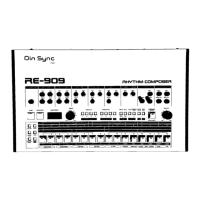

 To Next Page