EasyManua.ls Logo

Direct Air PHRVR100 ES - User Manual

Direct Air PHRVR100 ES
44 pages
Print Icon
To Next Page IconTo Next Page
Loading...
Your ventilation system should be installed in conformance with the appropriate provincial requirements or, in
the absence of such requirements, with the current edition of the National Building Code, and / or ASHRAE’s
“Good Engineering Practices”.
IMPORTANT - PLEASE READ THIS MANUAL
BEFORE INSTALLING UNIT
CAUTION - Before installation, careful consideration must be given to how this system
will operate if connected to any other piece of mechanical equipment, i.e. a forced air furnace
or air handler, operating at a higher static pressure. After installation, the compatibility of the
two pieces of equipment must be confirmed by measuring the airflow of the Heat Recovery
Ventilator using the balancing procedure found in this manual.
It is always important to assess how the operation of any HRV may interact with vented com-
bustion equipment (i.e. Gas Furnaces, Oil Furnaces, Wood Stoves, etc.).
NEVER - install a ventilator in a situation where its normal operation, lack of operation or par-
tial failure may result in the backdrafting or improper functioning of vented combustion equipment!!!
CAUTION - For residential installation use only.
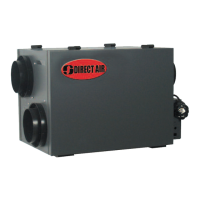
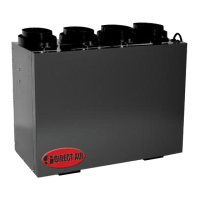
PHRVR100 ES, 104 ES
Heat Recovery Ventilator
Installation Manual

Questions and Answers

  • H
    Holly SimsAug 15, 2025
    How to improve poor air flow in my Direct Air Fan?
    • A
      Andrea ShieldsAug 15, 2025
      To improve poor air flow in your Direct Air Fan, you can try the following: * Clean exterior hoods or vents. * Remove and clean the filter. * Remove and clean the core. * Check and open indoor grilles. * Have an electrician check the supply voltage. * Check the duct installation. * Increase the speed of the HRV (i.e., change the unit control from REDUCED to NORMAL speed).
  • P
    prestonangelaAug 18, 2025
    Why is the air too humid when using my Direct Air PHRVR100 ES Fan?
    • J
      Jerry CruzAug 19, 2025
      Several factors can cause the air to be too humid when using your Direct Air Fan. It could be due to a dehumidistat control set too high, a sudden change in temperature, storing too much wood for heating inside, a dryer vent exhausting inside the home, poor air circulation near windows, an out-of-balance HRV, a closed well-sealed basement door, or a failed damper system stuck in recirculation mode. To address this, you can reduce the desired level of humidity and use continuous exchange mode. Wait until the outside temperature stabilizes, store wood outside, ensure the dryer vent exhausts outside, open curtains or blinds, have a contractor balance the HRV airflow, open the basement door or install a grill, and have a contractor verify the damper system.
  • K
    katie26Aug 21, 2025
    What to do if there is persistent condensation on the window when using Direct Air PHRVR100 ES?
    • C
      cathy09Aug 21, 2025
      If you notice persistent condensation on the window when using your Direct Air Fan, it might be due to improper adjustment of the dehumidistat control, an out-of-balance HRV, or poor air circulation near the windows. To resolve this, reduce the desired level of humidity and use continuous exchange mode. Additionally, have a contractor balance the HRV, and ensure you open curtains or blinds to improve air circulation.
  • D
    David RussellAug 25, 2025
    Why does the supply air feel cold from my Direct Air PHRVR100 ES?
    • M
      mark22Aug 26, 2025
      The supply air from your Direct Air Fan might feel cold due to the poor location of supply grilles, which can irritate occupants, or because the outdoor temperature is extremely cold. To address this, locate the grilles high on the walls or under the baseboards, install ceiling-mounted diffusers or grilles to avoid directly spilling the supply air on occupants, turn down the HRV supply speed, or use a small duct heater (1kW) to temper the supply air. If the supply air is ducted into the furnace return, the furnace fan may need to run continuously to distribute ventilation air comfortably.
  • C
    cynthia06Aug 28, 2025
    How to fix air that is too dry when using my Direct Air Fan?
    • K
      krausedavidAug 28, 2025
      If the air is too dry when using your Direct Air Fan, it may be because the dehumidistat control is set too low. To fix this, increase the desired level of humidity and change the ventilation mode from continuous mode to standby.
  • A
    Ashley MorganSep 1, 2025
    Why are my Direct Air PHRVR100 ES HRV and/or ducts frosting up?
    • C
      Connie MartinSep 1, 2025
      If your Direct Air Fan HRV and/or ducts are frosting up, it could be due to improperly balanced HRV airflows or a malfunction of the HRV defrost system. Consider having an HVAC contractor balance the HRV airflows. Note that minimal frost build-up is expected on the core before the unit initiates defrost cycle functions.
  • C
    catherine00Sep 4, 2025
    Why is there condensation or ice build up in the insulated duct to the outside of my Direct Air Fan?
    • J
      Joel NashSep 4, 2025
      Condensation or ice build-up in the insulated duct to the outside of your Direct Air Fan could be due to an incomplete vapor barrier around the insulated duct or a hole or tear in the outer duct covering. To resolve this, tape and seal all joints and tape any holes or tears made in the outer duct covering. Ensure that the vapor barrier is completely sealed.
  • R
    Robert LambertSep 7, 2025
    How to fix Direct Air PHRVR100 ES Fan HRV out of balance?
    • A
      Amy RobertsonSep 7, 2025
      Have contractor balance HRV airfolws.
  • H
    Heidi HowardSep 12, 2025
    What to do if the LED is flashing on my Direct Air PHRVR100 ES?
    • A
      alexis33Sep 12, 2025
      Make sure the unit is plugged in. The transformer may need replacing.

Direct Air PHRVR100 ES Specifications

General IconGeneral
BrandDirect Air
ModelPHRVR100 ES
CategoryFan
LanguageEnglish

Related product manuals