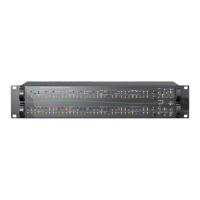
The D.O.TEC® ANDIAMO is a high-quality AD/DA converter designed for MADI signals, offering 32 channels of analog input and output within a 1U rack-mount form factor. It features redundant power supplies for enhanced reliability and delivers excellent audio quality. The device is suitable for various applications, including monitoring digital audio, recording line signals, converting a high number of channels between analog and digital, cascaded use of two ANDIAMOs for 64-channel MADI signal conversion, and MADI format conversion.
Function Description:
The ANDIAMO converts analog audio signals to digital MADI and vice versa. It supports both optical (SC multi-mode connectors) and coaxial (BNC connectors) MADI versions. The device can operate with 56 or 64 MADI channels and supports 48k/96k Frame MADI formats, including S/MUX 2. Clocking options include internal, word clock, and MADI input, with automatic sample rate detection when using external clock sources. The unit also features a USB 2.0 port for firmware updates and remote control via a Windows PC application.
Important Technical Specifications:
- Dimensions: 19" (483 mm) width, 1 HE (44.5 mm) height, 10" (254 mm) depth.
- Weight: Approximately 3 kg.
- Power Consumption: Typical 0.2 A (@84 V) up to max. 0.1 A (@264 V); max. 0.4 A (@84 V) up to max. 0.2 A (@264 V).
- Power Supply: 84 V - 264 V AC / 47 Hz - 63 Hz / Safety class 1, with two redundant power supplies.
- Fuses: 250 V - 2 A (slow-blow) – 2 fuses per power supply.
- Environmental Conditions: Operating temperature +5°C to +45°C; relative humidity: 10% - 80%, non-condensing.
- MADI Port (optical version): 1 x SC socket FDDI (input / output), ISO/IEC 9314-3, wave length 1310 nm, Multi-Mode 62.5/125 or 50/125.
- MADI Port (coaxial version): 2 x BNC socket (input / output), impedance: 75 Ω, 0.3 V up to 0.6 V (peak to peak).
- Sample Rate: 30 - 50 kHz @1 FS, 60 - 100 kHz @2 FS.
- MADI Format (I/O): 48k Frame, 96k Frame, 56 channel, 64 channel, S/MUX 2.
- Line Input: 4 x DSUB-25 (8 analog audio channels each - balanced).
- Line Output: 4 x DSUB-25 (8 analog audio channels each - balanced).
- A/D Section:
- SNR: -115.5 dB RMS (20 Hz - 20 kHz) / -118 dB(A).
- THD @ -1 dBFS: -113 dB.
- Frequency response: -0.15 dB (10 Hz) / -0.15 dB (20 kHz).
- Input impedance: 20 kΩ (balanced) / 10 kΩ (unbalanced).
- Input level (depending on model): Model A: +15 dBu (high) / +6 dBu (low); Model B: +18 dBu (high) / +9 dBu (low); Model C: +24 dBu (high) / +15 dBu (low).
- D/A Section:
- SNR: -113.5 dB RMS (20 Hz - 20 kHz) / -116.5 dB(A).
- THD @ -1 dBFS: -100 dB.
- Frequency response: -0.5 dB (10 Hz) / -0.15 dB (20 kHz).
- Output impedance: < 50 Ω.
- Output level (depending on model): Model A: +15 dBu (high) / +6 dBu (low) with 600 Ω minimum load resistance; Model B: +18 dBu (high) / +9 dBu (low) with 600 Ω minimum load resistance; Model C: +24 dBu (high) / +15 dBu (low) with 2.4 kΩ minimum load resistance.
- Outputs are not servo balanced.
- Latency: Approximately 1 ms (A/D - D/A), 3 samples (MADI I/O).
- Word Clock: 1 x BNC socket (75 Ω impedance) - input, 1 x BNC socket (75 Ω impedance) - output, supports WCLK signal or AES3id signal, termination 75 Ω switchable.
- USB: 1x USB socket (Type B) for firmware updates and remote control (Windows PC).
Usage Features:
- Front Panel Control: A simple menu system, navigated by two push buttons (SELECT and SET), allows adjustment of system settings. LEDs indicate the active parameter, selected option, and error states.
- Global Control: Power supply status is indicated by green LEDs on the front panel, with power switches located on the back.
- Clocking: Users can select from internal, word clock, or MADI input as the clock source. LEDs indicate termination status (for word clock), clock source selection, and lock/sync state.
- Sample Rates: The device supports 44.1 kHz and 48 kHz base sample rates, with 1 FS and 2 FS scaling factors. When using internal clock, the sample rate can be manually adjusted. For word clock or MADI input, the base rate is automatically detected.
- Level Settings: The sensitivity of AD and DA converters can be switched between two settings (high and low) for input and output independently, corresponding to 0 dBFS. Different models have different sensitivity levels.
- Level Meters: All 32 channels have individual signal metering with three LEDs: red for analog input overload (OVR), green for input signal level (SIG input), and green for output signal level (SIG output).
- Output Format: The MADI output signal format (56 ch or 64 ch) and frame format (48k Frame or 96k Frame) can be defined, allowing for format conversion.
- Bank Selection / Signal Routing: At 1 FS, bank selection defines which block of 32 channels (1-32 or 33-64) in the MADI stream is routed to the DA converters. The outgoing MADI channels in the same block are replaced by AD converter signals, while remaining MADI data passes unchanged. At 2 FS, only 32 channels are transmitted, so bank selection is not applicable.
- Matrix Mode: Two routing methods are available: 'Standard Bank Routing' (analog and digital I/Os as a whole) and 'Matrix Mode' (individual signal routing per channel). Matrix Mode requires the ANDIAMO Remote software for setup, but settings are stored in the device, allowing toggling between modes without the software.
- Delay Compensation: When two ANDIAMOs are cascaded for 64-channel MADI conversion, delay compensation ensures phase-locked operation of all audio channels by adjusting for a 3-sample delay between MADI input and output.
- Digital Snake Configuration: Four ANDIAMOs can be cascaded to build a 'digital snake' for 64-channel audio transmission between two locations, resulting in a total effective latency of six samples.
- Remote Control (ANDIAMO Remote Software): A Windows PC application allows remote control via USB, Serial over MADI (embedded RS-232 data), or MIDI over MADI (embedded MIDI data). All settings are stored in the device, and an offline mode allows preparing settings for later use.
- Presets: System and routing matrix settings can be stored to and reloaded from single files (.and files), allowing independent management of settings like routing and clock source.
- Offline Mode: The remote software can operate in an offline mode, allowing users to create or modify settings without an active connection to the device.
Maintenance Features:
- Troubleshooting Guide: The manual provides a table to help identify possible defects and their solutions, including power supply issues, optical port cleanliness, cable connections, signal stability, and clock sync problems.
- Cleaning: The device should be cleaned with a soft, dry cloth. Cleaning agents should be avoided, and the device must be disconnected from the power supply during cleaning.
- Firmware Updates: Firmware updates are performed via the USB port using the D.O.TEC® USB driver and Update Tool.
- No User-Serviceable Parts: The device contains no user-serviceable parts and should not be opened. In case of hardware defects, the device should be sent to a D.O.TEC® representative.

 Need help?
 General

 To Next Page