DLA ENGINE OPERATING-INSTRUCTION
MANUAL
04-21-21 Copyrighted Material
Owner’s Manual All Rights Reserved 03180-10000
Page - 24 DLA 32, 58, 64, 64-I2, 116, 116-I2 & 128cc, 180c, 232cc Rev. A.05.15
64-I2, 116-I2m, 128, 232 QUAD: CONNECTING THE TWO (2), CDIs TO THE PROPER
SENSOR
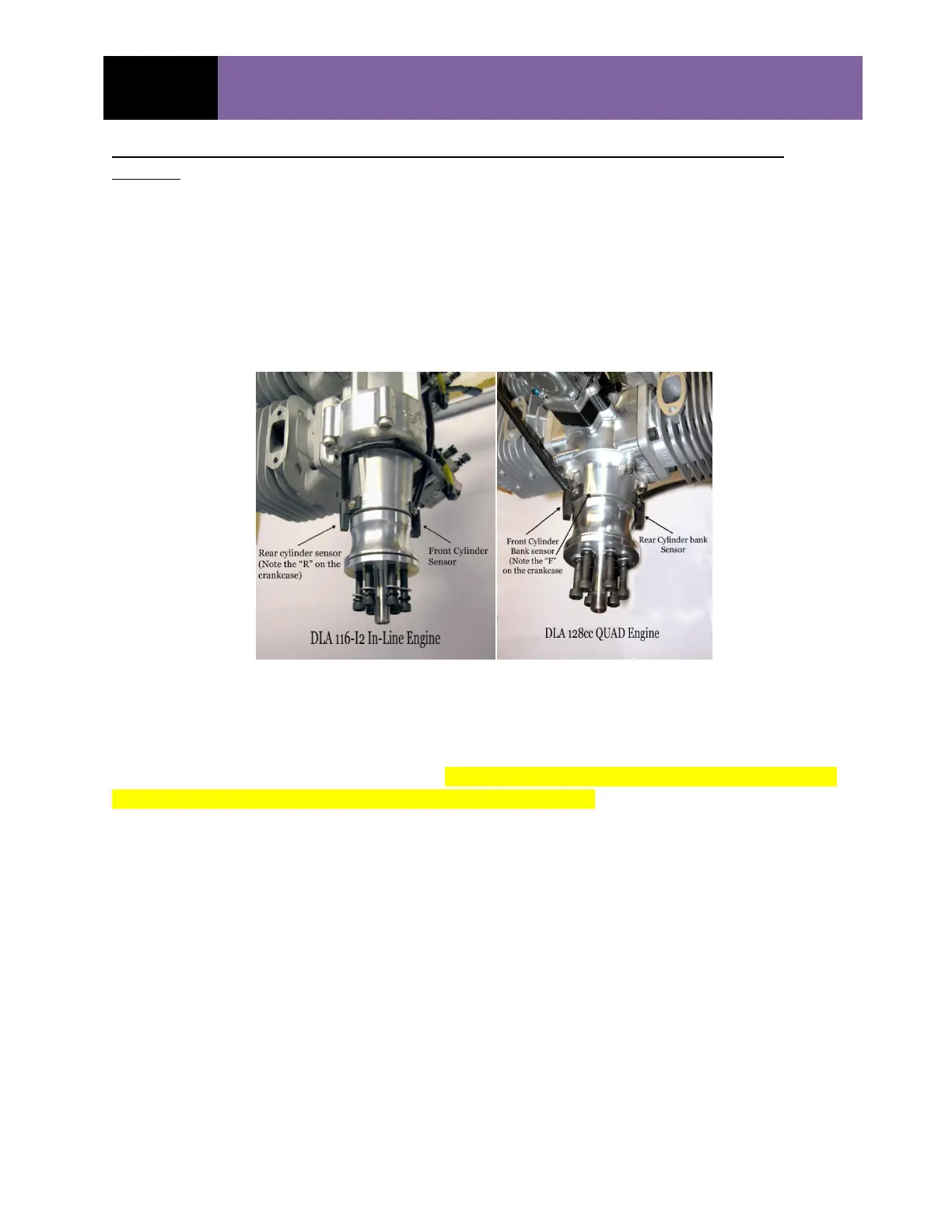
The 64-I2 & 116-I2 In-line and the 128cc & 232cc QUAD have two (2) sensors and two (2)
ignitions to drive the front and rear cylinders separately. The paired combinations of one each
sensor and one ignition is dedicated specifically to the front or rear cylinder bank(s). Therefore,
you must connect the front cylinder’(s) sensor/ignition to the front cylinder(s) and the rear
sensor/ignition to the rear cylinder(s). The 64-I2 & 116-I2 and 128cc & 232cc sensors are
typically mark with an “F” or “R” to denote which sensor goes with the designated cylinder(s)
bank (front or rear). See pictures below.
If the crankcase should not be marked with an “F” or “R”, then refer to the pictures for the correct
sensor identification. Another way to identify the front sensor is to rotate the crankshaft so that
the front cylinder-piston is at top-dead-center (TDC
f
). Note the location of the timing magnet on
the prop-hub. The magnet will be located just CCW from the front sensor. The magnet will be
~28-30
O
CCW relative to the front sensor. For an optional method of connecting the dual CDIs
to a single battery, refer to Appendix B at the end of this manual.
CAUTIONS:
1. Advancing the timing causes the engine to run hotter. (See Temperature Limits)
2. Advancing the timing typically increases the power…. to a limit.
3. Advancing the timing, may make the engine harder and more dangerous to start.
4. Advancing the timing is harder on the engine and advancing beyond 32
O
voids the
warranty.
COWL DUCTING and AIR FLOW
Be sure that the cowl openings are sufficient to provide adequate airflow across the DLA cylinder
head’s, cooling fins. Generally, the “rule-of-thumb” is to have the air exit holes to be three (3)
times the size of the air intake. If the air intake is too big, sufficient air flow may not be directed


 To Next Page