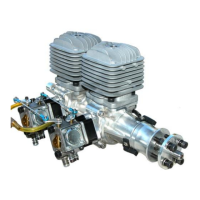
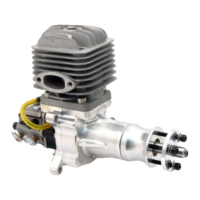
DLA ENGINE OPERATING-INSTRUCTION
MANUAL
06/29/2016 Copyrighted Material
Owner’s Manual All Rights Reserved 03180-10000
Page - 30 DLA 32, 58, 64, 64-I2, 116, 116-I2 & 128cc, 180c, 232cc Rev. A.05.11
flexible than when lubricated with the gas/oil mixture. In order to pump the gas/oil from the
tank, a considerable amount of hand cranking may be required to draw the gas from the tank to
the carburetor’s nipple and then into the carb’s reservoir. Possible expediencies:
Remove the gas line from the carb’s nipple and allow the gas to drain to end of the
gas line and then re-attach to the carb’s nipple.
Use an electric starter, rather than hand “cranking” the prop. This
creates a much greater pumping action and draws the gas to the carburetor much
more quickly and save wearing out your arm. Hand starting the engine is also
not safe and is strongly NOT RECOMMEND!
The above actions are particularly true and important to use when initially starting
the 32cc engines.
Starting:
1. Be sure the Ignition Kill Switch is in the off position, and that your ignition and receiver
batteries are fully charged.
2. Add the gas:oil mixture to the fuel tank.
3. Turn on your transmitter and receiver.
4. Make sure the transmitter throttle control is in the low or idle position.
5. With the kill switch in the off position
a. Close the carburetor choke
b. Turn ignition kill switch to the on position.
c. Rotate the propeller (counter-clockwise, as facing the engine from the front), using
an electric starter motor, until the engine starts to fire.
i. Stop rotating the propeller when the engine starts to fire.
ii. Do not rotate or “flip” the prop by hand, as that is dangerous.
d. If the engine is still firing and the propeller rotating, wait for the propeller to stop.
e. With the propeller stopped, turn the ignition switch off and open the choke.
f. Turn the ignition switch back on.
g. Engage the electric starter and rotate the propeller until the engine starts.
h. Warm up the engine for twenty (20) to thirty (30) seconds before advancing the
throttle.
i. Check to see that:
i. The idle is correct.
ii. The transitions from low to high are correct.
ENGINE BREAK-IN:
The engine may be broken in either on a static bench mount or on the aircraft. If using a bench
mount, it is necessary to provide a soft mounting environment for the engine. A soft mount is one



 To Next Page