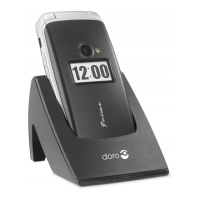
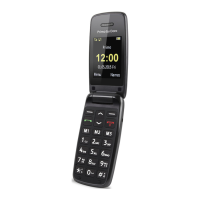
Need help?
Do you have a question about the Doro 2414 and is the answer not in the manual?
Guide for inserting SIM, memory, and battery into the device.
Steps to power the phone on and off, including PIN code entry.
Guide to initial phone setup using the start-up wizard.
Instructions on how to dial numbers and initiate calls.
How to answer or reject incoming calls and control volume.
Setting up and using speed dial numbers for quick calling.
Procedures for making emergency SOS calls.
Steps to add new contacts to the phonebook.
How to use the dedicated button for emergency assistance.
Guide to composing and sending SMS messages.
Instructions for creating and sending MMS messages.
How to adjust camera settings and take photos.
Steps to turn on and manage Bluetooth connectivity.
How to search for and connect to Bluetooth devices.
Customizing ringtones and notification sounds.
Adjusting screen brightness and backlight duration.
Setting and managing alarms on the device.
How to turn the phone's torch on and off.
Instructions for resetting phone settings or all data.
Information on network usage, subscriptions, and associated costs.
Guidelines for using the device in different environments and conditions.
Precautions for users with medical implants, like pacemakers.
Safety advice for using the phone in potentially explosive environments.
Key technical specifications of the Doro 2414 mobile phone.
Information on radio wave exposure limits and compliance.
Environmental guidelines for disposing of the product and accessories.
Statement of compliance with EU directives for radio equipment.
The Doro 2414 is a user-friendly mobile phone designed for ease of use, particularly for individuals who may prefer a simpler interface. This quick start guide provides comprehensive instructions on how to set up, operate, and maintain the device, ensuring a smooth user experience.
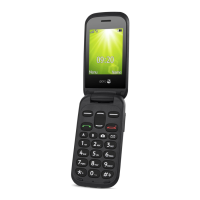
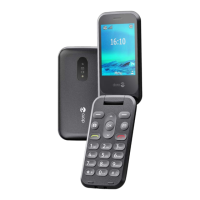
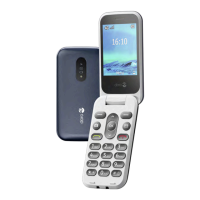
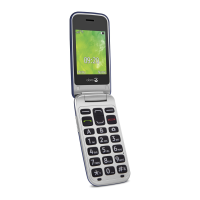
The Doro 2414 serves as a basic mobile phone, primarily focused on communication through calls and text messages. It features a traditional keypad with large, well-spaced buttons, making dialling and text input straightforward. The device includes essential functions such as a phonebook, call history, and an alarm. A notable safety feature is the assistance button, which allows users to quickly contact predefined help numbers in case of an emergency. The phone also incorporates a camera for taking photos, a torch for illumination, and Bluetooth connectivity for pairing with other devices like headsets.
To begin using the Doro 2414, users first need to install a SIM card (required) and, optionally, an SD card for expanded storage. The battery must then be inserted, and the battery cover replaced. The guide provides clear instructions on how to remove the battery cover without damage, slide in the SIM card (micro SIM or 3FF SIM card type), and gently insert the SD card (microSD, microSDHC compatible). It emphasizes the importance of using compatible cards to prevent damage to the device or data corruption. After inserting the battery, the phone is ready to be charged using the provided mains adapter and charging socket or cradle.
To turn the phone on or off, users press and hold the red button. If a SIM card is protected by a PIN code, the phone will prompt for the PIN. The guide explains how to enter the PIN and confirms that if the PIN is blocked after too many incorrect attempts, the PUK code will be required to unlock it.
Upon first starting the phone, a start-up wizard guides users through basic settings, simplifying the initial setup process. This wizard can also be run later if needed.
The manual uses an arrow (→) to indicate the next action in step-by-step instructions, making it easy to follow. Actions are confirmed by pressing the OK button. Items can be selected by scrolling vertically using the scroll buttons or highlighting them and pressing OK. Horizontal scrolling is achieved using the * or # buttons.
Entering text is intuitive: users repeatedly press a numerical key until the desired character appears, waiting a few seconds before entering the next character. A list of special characters can be accessed by pressing the * button, and the cursor can be moved within the text using the scroll buttons. The # button cycles between upper case, lower case, and numerals.
Making a call involves entering the phone number and pressing the green call key. Calls can be ended by pressing the red end call key. For international calls, the guide advises using the + prefix before the country code, which can be accessed by pressing the * button twice. Calls can also be made directly from the phonebook by selecting a contact and pressing the call key.
To answer an incoming call, users press the green call key. Alternatively, pressing the left selection button allows users to silence the ring signal and then reject the call, or reject it directly.
During a call, the scroll buttons can be used to adjust the sound volume, with the current level indicated on the display.
The phone features a silent profile that disables keypad, message, and ring tones while keeping vibration, tasks, and alarms active. Silent mode can be activated or deactivated by pressing and holding the # button.
During a call, the soft keys provide access to additional functions.
The Doro 2414 supports speed dial for numbers 2-9. Users can press and hold the corresponding button from standby to dial a predefined contact. The guide explains how to add speed dial numbers through the Phonebook settings.
A critical safety feature, the SOS call function allows users to place an emergency call by entering the local emergency number and pressing the green call key.
The phone stores a combined log of received, missed, and dialled calls, with up to 20 entries of each type. For multiple calls from the same number, only the most recent call is saved. Users can scroll through the call log to view entries and redial directly.
The phonebook can store 300 entries, each with one phone number. Adding a contact involves entering a name and phone number, then saving the entry.
The ICE feature allows users to store vital information such as medication and next of kin contacts. This information can be accessed by first responders in an emergency, enhancing safety. Users can edit and save this information through the Phonebook menu.
The dedicated assistance button provides quick access to predefined help numbers. When pressed and held for 3 seconds, or pressed twice within 1 second, the phone initiates an assistance call after a 5-second delay, during which a false alarm can be prevented by pressing the red end call button. An assistance text message (SMS) is sent to all recipients, and the phone dials the first recipient. If unanswered, it proceeds to the next number, repeating three times or until a call is answered or the red end call button is pressed. During an assistance call, the phone defaults to handsfree mode, and users are cautioned not to hold the device near their ear due to potentially loud volume.
The Doro 2414 supports both text (SMS) and picture (MMS) messages. To create and send a text message, users write their message, select a recipient from the phonebook or enter the number manually, and then send. For picture messages, users can write a message, add a picture from their gallery, and optionally add sound, video, or a subject before sending. Both the user and recipient must have subscriptions that support picture messages.
The phone includes a camera for taking photos. Users can access the camera via a shortcut button or the menu, take a photo, and access additional settings through the Options menu.
Bluetooth connectivity allows the phone to connect wirelessly to other compatible devices. Users can activate Bluetooth, search for new devices, and bond with them. The guide advises turning off Bluetooth connectivity and visibility when not in use and avoiding pairing with unknown devices.
Users can customize tone settings, such as ringtones, by selecting from available melodies. LCD backlight settings, including brightness and time, can also be adjusted.
The phone includes an alarm function, which can be set for single occurrences or repeated for specific days. The alarm works even when the phone is switched off. A built-in torch can be turned on or off by sliding a dedicated switch.
The phone offers options to reset either specific phone settings to default values or to perform a full reset, which deletes phone settings and content like contacts, number lists, and messages (SIM memory is unaffected). Both reset options require a phone code (default is 1234).
The guide emphasizes using only Doro-approved batteries, chargers, and accessories to avoid danger and invalidate the warranty. When the battery is low, a warning signal is heard, and an icon is displayed. Users are instructed to connect the mains adapter to the wall socket and the charging socket. A tip is provided to remove any protective plastic film from the display.
The Doro 2414 is a technically advanced product that requires careful handling. Negligence can void the warranty. Key maintenance tips include:
The product contains a Li-ion battery, and improper handling can pose a risk of fire and burns. Users are warned not to disassemble, crush, puncture, short external contacts, expose to temperatures above 60°C (140°F), or dispose of in fire or water. Used batteries should be recycled or disposed of according to local regulations.
The manual includes important safety instructions, such as keeping small parts out of reach of children, ensuring the mains adapter is easily accessible, and being aware of network services and associated costs. It also details operating environment guidelines, emphasizing turning off the unit where its use is prohibited or could cause interference or hazards. Specific warnings are given regarding medical units (pacemakers, hearing aids), areas with explosion risk (e.g., filling stations, chemical factories), and vehicle safety (airbags).
The document clarifies copyright information, Doro AB's ownership of trademarks, and disclaimers regarding the accuracy and reliability of the document's content. It also states that Doro does not provide warranty or support for third-party apps and warns against unauthorized copying of copyrighted materials.
 General
| Display diagonal | 2.4 \ |
|---|---|
| Display resolution | 320 x 240 pixels |
| RAM capacity | 8 MB |
| Flash card support | - |
| Compatible memory cards | MicroSD (TransFlash) |
| Rear camera | Yes |
| Rear camera resolution (numeric) | 3 MP |
| Data network | GSM |
| 2G bands (primary SIM) | 900, 1800 MHz |
| Mobile network generation | 2G |
| Bluetooth version | 3.0+HS |
| Multimedia Messaging Service (MMS) | Multimedia Messaging Service (MMS) is a standard way to send messages that include multimedia content to and from a mobile phone over a cellular network |
| Ringer type | Polyphonic |
| Talk time (2G) | 8 h |
| Battery capacity | 800 mAh |
| Standby time (2G) | 300 h |
| Standby time (3G) | - h |
| Product color | Silver |
| Subscription type | No subscription |
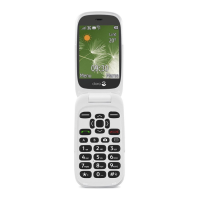
| Form factor | Clamshell |
| Personal info management (PIM) | Alarm clock, Calculator, Calendar |
 Weight and Dimensions
| Depth | 18.5 mm |
|---|---|
| Width | 52 mm |
| Height | 103 mm |
| Weight | 89 g |

 To Next Page