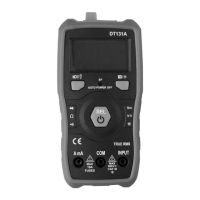
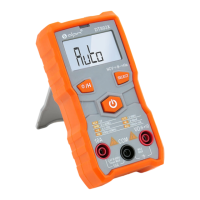
Automatyczny miernik cyfrowy
6
2. Nacisnąć dwukrotnie przycisk NCV . Na wyświetlaczu pojawi się "EF".
3. Wprzypadku wykrycia napięcia wzakresie AC 30-1000 V pojawi się sygna-
lizacja dźwiękowa, podświetli się dioda EF , ana wyświetlaczu pojawią
się kreski "- - - -"
Funkcja latarki
Nacisnąć iprzytrzymać przycisk NCV , aby włączyć lub wyłączyć latarkę .
Podświetlenie wyświetlacza
Nacisnąć iprzytrzymać przycisk , aby włączyć lub wyłączyć pod-
świetlenie.
Wymiana baterii
Baterię należy wymienić na nową gdy na wyświetlaczu LCD pojawi się sym-
bol wyczerpanej baterii . Niski poziom baterii może powodować błędne
wskazania pomiarów.
1. Zdjąć tylną pokrywę miernika.
2. Umieścić nowe baterie 2 x AAA zwracając uwagę na prawidłową polaryzację.
Przed zdjęciem tylnej pokrywy należy odłączyć wszystkie przewody
pomiarowe od miernika imierzonego obwodu oraz wyłącznik mier-
nik przytrzymując przycisk
Należy używać wyłącznie baterii
ibezpieczników zgodnych ze specyfikacją urządzenia Zaleca się
stosowanie baterii alkalicznych Zużyte baterie jako odpad niebez-
pieczny należy wyrzucić do specjalnie oznaczonych pojemnik wlub
przekazać do punktu selektywnej zbiórki Nie wolno wyrzucać ba-
terii do kosza na śmieci Nie należy stosować jednocześnie baterii
nowych iużywanych.
Gwarancja
Warunki gwarancji zamieszczone są na stronie: http://www.dpm.eu/gwarancja
General information
Universal multimeter with automatic selection of the measuring range and
non-contact voltage detector (NCV) Measurements: AC/DC amperage and
voltage, resistance, capacitors diode test circuit continuity test true RMS
measurement LCD display (4 digits) backlight + ashlight auto switch off
(15 min) low battery indicator overload protection power supply: 2 x AAA.
Safety guidelines
1. Prior to initiation of device’s usage it is recommended to get thoroughly
acquainted with operating manual and terms of safe use. This will allow
avoiding an electric shock, health damages or loss of life, as well as it may
prevent damages to the device.
2. Prior to commencing measurements it is recommended to check for dam-
ages on device’s casing or measuring cables. In case any cable or device
damages are detected device should not be used, as it may pose an electric
shock threat.
3. The device should not be used when insulation wrapping the probes and ca-
bles is damaged.
4. Only gauging cables delivered with the set may be used for measurements.
In case gauging cables are damaged they should be replaced with cables of
exact technical parameters.
5. The device can be used only for measurements compliant with the manual
and its technical specication. Otherwise, device’s safety provisions may
not be sufcient for safe usage.
6. During measurements all metal ends and gauging slots should not be
touched. Fingers should be kept above insulation sheaths.
7. It is not allowed to make measurements with wet hands or in places with
excessive air humidity.
8. It is not recommended to exceed upper limits of electric values given for
each gauging range. When the scale of measured electric value is not known
selection of the highest range is recommended for gauging.
9. It is not recommended to place any electronic elements into gauging slots
during voltage measurements with gauging probes.
10. Prior to measurement of resistance, circuit continuity and capacitor’s ca-
pacity the capacitances should be discharged and all power supply sources
disconnected.
11. Particular caution should be taken by measurements, which exceed DC 60 V
or AC 30 V rms.
12. Gauging probes should be removed from gauging slots prior to every change
of measured parameters.
13. The device should not be used, or kept, in high air humidity or temperature
conditions, in strong electromagnetic eld or in an explosive or ammable
environment. Such conditions may inuence gauging results and create an
electric shock hazard.
14. The device should not be used when the display indicates exhausted battery.
Low battery level may lead to faulty gauging indications.
15. Make sure that the device is switched off before batteries are replaced.
16. In case device is not used for alonger period of time the battery should be
removed in order to avoid spilling of electrolyte.
17. Device should be used and stored in aplace inaccessible for children.
18. Device is designed to be used indoors, in room temperature.
19. Device should not be used directly after it is relocated from aroom with
high air humidity, excessively low or high temperature conditions.
Technical specication
Measurement accuracy for particular gauging values is given for 1 year from
calibration date and for an operating temperature of 23
o
C 5
o
C and air hu-
midity of 75%.
Accuracy: % of indicated value number of least signicant digits.
4 digit LCD display power supply: 2 x AAA number of readouts: 2 / s fuse:
F 10 A / 600 V Buzzer dimensions: 145 x 73 x 34 mm operating condi-
tions: od 0-40
o
C, humidity < 80% storage conditions: od –10
o
C to +50
o
C,
humidity < 85% weight: ok. 185 g
Kit includes: multimeter, gauging cables, battery (a test battery – not covered
by the guarantee), operating manual.
Safety category
CAT I– gauging category CAT I denes safety requirements for measurements
in devices which are not connected directly to a low voltage network, such as
batteries, accumulators, ashlights.
CAT II – gauging category CAT II denes safety requirements for measure-
ments carried out in devices directly connected to a low voltage network, such
as home appliances, ofce equipment or workshop equipment.
CAT III – gauging category CAT III denes safety requirements for measure-
ments carried out in the circuits of installations inside buildings.
Multimeter should not be used for measurements of devices de-
fined by CAT IV.
Description
ON/OFF switch; selection of measurement functions
LCD display – 4 digits


 To Next Page
 Loading...