
 Need help?
Do you have a question about the Dräger PAS AirPack and is the answer not in the manual?
Highlights critical safety information and general precautions for using the equipment.
Instructions on how to correctly operate the breathing apparatus.
Specific guidance for using compressed air from Zone 1 or Zone 2 hazardous areas.
Steps for securely connecting approved breathing air cylinders.
Step-by-step guide to conduct essential functional tests for system integrity.
Outlines service and testing tasks for the pneumatic assembly with frequencies.
Lists compatible external air supply equipment and connection types.
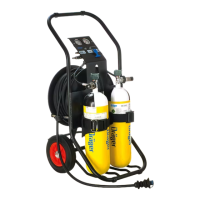
The PAS® AirPack Pneumatic Assembly is a robust and versatile device designed to provide a reliable supply of breathing air for multiple users in various demanding environments. Its primary function is to serve as a centralized breathing air supply system, allowing two or more breathing apparatus wearers to connect simultaneously and receive a continuous flow of medium-pressure air. This makes it particularly suitable for situations where extended duration breathing air is required, such as in industrial settings, confined spaces, or during emergency response operations.
The core function of the PAS® AirPack is to regulate and distribute medium-pressure breathing air from an external source to individual breathing apparatus. It features multiple output connectors, typically four, allowing up to two breathing apparatus wearers to connect directly to the unit. For scenarios requiring more than two wearers or greater flexibility, extension hoses and stand-alone hose reels can be integrated, expanding the system's reach and capacity. The device is designed to operate with either a factory airline or a compressor as its input source, ensuring adaptability to different site conditions.
A critical aspect of its functionality is the integrated pressure management system. The unit includes a medium-pressure input, which is then distributed to the output connectors. Each output is equipped with a quick-connect coupling, facilitating easy and secure attachment of breathing apparatus. The system incorporates safety features such as pressure gauges to monitor the input and output pressures, and a relief valve to prevent over-pressurization. This ensures that the air supplied to the wearers is within safe and effective operating parameters.
The assembly is designed for both stationary and mobile use. Its robust construction allows it to be deployed in challenging environments, while its modular design supports various configurations, from direct connections to extended hose setups. This flexibility ensures that the PAS® AirPack can meet the diverse needs of different operational scenarios, providing a dependable breathing air supply for extended periods.
The PAS® AirPack is designed for ease of use and quick deployment. Connecting breathing apparatus is straightforward, thanks to the quick-connect couplings on the output connectors. Users simply attach their breathing apparatus to the available output, and the system is ready to deliver air. The clear labeling of connectors and intuitive design minimize the risk of errors during setup.
For scenarios requiring extended reach, the system supports the use of extension hoses and stand-alone hose reels. These accessories can be easily integrated, allowing wearers to move further away from the main unit while maintaining a continuous air supply. This is particularly beneficial in large industrial complexes or during rescue operations where mobility is crucial. The ability to connect multiple wearers simultaneously enhances team efficiency and safety, as it eliminates the need for individual air cylinders for each person, reducing logistical burdens.
The device also features a robust chassis, often made of durable materials like stainless steel, which protects the internal components from damage in harsh environments. This ensures the unit's longevity and reliability, even with frequent use in demanding conditions. The compact design of the main unit, despite its multi-user capability, allows for relatively easy transport and positioning.
Before use, a thorough functional test is recommended to ensure all components are working correctly. This includes checking the pressure gauges, verifying the integrity of all connections, and ensuring the relief valve operates as expected. The clear instructions provided in the manual guide users through these pre-use checks, promoting safe and effective operation.
Regular maintenance is crucial for ensuring the continued reliability and safety of the PAS® AirPack. The system is designed with several features that facilitate easy inspection and servicing. Key components, such as hoses, couplings, and pressure gauges, are accessible for visual inspection and functional checks.
A comprehensive maintenance schedule is recommended, including periodic visual inspections, functional tests, and component replacements. For instance, hoses and couplings should be regularly inspected for signs of wear, damage, or leaks. Pressure gauges should be checked for accuracy, and the relief valve should be tested to ensure it activates at the correct pressure.
The modular design of the PAS® AirPack simplifies component replacement. If a part is found to be faulty or worn, it can often be replaced individually without needing to replace the entire unit. This reduces maintenance costs and downtime. For example, if an output coupling is damaged, it can be replaced, restoring the unit's full functionality.
Cleaning the device is also an important aspect of maintenance. The exterior can be cleaned with a mild detergent and water, ensuring that dirt and debris do not accumulate and potentially affect performance. It is important to ensure that all components are thoroughly dried after cleaning to prevent corrosion or other damage.
For more complex maintenance tasks, such as internal inspections or calibration of pressure components, it is recommended to consult qualified service personnel. These professionals have the expertise and specialized tools to perform thorough diagnostics and repairs, ensuring the device continues to meet safety and performance standards. Regular servicing by authorized personnel helps extend the lifespan of the PAS® AirPack and guarantees its readiness for critical operations. The maintenance logbook, often provided with the device, helps track all service activities, ensuring that all required maintenance is performed on schedule.
 General
| Operating Temperature | -30°C to +60°C |
|---|---|
| Product Type | Breathing Apparatus |
| Application | Industrial |
| Air Supply | Compressed air |
| Duration | Dependent on cylinder size and consumption rate |
| Cylinder Material | Steel or composite |
| Air Capacity | Varies depending on cylinder size; e.g., 6L, 6.8L, 9L |
| Approval | EN 137 |
| Weight | Varies depending on cylinder size and configuration; typically between 10-15 kg (without cylinder) |
| Operating Pressure | 200 bar or 300 bar (depending on model) |

 To Next Page
