PAS
®
Lite Series
Self contained breathing apparatus
Instructions for Use
PAS
®
is a registered trademark of Dräger 3357781 (A3-D-P) Page 1 of 2
1 For your safety
1.1 General safety statements
● Before using this product, carefully read the Instructions for Use.
● Strictly follow the Instructions for Use. The user must fully understand
and strictly observe the instructions. Use the product only for the
purposes specified in the Intended Use section of this document.
● Do not dispose of the Instructions for Use. Ensure that they are
retained and appropriately used by the product user.
● Only fully trained and competent users are permitted to use this
product.
● Comply with all local and national rules and regulations associated
with this product.
● Only trained and competent personnel are permitted to inspect, repair
and service the product. Dräger recommends a Dräger service
contract for all maintenance activities and that all repairs are carried
out by Dräger.
● Properly trained service personnel must inspect and service this
product as detailed in the Maintenance section of this document.
● Use only genuine Dräger spare parts and accessories, or the proper
functioning of the product may be impaired.
● Do not use a faulty or incomplete product, and do not modify the
product.
● Notify Dräger in the event of any component fault or failure.
● The air supply shall meet the requirements for breathing air according to
EN12021.
1.2 Definitions of alert icons
Alert icons are used in this document to provide and highlight text that
requires a greater awareness by the user. A definition of the meaning of
each icon is as follows:
WARNING
Indicates a potentially hazardous situation which, if not avoided,
could result in death or serious injury.
CAUTION
Indicates a potentially hazardous situation which, if not avoided,
could result in physical injury or damage to the product or
environment. It may also be used to alert against unsafe practices.
NOTICE
Indicates additional information on how to use the product.
2 Description
2.1 Product overview
The Dräger PAS
®
Lite Series is a self contained breathing apparatus
(SCBA) that uses an open-circuit breathing system. The series is
compatible with a wide range of compressed-air cylinders, face masks and
lung demand valves (e.g. FPS 7000 and Panorama Nova face masks, PSS
Series lung demand valves, and steel or composite cylinders).
2.2 Feature description
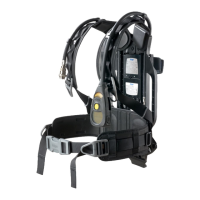
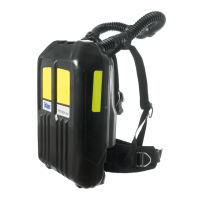
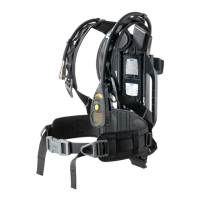
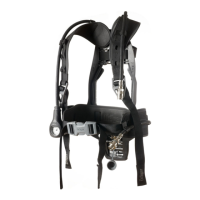
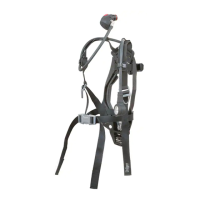
The carrying system uses a lightweight polymer-composite space frame
(Fig 1, Item 3). The shoulder straps and waist belt are fully adjustable and
use webbing harness straps with rubberized shoulder straps and a plastic
waist belt buckle.
The apparatus uses the Dräger high-performance pressure reducer (8)
that reduces cylinder pressure and supplies breathing air to the lung
demand valve (1) through a medium-pressure hose (7). Medium-pressure
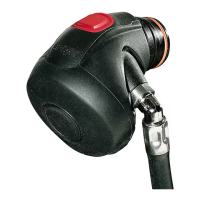
air is supplied either directly or through a coupling (9) that allows removal
and fitting of the lung demand valve when required. A gauge hose (5)
supplies high-pressure air from the cylinder to the gauge (4). The reducer
also incorporates a whistle (6) that sounds to warn the wearer that there is
low cylinder pressure.
The air hoses and the pressure reducer are integrated into the space frame
to prevent snagging and enhance component protection. The hose clips
(2) hold the air hoses in position on the shoulder straps.
Air cylinders, lung demand valves and face masks
The Dräger PAS Lite Series is compatible with a single steel or composite
material cylinder of 4 to 9 litre capacity, and 200 or 300 bar pressure. Full
descriptions and user instructions are contained in separate instructions
supplied with the cylinder, mask or lung demand valve.
2.3 Intended use
The PAS Lite Series breathing apparatus, when fitted with a cylinder, lung
demand valve and face mask, is intended for use by emergency services
and in industrial applications where a high level of respiratory protection is
required. The assembled breathing apparatus provides the wearer with
respiratory protection for working in contaminated or oxygen-deficient
conditions, and is suitable for fire fighting.
The cylinder, face mask and other accessories used with this product must
be certified Dräger components, assembled in an approved configuration.
Contact Dräger for further information.
Use in potentially explosive atmospheres
Electronic sub-assemblies are ATEX certified.
2.4 Approvals
The European standards, guidelines, and directives according to which
this product is approved are specified in the declaration of conformity (see
declaration of conformity or www.draeger.com/product-certificates).
2.5 Explanation of marking and symbols
Refer to the relevant authority for explanation of approval body symbols
and marking on the equipment. Examples of other marking on component
parts of the breathing apparatus are:
BRAC-1359 – Dräger serial number
08/09 – Month and year of manufacture
3356812 or R21034 – Dräger part number
SF – Standard force coupling
LF – Low force coupling
!
3 Use
WARNING
Only trained and competent personnel may prepare and use
breathing apparatus. Ensure that any accessories, ancillary
equipment and other protective clothing items do not interfere with
the apparatus and do not create a safety hazard.
The effective working duration of the apparatus is dependent on
the initial air supply available and the breathing rate of the wearer.
Fill air cylinders to their full rated pressure prior to use, and do not
commence any operation using a cylinder that is less than 90 per
cent full (or greater when national regulations dictate).
CAUTION
Do not apply excessive force or use tools to open or close a
cylinder valve, and do not drop or throw down the breathing
apparatus.
3.1 Preparation for use
NOTICE
The pressure gauge may be fitted with a thin flexible protective
covering. Remove this covering before first use.
1. Carry out a visual inspection of the breathing apparatus (see
Section 3.5.1).
2. Fit the air cylinder (see Section 3.5.2).
3. For breathing apparatus with a medium-pressure coupling for the lung
demand valve, disconnect and then reconnect the male coupling. To
connect, press the male coupling into the female coupling until an
audible click is heard. If there is any difficulty disconnecting or
connecting, see the troubleshooting information in Section 4.
4. Press the reset button (Fig 1, Item 11) when using a positive-pressure
lung demand valve (see the Instructions for Use supplied with the lung
demand valve).
5. Carry out a full functional test of the apparatus (see Section 3.5.3).
6. Connect the lung demand valve to the face mask and check the
security of attachment by gently attempting to pull the coupling apart.
3.2 Putting on the breathing apparatus
1. Fully loosen the shoulder straps and waist belt and put on the
breathing apparatus.
2. Check that the shoulder straps are not twisted and take the weight of
the system on the shoulders by pulling the shoulder straps. Do not fully
tighten at this stage.
3. Close the waist belt buckle and pull the ends of the waist belt until it fits
securely and comfortably on the waist (Fig 2). Tuck the belt ends
behind the waist belt.
4. Pull the shoulder straps until the breathing apparatus is secure and
comfortable. Do not over tighten. Tuck the belt ends behind the waist
belt.
!
!
5. Fully loosen the head straps of the face mask and place the neck strap
over the back of the neck.
6. Press the reset button when using a positive-pressure lung demand
valve.
7. Open the cylinder valve slowly, but fully, to pressurize the system.
8. Put on the face mask and check for tight fit (see the Instructions for Use
supplied with the mask).
3.3 During use
WARNING
Fully open the cylinder valve and ensure that it remains open
during use.
Users should be in a safe area before the whistle warning
commences. Evacuate to a safe area immediately if the warning
commences during an operation.
Using the supplementary air supply (Fig 1, Item 10) will use air
from the cylinder and rapidly reduce the working duration of the
apparatus.
● Regularly check the remaining cylinder pressure on the gauge.
● If supplementary air is required, briefly press the rubber cover (10) at
the front of the lung demand valve to deliver extra air into the face
mask.
3.4 After use
WARNING
Do not remove the breathing apparatus until in a safe breathing
environment.
1. Loosen the face mask straps. As the seal to the face is broken, press
the reset button when using a positive-pressure lung demand valve.
Remove the face mask.
2. Close the cylinder valve.
3. Press the rubber cover at the front of the lung demand valve to vent
the system fully. Press the reset button when using a positive-pressure
lung demand valve.
4. Release the waist belt buckle.
5. Lift the shoulder strap buckles to loosen the straps.
6. Remove the breathing apparatus and face mask.
7. Carry out the after use tasks in the maintenance table (see Section 5).
8. Remove the air cylinder (see Section 3.5.2) if required.
9. Pass the breathing apparatus to the service department with details of
any faults or damage that occurred during use.
3.5 Common user tasks
3.5.1 Visual inspection
A visual inspection must check the full breathing apparatus including all
component parts and accessories. Check that the equipment is clean and
undamaged, paying particular attention to pneumatic components, hoses
and connectors. Typical signs of damage that may affect the operation of the
breathing apparatus include impact, abrasion, cutting, corrosion and
discolouration. Report damage to service personnel and do not use the
apparatus until faults are rectified.
3.5.2 Air cylinder fitting and removing
WARNING
High-pressure air release may cause injury to the user or other
personnel near the breathing apparatus. Close the cylinder valve and
fully vent the system before attempting to disconnect an air cylinder.
Impact damage to the cylinder valve or reducer connector may
prevent valve connection or cause an air leak. Handle the air
cylinder and breathing apparatus with care.
NOTICE
For other cylinder connector types, refer to the Instructions for Use
supplied for the connector.
Fitting a cylinder with a threaded connector
1. Check the threads of the cylinder valve port and the pressure reducer.
Ensure that the O-ring seal (Fig 3, Item 1) and the sintered filter (2) in
the reducer are clean and undamaged.
2. Lay the apparatus horizontal, with the reducer uppermost, and fully
extend the cylinder strap.
3. Insert the cylinder through the loop of the strap, and align the valve with
the reducer.
4. Lift the cylinder and space frame into the vertical position (supported
on the end of the cylinder opposite the valve).
5. Tighten the hand wheel of the reducer, using only the thumb and index
finger, until a definite metal-to-metal contact is felt. Do not use tools or
over tighten.
6. Place the unit back into the horizontal position.
7. Take up the slack in the cylinder strap (Fig 4).
8. Pull the strap over the cylinder to operate the cam lock (Fig 5).
9. Secure the strap end using the cylinder strap retainer (Fig 6). Release
the cam lock to adjust the position of the cylinder strap retainer if
necessary.
Removing a cylinder with a threaded connector
1. Close the cylinder valve and fully vent the system.
2. Lay the apparatus horizontal, with the cylinder uppermost.
3. Lift the cylinder strap retainer.
4. Lift the strap against the cam lock to release the buckle tension, and
then loosen the strap.
5. Disconnect the cylinder valve from the pressure reducer.
6. Lift the cylinder away from the reducer and remove the cylinder.
3.5.3 Functional testing
WARNING
Failure of the breathing apparatus to meet any of the standards or
parameters described in the functional tests indicates a system fault.
Report the fault to trained service personnel or contact Dräger. Do
not use the breathing apparatus until the fault condition is rectified.
Assemble the breathing apparatus as described in the preparation for use
(see Section 3.1) before commencing any functional testing.
WRA
H
-1653
COMP
R
ESSED A
IR
ba
r
0
50
100
150
200
250
3
00
'
'
D
r
ä
g
e
r
D
r
ä
g
e
r
D
r
ä
g
e
r
D
r
ä
g
e
r
100
150
50
200
250
300
0
bar
COMPRESSED AIR
'

 Need help?
 General


 To Next Page