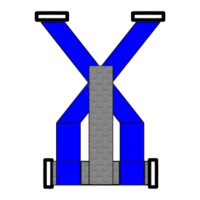
1. After following the instructions, have an assistant pull upward on the support handle to ensure the
support harness does not ride up. Some movement upward is fine, but the harness should not ride up
to your chest or slip off like a shirt.
2. If the harness does begin to ride up toward the chest, remove the harness and refit as per the above
instructions.
It may be required to shorten or lengthen the shoulder straps to adjust the placement of the
waist belt. Always try the harness with the Front Shoulder buckles at the smallest setting first
(Front Shoulder buckles adjusted to the bottom near waistbelt), while increasing gradually as
needed.
Waistbelt should rest either at TOP of belly (preferred placement) or BOTTOM of belly.
Avoid the Middle of the belly, as this will cause waistbelt to slip/ride up.
For smaller framed individuals, it may be necessary to keep or adjust the Front Shoulder
buckles downward for the smallest fit. This will raise the waist belt slightly higher than the
waistline or Top of Belly, depending on harness size.
For larger/wider framed individuals, it may be necessary to adjust the Front Shoulder buckles
upward to open for a larger fit. This increases the length of harness, which lowers the waist
belt slightly below the user’s chest near the bottom of the belly, depending on harness size. Do
not extend where waistbelt falls to/bellow hip area.
All body types differ, and some testing and modification may be required to find the proper
waist belt location to ensure proper fitting.
“Please keep in mind, that the harness is not meant to fit “SKINTIGHT”. Some play is allowable.
The overall Ideal Fit
“While holding onto the Rear Support Handle and pulling upward on the Rear Support handle,
the waistbelt and harness is catching/supporting the user’s overall lower and upper body with
little ride-up.


 To Next Page
 Loading...