
 Need help?
Do you have a question about the Drop BMR1 and is the answer not in the manual?
Install the stand to the speaker using the included accessory pack.
Connect the passive speaker to the active speaker using the provided speaker cable.
Plug the power supply into the active speaker first, then connect to the 100~240 Vac source.
Connect to audio source via 3.5 mm jack (analog) or Bluetooth (digital).
Indicated by a solid white light, this is the first mode when the device is powered on.
Enter by single press. Pairing mode blinks fast. Solid blue when connected. Slow blink when idle.
Mode skipped if no headphones detected. Speaker output disabled until mode is switched.
Long press for 12 seconds to activate master reset. Light turns off and then on to signal success.
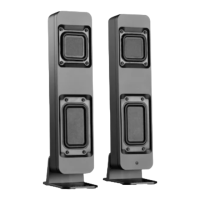
The Drop BMR1 Nearfield Monitors are a pair of speakers designed for nearfield listening, offering both wired and wireless audio connectivity options. This quick start guide outlines the setup, operation, and maintenance features of the device.
The initial setup involves attaching the stands to the speakers. The BMR1 monitors can be oriented either vertically or horizontally, providing flexibility in placement to suit various desk setups or listening environments. The stands are secured using an included accessory pack.
Once the stands are attached, the next step is to connect the two speakers. The system consists of an active speaker and a passive speaker. The passive speaker is connected to the active speaker using a provided speaker cable. This establishes the audio signal path between the two units.
Powering the device is straightforward. The power supply should first be plugged into the active speaker. After this, the power supply can be connected to a 100-240 Vac source. This sequence ensures proper power delivery to the active speaker, which then powers the passive speaker.
The BMR1 monitors offer multiple ways to connect to an audio source:
The BMR1 monitors are operated using a single button, which controls various functions and modes, indicated by different light patterns and colors.
Default Mode (Analog In): When the device is powered on, it defaults to the Analog In mode. This is indicated by a solid white light. In this mode, the monitors are ready to play audio from a device connected via the 3.5 mm analog input.
Bluetooth Mode: To switch to Bluetooth mode from the default mode, a single press of the button is required.
Headphone Mode: The monitors also feature a headphone mode, which is designed to be skipped if no headphones are detected. When headphones are connected and the device is in this mode, the speaker output is automatically disabled. This ensures that audio is routed exclusively through the headphones, preventing simultaneous playback from both speakers and headphones. The speaker output will remain disabled until the mode is switched back to either default (Analog In) or Bluetooth mode. A notable feature is the support for gaming headsets with microphone capabilities. When a gaming headset is connected via the supplied TRRS cable to a compatible device (such as a laptop), the BMR1 monitors can facilitate both audio output to the headset and microphone input from the headset, making them suitable for gaming or communication.
Master Reset: For troubleshooting or to clear all settings, the BMR1 monitors offer a Master Reset function. This is activated by a long press of the button for 12 seconds, regardless of the current mode. Upon activation, the light will briefly turn off, then illuminate again, signaling that the reset has been successful and the device has reverted to its factory default settings. This can be useful for resolving persistent connectivity issues or preparing the device for a new user.
The Drop BMR1 Nearfield Monitors are designed for ease of use and versatility. Their ability to switch between vertical and horizontal orientations allows for flexible placement. The combination of analog and Bluetooth inputs caters to both traditional wired setups and modern wireless streaming. The intuitive single-button control, with clear light indicators for different modes and states, simplifies operation. The dedicated headphone mode with gaming headset support enhances their utility for personal listening and interactive applications. The master reset function provides a reliable way to restore the device to its initial state, ensuring long-term usability.
 General
| Screen Size | 27 inches |
|---|---|
| Resolution | 2560 x 1440 (QHD) |
| Panel Type | IPS |
| Color Gamut | 95% DCI-P3 |
| HDR | HDR400 |
| VESA Mount | 100x100mm |
| Refresh Rate | 165Hz |
| Response Time | 1ms |
| Brightness | 350 cd/m² |
| Contrast Ratio | 1000:1 |
| Ports | 1x DisplayPort 1.4, 2x HDMI 2.0, 1x 3.5mm |
| Adjustability | Height, tilt, swivel |

 To Next Page