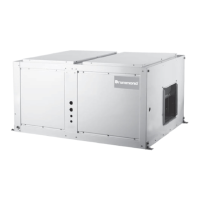
This document is an owner's manual for a Drummond™ Split System Cooling Only air conditioner, specifically models MVA-90CWN1-V, MOV-90CN1-D, MVA-120CWN1-V, and MOV-120CN1-D, which use R-410A refrigerant. The manual provides essential information regarding the safe and effective operation, maintenance, and troubleshooting of the unit.
The air conditioner is designed to provide a comfortable room environment and is suitable for use in offices, hospitals, commercial places, and homes. It aims to create a comfortable and elegant environment. The system is described as nested in the ceiling, offering a space-saving and noble design. It boasts high cooling capacity, efficiency, and energy-saving features. An innovative air supply system is incorporated to ensure homogeneous conditioning of the room temperature. The unit also features a low noise design, and its air outlet can be laid out according to user preference. It utilizes refrigerant to directly transmit cool air, ensuring high transmitting efficiency.
Safety Precautions and Usage:
The manual emphasizes several safety precautions to prevent injury, property damage, electric shock, and fire. Users are warned against incorrect operation due to ignoring instructions. Important safety information is categorized into "WARNING" and "CAUTION."
WARNINGS include:
- Failure to observe warnings may result in death.
- The appliance must be installed in accordance with national wiring regulations.
- Installation, improvement, repair, and maintenance should only be performed by a qualified dealer or service person to prevent water leakage, electric shock, and fire.
- In case of abnormality (e.g., smell of fire), the power supply must be turned off, and the dealer contacted.
- The indoor unit or remote controller must not get wet to avoid electric shock or fire.
- Buttons on the remote controller should not be pressed with hard, pointed objects to prevent damage.
- Fuses must not be replaced with incorrect rated current or other wires.
- The unit should not be inspected or serviced by unqualified persons.
- The product should not be disposed of as unsorted municipal waste; separate collection facilities are required.
- Disposal of electrical appliances in landfills can lead to hazardous substances leaking into the ground, affecting health.
- To prevent refrigerant leaks, the dealer must be contacted. If the system is installed in a small room, refrigerant concentration must be kept below the limit to avoid oxygen depletion.
- If refrigerant leaks and comes into contact with fire (burner, heater, cooker), harmful gases may result.
- Combustible heating devices must be turned off, the room ventilated, and the dealer contacted if refrigerant leaks. The air conditioner should not be used until the leak is repaired.
- Wire distribution must be performed by duly qualified electricians and comply with electric safety specifications.
- The air conditioner must be properly grounded, with reliable ground wires on the main switch.
- A separate power supply compliant with nominal parameter values must be provided.
- The ground wire of the main power switch must not be cut off.
- Damaged power wires must be changed immediately.
- The power supply should be connected for at least 12 hours before using the air conditioner for preheating. The power supply should not be cut off immediately after shutdown, as the unit needs time to completely shut down to prevent compressor drive-up by force and allow crankcase heating.
- Air inlets and outlets must not be blocked, as this reduces performance and can trigger protective devices.
- Flammable gases or liquids (e.g., hair styling jelly, paint, gasoline) must not be used or stored near the air conditioner to prevent fire.
- The deflector plate should not be touched while the air deflector is working to avoid injury or damage to driving parts.
- Fuses must not be substituted with improper nominal current values or other wires.
- Objects like sticks must not be inserted into the air inlet or outlet, as this is dangerous when the fan is running at high speed.
- The fan cover of the outdoor unit must not be removed.
- The main power switch should not be used to start or shut down the air conditioner; instead, the ON/OFF button on the remote controller should be used.
- Children should not be allowed to play with the air conditioner.
- Users should not repair the air conditioner themselves; professional maintainers should perform repairs.
- The main power switch must be cut off before cleaning the filter and the unit body. The unit is grounded for dual protection against electric shock. While normal filter replacement or cleaning with a dry cloth is safe, cutting off the power supply for maintenance or upkeep is a safer practice.
- The electric circuit must include an RCCB and a manual switch.
- The fan guard of the outdoor unit must not be removed.
- The air conditioner must not be operated with wet hands.
- Heat exchanger fins must not be touched due to their sharpness.
- Items susceptible to moisture damage should not be placed under the indoor unit, as condensation can form if humidity is above 80% or if the drain outlet is blocked or filter is polluted.
- After prolonged use, the unit stand and fittings should be checked for damage, as a damaged unit may fall.
- To avoid oxygen deficiency, the room should be sufficiently ventilated if equipment with a burner is used alongside the air conditioner.
- The drain hose must be arranged to ensure smooth drainage to prevent wetting of the building or furniture.
- Internal parts of the controller should not be touched, and the front panel should not be removed.
- Little children, plants, or animals should not be directly exposed to the airflow.
- Children should not be allowed to mount on the outdoor unit or place objects on it to prevent injury.
- The air conditioner should not be operated when using a room fumigation-type insecticide, as chemicals may deposit in the unit and endanger the health of hypersensitive individuals.
- Appliances producing open fire should not be placed in areas exposed to the airflow from the unit or under the indoor unit, as this may cause incomplete combustion or deformation of the unit.
- The air conditioner should not be installed where flammable gas may leak out, as this could cause a fire.
- The appliance is not intended for use by young children or infirm persons without supervision.
CAUTIONS include:
- Failure to observe cautions may result in injury or damage to equipment.
- The air conditioner should not be used for other purposes (e.g., cooling precision instruments, food, plants, animals, or works of art) to avoid quality deterioration.
- Before cleaning, the operation must be stopped, the breaker turned off, or the supply cord pulled out to prevent electric shock and injury.
- An earth leak detector must be installed to prevent electric shock or fire.
- The air conditioner must be grounded to prevent electric shock.
Operation Precautions:
- The manual should be read carefully before operating the unit.
- The air conditioner is designed for comfortable room environments and specific purposes outlined in the manual.
- The indoor relative humidity should be lower than 80%. If humidity is higher, condensation may occur on the unit's surface. In such cases, setting the indoor unit's air speed to high is recommended.
- If the air conditioner operates outside the specified circumstances, functions may fail.
- The system should be operated in a way that ensures proper airflow direction, avoiding direct airflow towards people.
- Room temperature should be adjusted for a comfortable environment, avoiding extremes.
- During cooling, curtains or window shades should be used to prevent direct sunlight.
- All windows and doors should be closed to prevent air from flowing out and compromising cooling/heating efficiency.
- The predetermined operation time should be set via the remote controller.
- Objects obstructing airflow near the air inlet or outlet should be avoided to maintain efficiency and prevent system interruption.
- Before leaving the unit idle for a long period, the main power switch should be cut off, and batteries removed from the remote controller. Turning off the main power switch saves energy, as some power is consumed even when the unit is not running.
- The air filter should be cleaned every two weeks.
- Professional personnel should be consigned to check, clean, and maintain the duct and drain system regularly.
- The air conditioner automatically shifts to air supply mode to prevent frosting of the indoor heat exchanger, then resumes cooling.
- When the room temperature reaches the set temperature, the compressor shuts down, and the unit shifts to air supply status. The compressor restarts when the room temperature rises. The opposite applies in heating mode.
Maintenance and Upkeep:
- Only professionals should perform repairs.
- The main power switch must be turned off before performing operations on electric connectors or cleaning the filter.
- Water or air with a temperature higher than 50°C should not be used to clean the filter or panel.
- The ventilating slot should be checked and maintained every half year, with washing and disinfection recommended once every two years.
- The air filter should be cleaned every two weeks, or more often in dusty environments, to prevent degradation of air conditioner effectiveness.
- If the stain is heavy, the filter should be replaced (optional assembly).
- The power cable should not be replaced without permission; a specialized power cable must be used as a substitute if damaged.
- The air conditioner should not be repaired without permission; such operations must be performed by the local distributor or after-sales service office.
Outdoor Unit Maintenance:
- Caution should be exercised when cleaning, as edges of sheet metal assemblies and condenser fins are sharp.
- The air inlet and outlet of the outdoor unit should be periodically checked for blockages by stain or lampblack.
- The distributor or after-sales service center should be contacted for assistance.
Operation Before Leaving the Air Conditioner Idle for a Long Period:
- The air conditioner should run in air supply mode for about half a day to ensure its interior is fully dry.
- The power should be switched off via the remote controller button, then the main power supply should be cut off.
- Batteries should be removed from the remote controller.
- After several seasons of service, foreign substances may accumulate. The air conditioner should be shut down using the ON/OFF button on the remote controller.
Startup After a Long Period Out of Service:
- Check that the air inlet and outlet of both indoor and outdoor units are not blocked.
- Verify that the ground wire is properly connected.
- Check that condensate water is discharged normally (during cooling season).
- Check the insulation work of the refrigerant circuit and ventilating duct.
- Check if the installing seat is corroded or rusted.
- Connect the indoor unit 12 hours after connecting the outdoor unit to the power supply.
- Switch on the power control of the remote or wired controller, then start the air conditioning.
Maintenance of Fan, Belt, and Pulley:
- One week after running, the elastic belt should be re-adjusted and inspected every three months.
- Regularly check belt tension. Proper tension avoids fan vibration, reduces noise, and prevents belt abrasion.
- Belt tension adjustment involves loosening motor bolts, adjusting the motor position, and tightening bolts. A tension frequency test device is recommended for precise tension.
- Pulley revision ensures fan and motor pulleys are on the same plane to prevent energy consumption and extend belt lifespan.
- If the unit is not running and the heating system is off in winter, the coil (system) must be drained, or appropriate antifreeze added to prevent frost crack.
- The filter should be cleaned using water or detergents depending on dirt levels and usage environment; a monthly cleaning is recommended.
- For units with humidifiers or ECSE, component operation instructions should be followed, and periodic checks performed.
- Comprehensive maintenance, including chemical scale removal in the coil and cleaning dirt from the coil surface, should be done every two years. Water pipelines and wind ducts should be checked for sealing and insulation to reduce energy loss.
- After 24 hours of service for a newly used belt, tension must be checked and adjusted. Improper adjustment can reduce belt lifespan or cause fracture.
- Belts are consumable and should be changed after about 6 months of usage or when efficacy is lost. If multi-belts rotate, the entire group should be changed simultaneously.
Phenomena Not Attributable to Faults:
The manual also lists phenomena that do not indicate a fault in the air conditioner:
- System does not run immediately after pressing ON/OFF: This is due to safety devices preventing overload. The compressor will start automatically after three minutes.
- RUN indicator is on: Indicates normal operation.
- RUN and Defrost/Preheat indicators are on in heating mode: Indicates heating mode is selected, and the indoor unit temperature is too low at startup before the compressor runs.
- Indoor unit gives out white aerosol: Can occur when indoor relative humidity is high and the unit is in cooling mode (especially in oily or dusty environments). Also occurs when the air conditioner shifts from defrosting to heating, expelling moist as steam.
- Uneven temperature distribution with heavy internal stain: Requires cleaning of the indoor unit by professional maintainers.
- Noise of air conditioner (sizzles, squeaks): Sizzles are due to refrigerant flow between units or when refrigerant stops flowing/changes volume. Squeaks occur when plastic assemblies inflate or deflate due to temperature changes.
- Dust blown out of indoor unit: Happens when the air conditioner resumes service after a long period of inactivity.
- Indoor unit gives out smell: The indoor unit absorbs room, furniture, or smoking smells and emits them during operation.
- Shift from cooling mode to air supply mode: Occurs to prevent frosting of the indoor heat exchanger, then returns to cooling.
- Compressor shuts down and shifts to air supply status: Happens when room temperature reaches the set temperature, restarting when temperature rises. The opposite applies in heating mode.
Troubleshooting:
The manual provides a troubleshooting guide for common issues, including:
- System not running: Possible causes include power supply failure, power switch not connected, blown fuse/tripped circuit breaker, or remote/wired controller failure. Solutions involve checking power, replacing fuses, or checking controllers.
- Poor cooling effect: Possible causes include excessive/deficient refrigerant, air/non-condensable gas in refrigerant loop, compressor failure, high/low voltage, obstructed refrigerant loop, dirty condenser/indoor unit, blocked filter, blocked intake/exhaust orifices, open doors/windows, direct sunlight, too many heat sources, or too high outdoor temperature. Solutions involve detecting leaks, filling refrigerant, making a vacuum, repairing/replacing compressor, installing voltage regulator, cleaning, removing obstructions, closing openings, reducing heat sources.
- Poor heating effect: Possible causes include outdoor temperature below -7°C, open doors/windows, or refrigerant leak/deficiency. Solutions involve using a heating device, closing openings, detecting leaks, and filling refrigerant.
- Unit frequently starting/shutting down: Possible causes include excessive/deficient refrigerant, air/non-condensable gas in refrigerant loop, compressor failure, high/low voltage, or obstructed refrigerant loop. Solutions involve detecting leaks, filling refrigerant, making a vacuum, repairing/replacing compressor, installing voltage regulator, or replacing parts.
Remote Controller Faults:
- Shift function cannot be set: If "AUTO" mode is selected, air speed is automatically set. If "DEWET" mode is selected, air speed is automatically set. Air speed is only selectable in cooling, heating, and supply air modes.
- Transmitting symbol "▲" does not blink: Batteries of the remote controller may be low.
- Temperature indicator does not light up: In "Supply Air" mode, temperature cannot be set.
- Display disappears: If the timer set on the timer has expired, the air conditioner stops running. If the TIMING ON display disappears, the air conditioner starts running automatically at the set time.
- No sound of receiving signal: Check if the remote controller's transmitting part is aligned with the indoor unit's receiving part. Check if the power switch of the air conditioner is properly connected.
The manual advises users to shut down the unit, cut off power, and contact the manufacturer's distributor in case of abnormal operation, providing detailed information about the model, environment, and fault. Users are warned against attempting repairs themselves.


 To Next Page

 General