EasyManua.ls Logo

Dual 1010 - Shut-off; Shut-off and change cycle

Dual 1010
18 pages
Print Icon
To Next Page IconTo Next Page
To Previous Page IconTo Previous Page
Loading...
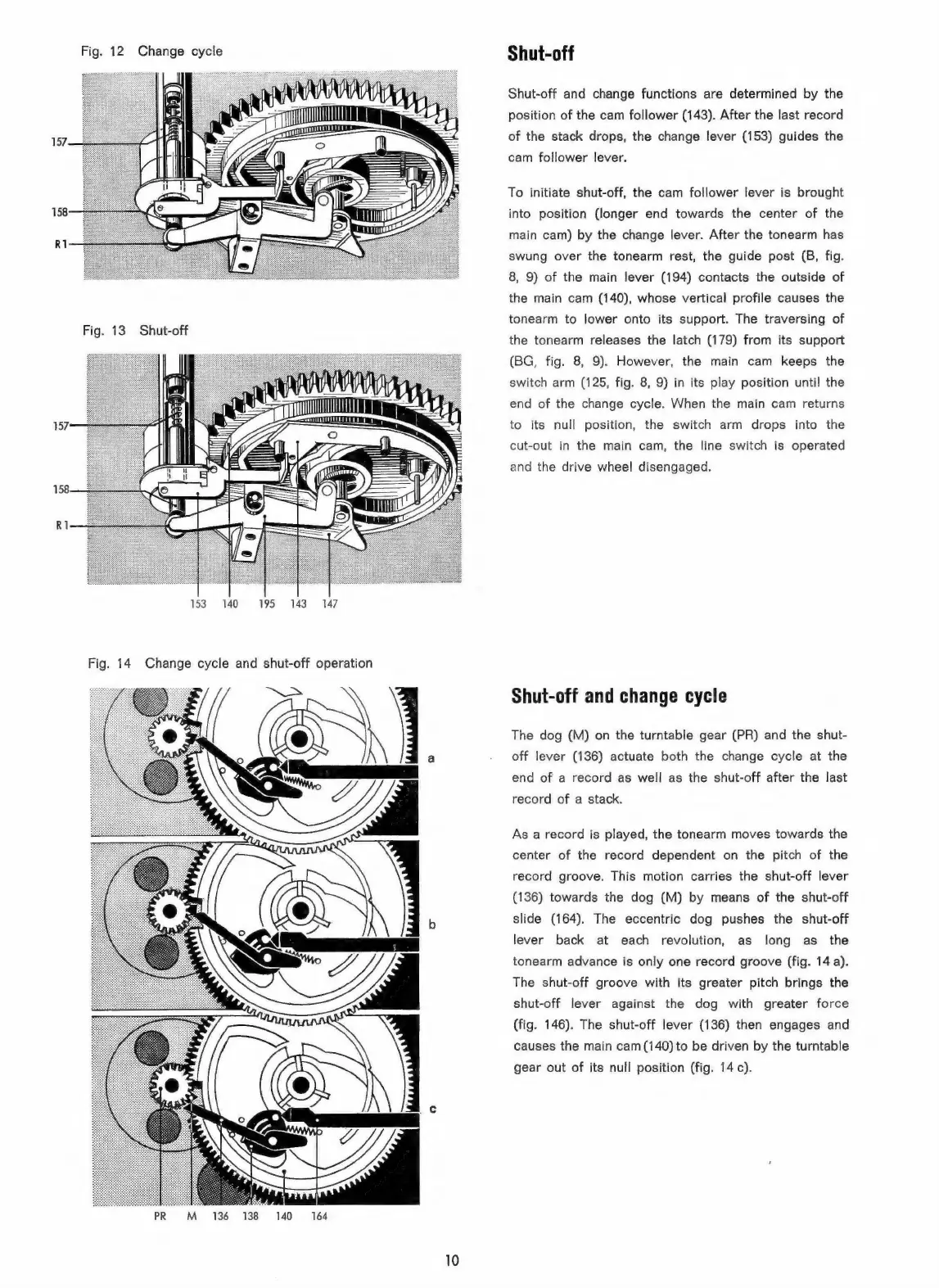
Fig.
12
Change
cycle
Fig.
14
Change
cycle
and
shut-off
operation
ecaM
PR
M_
136
138 140 164
10
Shut-off
Shut-off
and
change
functions
are
determined
by
the
position
of
the
cam
follower
(143).
After
the
last
record
of
the
stack
drops,
the
change
lever
(153)
guides
the
cam
follower
lever.
To
initiate
shut-off,
the
cam
follower
lever
is
brought
into
position
(longer
end
towards
the
center
of
the
main
cam)
by
the
change
lever.
After
the
tonearm
has
swung
over
the
tonearm
rest,
the
guide
post
(B,
fig.
8,
9)
of
the
main
lever
(194)
contacts
the
outside
of
the
main
cam
(140),
whose
vertical
profile
causes
the
tonearm
to
lower
onto
its
support.
The
traversing
of
the
tonearm
releases
the
latch
(179)
from
its
support
(BG,
fig.
8,
9).
However,
the
main
cam
keeps
the
switch
arm
(125,
fig.
8,
9)
in
its
play
position
until
the
end
of
the
change
cycle.
When
the
main
cam
returns
to
its
null
position,
the
switch
arm
drops
into
the
cut-out
in
the
main
cam,
the
line
switch
is
operated
and
the
drive
wheel
disengaged.
Shut-off
and
change
cycle
The
dog
(M)
on
the
turntable
gear
(PR)
and
the
shut-
off
lever
(136)
actuate
both
the
change
cycle
at
the
end
of
a
record
as
well
as
the
shut-off
after
the
last
record
of
a
stack.
As
a
record
is
played,
the
tonearm
moves
towards
the
center
of
the
record
dependent
on
the
pitch
of
the
record
groove.
This
motion
carries
the
shut-off
lever
(136)
towards
the
dog
(M)
by
means
of
the
shut-off
slide
(164).
The
eccentric
dog
pushes
the
shut-off
lever
back
at
each
revolution,
as
long
as
the
tonearm
advance
is
only
one
record
groove
(fig.
14
a).
The
shut-off
groove
with
its
greater
pitch
brings
the
shut-off
lever
against
the
dog
with
greater
force
(fig.
146).
The
shut-off
lever
(136)
then
engages
and
causes
the
main
cam(140)
to
be
driven
by
the
turntable
gear
out
of
its
null
position
(fig.
14
c).

Related product manuals