
 Need help?
Do you have a question about the Dunraven APOLLO ultrasonic and is the answer not in the manual?
List of tools needed for installation, including screwdriver and tape measure.
Procedure to measure tank height and set receiver switches for accurate level measurement.
Steps to pair the receiver with the transmitter to create a unique system code.
Instructions for installing the transmitter into the tank, ensuring vertical placement and seal.
Visual indicators for normal tank oil levels: Full, Empty, Early Warning, and Almost Empty.
Displays for receiver waiting for signal, no radio signal, low battery, or no ultrasonic echo.
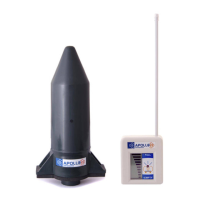
The Apollo Ultrasonic Oil Level Monitor is a sophisticated system designed to accurately measure and display the level of usable oil in your tank. It provides readings in 10 graduations, offering a clear and continuous overview of your oil reserves. The device is suitable for use with various fuel types, including diesel fuel, kerosene, and gas oil types A2, C1, C2, and D as defined by BS 2869. However, it's crucial to consult with the manufacturer or supplier before using it with any other fluids to ensure compatibility and safety.
This monitor is engineered for easy installation on most standard oil storage tanks, whether plastic or steel, provided they have a 20 mm, 32 mm, or 38mm (1½") gauge hole. For tanks with a 1½" (38 mm) BSP gauge socket, an optional adapter is available to facilitate proper fitting. The installation process involves a few straightforward steps, starting with the transmitter. After removing the cap from the tank's gauge hole, the transmitter is inserted, ensuring the weather seal is securely in place and the unit is positioned vertically on top of the tank. For tanks with a pre-drilled 20 mm or 32 mm hole, the transmitter is simply inserted. For tanks with a 38 mm (1½") BSP gauge socket, an adapter is screwed into the socket, and then the transmitter is fitted to the adapter. Once in place, the transmitter is secured using the two stainless steel self-tapping screws provided, taking care not to overtighten or use longer screws.
The receiver setup is equally important. First, you need to accurately measure the height of your tank. Using the provided tank height chart, you can determine the correct multi-switch settings. These switches are located in a recess at the back of the receiver. A screwdriver or the tip of a ballpoint pen can be used to flip the relevant switches upwards to the "ON" position. For example, if your tank is 850 mm high, you would set switches 4 and 8 to "ON." Additionally, switch 1 should be set to "ON" to enable the low-level audible warning feature. Once these settings are configured, your Apollo Ultrasonic receiver is programmed to your tank height.
A critical step in setting up the system is matching the receiver and transmitter. This process ensures that the system code is unique to your tank, and it only needs to be done once. To initiate matching, plug the receiver into a suitable and convenient electrical socket and switch it on. The display screen on the front of the receiver will show a flashing top bar, indicating that it is awaiting a unique code. This flashing top bar will last for two minutes, providing a window to match the transmitter. During this time, hold the transmitter against the right-hand side of the receiver, ensuring the black dots on both units are touching. This is crucial for the unique code to be transferred. Hold them together for approximately 20 seconds. As the matching process progresses, bars will increase up the display screen, and you will hear an audible beep. A change in tone will signal the completion of the matching process. When all 10 bars are shown and flashing, it indicates that the unique code has been successfully transferred.
Once the transmitter is installed and the receiver is matched, signals should be received every hour. If the transmitter is installed within 10 minutes of matching, the current oil level will be displayed immediately. Otherwise, it may take up to an hour for the correct oil level indication to appear on the screen. It is essential to keep the receiver plugged into an electrical socket at all times; do not unplug it to reset the device. In the event of a power failure, or if the receiver is switched off or moved to a new socket, the receiver display screen will show the top bar flashing when power returns or the unit is switched on. This flashing top bar will continue for two minutes, after which the display screen will be blank while the unique signal is located, which can take up to an hour.
The Apollo Ultrasonic provides various on-screen displays to keep you informed about your oil level and system status. Normal messages include "FULL," "Full," "Almost empty," and "Early Warning," each represented by different bar configurations. A blank screen or a top bar only after installation or a power failure indicates that the receiver is waiting for a signal. In such cases, no action is required, as the signal should be received within one hour. A flashing triangle with no bars signifies that no radio signal has been received from the transmitter after waiting for four hours. If this occurs, you should check for correct matching procedure, the location of the receiver relative to the transmitter (try repositioning the receiver), and ensure the transmitter seal is undamaged. A fixed triangle only indicates a low battery warning, but the unit will continue to provide readings until the battery is exhausted. In this situation, you should replace the Lithium CR2430 battery in the transmitter. A flashing triangle with only the middle bar indicates "No ultrasonic echo." This could mean the transmitter sensor cone is not clean, the transmitter is not vertical, or the transmitter seal is damaged. If this message persists, double-check the transmitter's vertical position on the tank. Note that if the oil level is within 6 inches of the transmitter, this message, along with others, may occur. For accurate readings, wait until the oil level drops below 6 inches.
Maintenance of the Apollo Ultrasonic primarily involves battery replacement in the transmitter. To do this, first remove the transmitter unit from the tank and take it to a safe location. The battery is accessed by removing two self-tapping screws from the base of the unit. Carefully remove the old battery, noting its orientation (the '+' mark should face outwards), and replace it with a new 3V-CR2430 battery. Reassemble the unit, ensuring the O-Ring is undamaged and securely in position. Finally, re-locate the transmitter on the tank. There is no need to rematch the receiver and transmitter after a battery change. The device comes with a one-year warranty, subject to normal operating conditions. However, the warranty is void if the transmitter seal is broken, emphasizing the importance of careful handling during maintenance.
 General
| Technology | Ultrasonic |
|---|---|
| Measurement Principle | Time of Flight |
| Power Supply | 12-24V DC |
| Protection Rating | IP67 |
| Output | 4-20mA, RS485 |

 To Next Page
